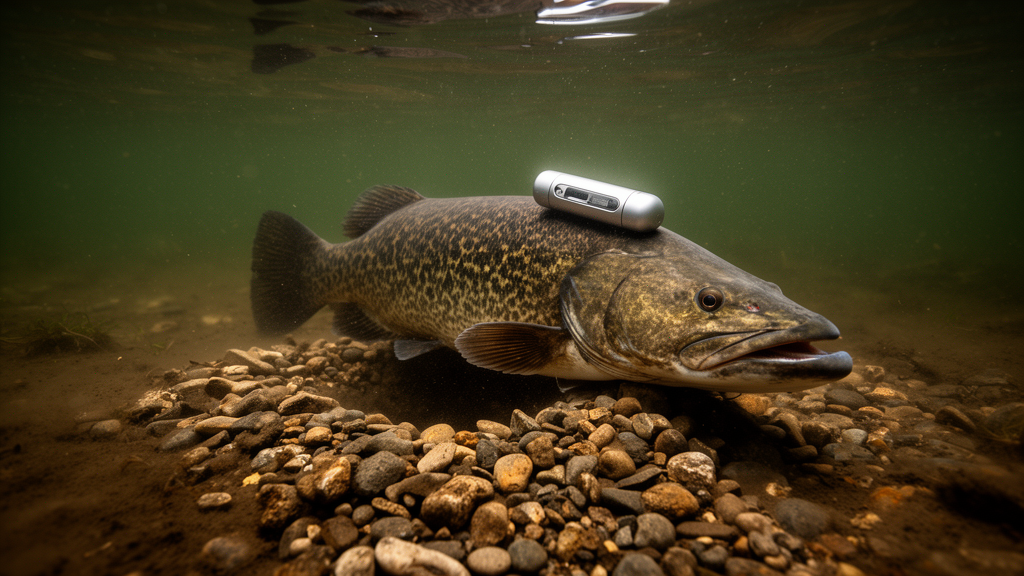
A multi-scale biotelemetry framework has successfully detected and characterised the nesting behaviour of wild Murray cod in a lowland river system in south-eastern Australia. By combining controlled experimental modelling with acoustic tracking, researchers identified reproductive activity in 14 of 20 accelerometry-tagged wild fish. The findings demonstrate that reproductive events in this large-bodied freshwater species are tightly linked to specific seasonal windows and complex structural riverine habitats, offering a verified method to document breeding activity where turbid conditions prevent direct human observation.
Identifying reproductive behaviour in wild fishes has long presented severe practical difficulties in murky and turbid freshwater systems. Developing reliable methods to track these cryptic reproductive events is essential for informing targeted management interventions and supporting conservation outcomes for vulnerable riverine species. To resolve this challenge, researchers created an integrative monitoring workflow designed to link animal movement across multiple spatial scales with validated behavioral models.
The study began with pond-based mesocosm experiments designed to establish a baseline for reproductive movement. Researchers gathered paired accelerometer data from fish while conducting direct visual observations and genetic parentage analyses. This setup allowed the team to distinguish between nesting and non-nesting behaviours under observable conditions. The resulting observational, genetic, and accelerometry dataset was used to train a Random Forest model capable of classifying reproductive activity based on movement signatures.
Following the experimental stage, the investigation examined free-ranging wild populations across a 58-kilometre stretch of a lowland river in south-eastern Australia. Adult Murray cod were monitored over 16 months using an extensive broad-scale acoustic telemetry array. This tracking allowed the team to quantify breeding-season residency patterns across the river network and guide the deployment of an intensive fine-scale array where residency warranted detailed monitoring.
Within the selected river segments, the trained Random Forest classifier was applied to accelerometry records collected from acoustically tracked wild fish to distinguish nesting from non-nesting states. These automated behavioural classifications were integrated with high-resolution habitat mapping and fine-scale space-use metrics. By overlaying movement classifications onto physical riverbed mapping, the team successfully quantified the specific habitat associations of active nest sites.
Field results revealed that Murray cod nesting behaviour was strictly seasonal and clustered primarily in spring. Across classified records, nesting occurred predominantly in October, accounting for 38.4 percent of records, and November, accounting for 30.4 percent. Fine-scale positioning confirmed discrete nest sites were located within complex structural habitats, with nesting fish occupying depths ranging from 2 to 5.16 metres and averaging 3.61 metres. Tracking across breeding seasons also documented repeated nest-site fidelity in several individuals.
The researchers concluded that linking biotelemetry across spatial scales with experimentally trained predictive models provides a robust framework for investigating wild aquatic animals. Demonstrating that accelerometry records can reliably identify nesting events without direct visual confirmation provides a transferable approach for monitoring other cryptic aquatic species in turbid environments.
Subject of Research: Inferring wild Murray cod nesting behaviour and habitat use through multi-scale biotelemetry and accelerometry
Article Title: A multi-scale biotelemetry approach to inferring nesting behaviour from aquatic animal movement data
Article References: Stocks, J. R., Niella, Y. V., Pederson, H., van der Meulen, D. E., Butler, G. L., Brauer, C. J., Beheregaray, L. B., & Thiem, J. D. (2026). A multi-scale biotelemetry approach to inferring nesting behaviour from aquatic animal movement data. Movement Ecology. https://doi.org/10.1186/s40462-026-00730-1
Image Credits: AI Generated
DOI: 10.1186/s40462-026-00730-1
Keywords: Murray cod, Maccullochella peelii, biotelemetry, acoustic telemetry, accelerometry, nesting behaviour, Random Forest model, turbid environments, freshwater ecology, riverine fish, south-eastern Australia, nest-site fidelity, mesocosm experiments, parentage analysis, habitat mapping, breeding residency, aquatic animal movement
News Source: Drew Townsend. (November 19, 2026). Biotelemetry Array Identifies Wild Murray Cod Nesting Sites in Turbid Waters. Scienmag.