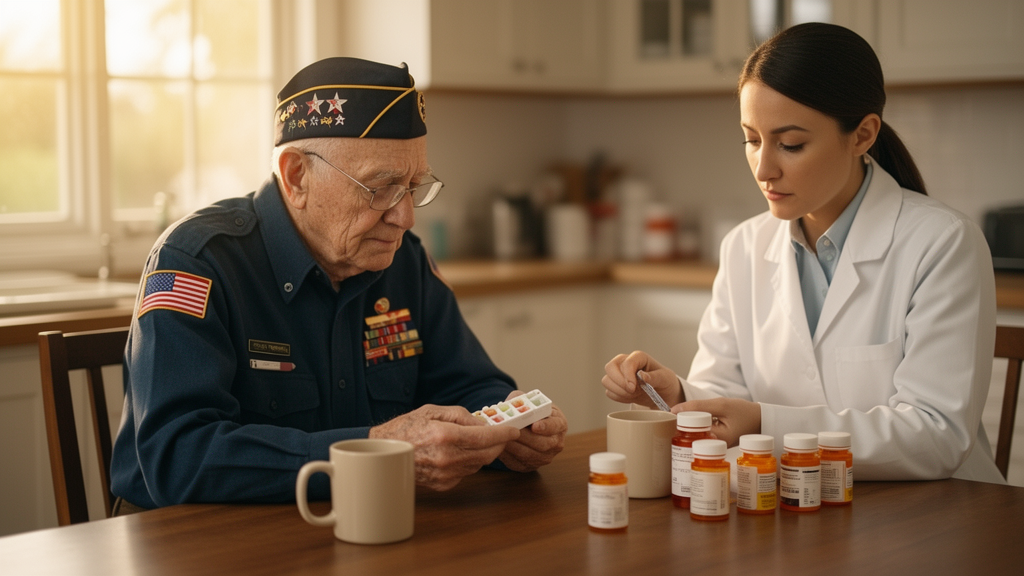
Older veterans with rheumatic diseases who take glucocorticoids and non-steroidal anti-inflammatory drugs at the same time face a higher risk of adverse events, and a team at the US Department of Veterans Affairs has now built and piloted an educational program to make that combination safer. The program, called ScaLable Medication Deprescribing, or SLIM-D, combines patient education materials with interdisciplinary collaboration and is currently running in the rheumatology clinic at the authors’ local VA Medical Center.
The SLIM-D program was designed using insights from the existing literature rather than from new clinical trial data, and its developers describe it as an optimization effort aimed at the safe use of these medications rather than a tested intervention with proven outcomes.
The program’s educational materials were formally evaluated for readability and clarity. Researchers used the Flesch-Kincaid Reading Ease and Flesch-Kincaid Grade Level scales to measure reading difficulty, and the Patient Education Materials Assessment Tool, or PEMAT-P, to assess how understandable and actionable the materials were for patients.
The results showed strong performance on these metrics. The program’s invitation brochure was written at an eighth-grade reading level, with a Flesch-Kincaid Reading Ease score of 60.2, a mean understandability score of 81.8 percent, and a mean actionability score of 82.4 percent. The educational booklet was written at a ninth-grade reading level, with a Reading Ease score of 50.9, a mean understandability score of 96.6 percent, and a mean actionability score of 98.5 percent. The authors reported these scores as means with standard deviations, reflecting variation among raters.
Identifying eligible patients was a central design challenge. The team developed an electronic health record query to find veterans who were candidates for the program, and created a corresponding EHR note to communicate eligibility information to the treating clinicians. This infrastructure allows the program to flag patients systematically rather than relying on ad hoc identification during clinic visits.
The pilot implementation produced early enrollment figures. As of February 2026, the electronic health record query had identified 116 veterans eligible for the SLIM-D program. Of those, 39, or 34 percent, were invited to participate, and 7, or 18 percent of those invited, agreed to take part. The authors present these numbers as pilot implementation data, not as evidence of clinical effect.
The program is currently implemented in the rheumatology clinic at the authors’ local VA Medical Center, and the team reports that it has successfully created and launched the program to optimize the concomitant use of glucocorticoids and NSAIDs in older veterans with rheumatic and musculoskeletal diseases. Formal program evaluation is ongoing, meaning conclusions about whether SLIM-D reduces adverse events or changes prescribing patterns await future results.
For now, the reported findings are limited to material development, readability and comprehension scoring, and early pilot enrollment at a single center, with the authors themselves emphasizing that assessment of the program’s impact remains in progress.
Subject of Research: An educational program for safer concurrent glucocorticoid and NSAID use in older veterans with rheumatic diseases
Article Title: Development and pilot implementation of an educational program for concurrent use of non-steroidal anti-inflammatory drugs and glucocorticoids in older veterans with rheumatic diseases
Article References: Noboa, M. E. R., Howell, H., Gaffo, A., & Danila, M. I. (2026). Development and pilot implementation of an educational program for concurrent use of non-steroidal anti-inflammatory drugs and glucocorticoids in older veterans with rheumatic diseases. BMC Rheumatology. https://doi.org/10.1186/s41927-026-00689-x
Image Credits: AI Generated
DOI: 10.1186/s41927-026-00689-x
Keywords: veterans, glucocorticoids, NSAIDs, rheumatic diseases, polypharmacy, patient education, deprescribing, VA rheumatology, medication safety, electronic health records, pilot program, Development
News Source: Ophelia Keating. (October 30, 2026). VA Program Tackles Risky Combined Use of Steroids and NSAIDs in Older Veterans. Scienmag.