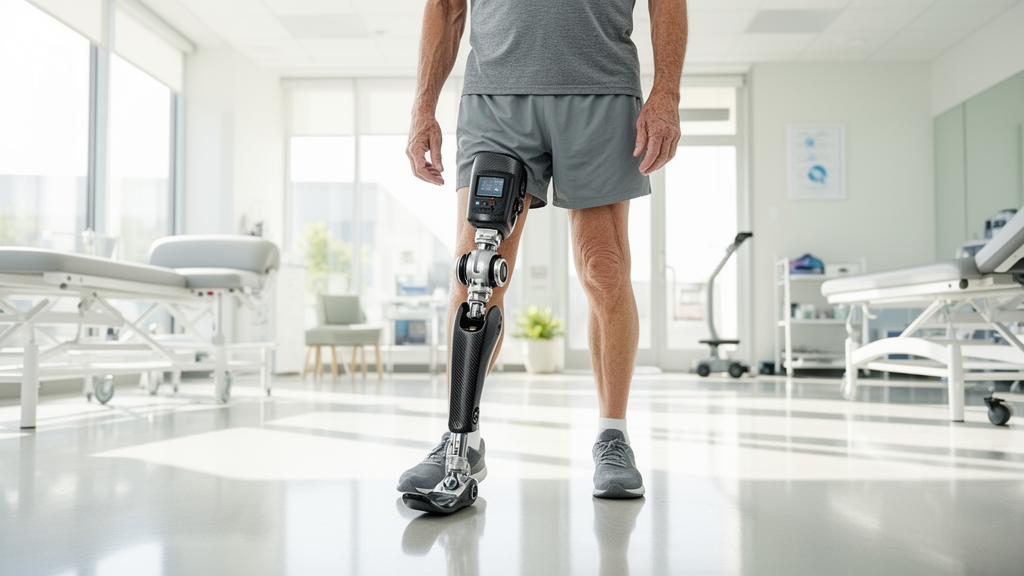
In an extensive retrospective cohort study evaluating prosthetic knee prescriptions across the United States Department of Veterans Affairs healthcare system from 2017 to 2026, researchers found that microprocessor-controlled prosthetic knees accounted for 44.1 percent of all specified knee component prescriptions. This utilization rate markedly surpasses the 26 percent proportion documented in civilian private sector practice analyses, representing a 69.6 to 69.9 percent higher frequency of microprocessor knee prescriptions for eligible Veterans. Published in the journal Technology and Innovation, the investigation examined 37,165 lower extremity prosthetic prescriptions across VA Amputation Specialty Care Clinics to evaluate how clinical decision-making functions within a national integrated health network operating without restrictive commercial reimbursement structures or payer policy limitations. While mechanical knee mechanisms remained the most frequently prescribed category overall at 55.9 percent, the observed prescription volume for advanced microprocessor systems highlights substantial utilization for individuals presenting with variable cadence and high-activity community mobility requirements.
As the largest integrated healthcare network in the United States, the Department of Veterans Affairs serves as the primary national provider of specialized interdisciplinary care for individuals living with limb loss and complex musculoskeletal trauma. The federal agency delivers orthotic, prosthetic, and pedorthic clinical services across 136 specialized clinic facilities nationwide, supported by more than 500 clinical staff members alongside 20 resident orthotist-prosthetists. Within these comprehensive amputee clinic teams, directing physicians collaborate routinely with prosthetists, physical therapists, and allied healthcare professionals to construct longitudinal rehabilitation plans tailored to the personal mobility goals and functional capabilities of Veterans. Unlike conventional commercial care settings, where restrictive reimbursement policies, payer authorization hurdles, and out-of-pocket patient expenses frequently constrain component selection, VA clinical teams are empowered to prescribe advanced prosthetic interventions based strictly on clinical appropriateness and patient necessity. This clinical autonomy allows the system to adopt emerging evidence-based prosthetic technologies, establishing an environment for assessing component deployment across diverse patient populations.
The clinical rationale for analyzing microprocessor knee prescription patterns stems from an extensive body of scientific evidence demonstrating substantial functional, cognitive, and safety benefits for individuals living with transfemoral amputations. Peer-reviewed rehabilitation literature indicates that these responsive mechanisms reduce fall incidents, decrease the cognitive effort required for ambulation, enhance metabolic energy efficiency, improve balance, facilitate walking capability, support employability, and promote community participation. Although published findings show that these benefits extend to limited community ambulators, traditional civilian insurance programs have historically restricted coverage, prompting the study authors to examine whether VA clinicians utilized these advanced mechanisms across various mobility tiers.
To evaluate knee prescription patterns across the agency’s amputee clinics over a comprehensive nine-year timeline, the research group executed a multi-site retrospective chart review adhering to Strengthening the Reporting of Observational Studies in Epidemiology guidelines and the Declaration of Helsinki. The investigation protocol was determined to be exempt from institutional review board oversight by the University of South Florida. Investigators evaluated existing electronic records for specifically formatted lower-limb prosthetic prescriptions issued between 2017 and 2026 for individuals who had undergone transfemoral amputation, knee disarticulation, or hip disarticulation. Collaborating with the national Orthotic, Prosthetic, and Pedorthic Clinical Services program office, two licensed prosthetists systematically evaluated medical records using established criteria to eliminate coding bias. Prescriptions were excluded if clinical documentation lacked adequate descriptive detail to identify the specific knee mechanism or if the recorded amputation level did not warrant a knee component, leaving a final analytical sample of 3,519 fully characterized prosthetic knee prescriptions for formal statistical evaluation.
The evaluated patient population was classified according to the Medicare Functional Classification Level framework, which categorizes prosthetic users from level K1 through level K4 based on their clinical potential for ambulation. Within the analyzed VA dataset, the largest segment of prosthetic knee prescriptions was issued for level K3 ambulators, who represent variable-cadence community ambulators capable of traversing most environmental obstacles, accounting for 39.8 percent of all prescriptions. Level K2 individuals, defined as household ambulators capable of limited community traversal, constituted the second-largest clinical demographic at 34.8 percent of prescriptions. Level K1 users, representing individuals utilizing prostheses primarily for transfers and household therapeutic ambulation, accounted for 17.4 percent of the cohort, while high-activity and bilateral users at level K4 represented 9.6 percent. This functional distribution differed from broader civilian prosthetics registries, showing a substantially higher proportion of level K1 patients receiving care within the VA compared to the seven percent proportion documented in non-VA practice analyses.
Detailed analysis of knee mechanisms revealed marked contrasts across functional mobility levels within the Veteran cohort. Their overall preponderance was driven primarily by overwhelming clinical application among patients in lower functional tiers. Specifically, mechanical systems were prescribed in 95.2 percent of level K1 prescriptions and 65.8 percent of level K2 prescriptions, reflecting traditional clinical alignment between basic mechanical stability and household mobility demands. Conversely, microprocessor-controlled knees dominated the higher mobility categories, accounting for 62.1 percent of prescriptions among level K3 ambulators and 60.8 percent among level K4 users. A formal chi-square test of independence confirmed a statistically significant relationship between functional mobility level and the prescribed knee category, yielding a test statistic of chi-square with three degrees of freedom equal to 1195.12, with a p-value of less than 0.001.
The retrospective analysis also cataloged specific commercial models identified within prescription records, revealing clear clinical patterns among VA prosthetic providers. The most commonly documented microprocessor-controlled systems included the Kenevo, C-Leg, Genium, and X3 or X4 systems manufactured by Otto Bock Healthcare, alongside the Rheo Knee and motorized Power Knee produced by Ossur, the Quattro developed by Proteor, and the Rheo XC. Prescriptions for the majority of these microprocessor models were concentrated among level K3 ambulators, with the notable exception of the Kenevo, which was predominantly prescribed for level K2 users. Beyond daily ambulation devices, activity-specific prosthetic knees designed for non-routine recreational use accounted for 3.6 percent of all specified prescriptions. These specialized systems were primarily indicated for sports, including running, swimming, skiing, snowboarding, and wakeboarding, with 59.7 percent of activity devices assigned to level K4 ambulators and 25.8 percent allocated to level K3 individuals.
To contrast VA prescribing practices with civilian sector benchmarks, the researchers modeled expected non-VA prescription distributions using observational case proportions from the American Board for Certification in Orthotics, Prosthetics, and Orthotics practice analysis. While both healthcare sectors prescribed mechanical knees in absolute majority overall, statistical evaluation confirmed that VA clinicians prescribed microprocessor knees at a significantly elevated rate. The comparative chi-square test of independence demonstrated a highly significant relationship between the provider source and the prescribed knee category, producing a chi-square statistic with three degrees of freedom of 504.29, with a p-value of less than 0.001. In the comparative benchmark, civilian prosthetists reported that microprocessor knees constituted approximately 26 percent of their provision workload, whereas the VA recorded 44.1 percent. This pronounced difference demonstrates that Veterans within the integrated federal healthcare system experience substantially greater access to advanced microprocessor technology than their civilian counterparts treated under commercial insurance structures.
Despite the elevated frequency of microprocessor utilization relative to the civilian sector, the empirical results did not validate the investigators’ primary initial hypothesis, which posited that microprocessor knees would comprise the absolute majority of all prescriptions issued in the VA. Because published evidence supports functional and safety improvements for level K2 users, researchers had anticipated widespread microprocessor adoption across both K2 and higher tiers. However, the heavy concentration of mechanical knees among K1 and K2 patients kept total microprocessor adoption at 44.1 percent. The authors posited that because VA clinicians operate without restrictive reimbursement thresholds, their functional assessments may be more clinically conservative than civilian evaluations, where assigning higher K-levels is often required to secure insurance authorization for advanced components. Furthermore, the 3.6 percent prevalence of activity-specific knees closely mirrored the 4 percent proportion of specialized sports feet recorded in national practice data, reflecting consistent baseline demand for recreational limb components.
The authors delineated several methodological constraints that frame the interpretation of their retrospective findings. Foremost among these was prescription documentation ambiguity, as a minority of clinical records contained insufficient technical detail to definitively categorize the prescribed knee design, necessitating exclusion from the final analytical sample. Additionally, direct comparisons were constrained by the absence of granular national civilian datasets, forcing reliance on American Board for Certification practice surveys that did not cross-tabulate functional mobility level with specific amputation levels or disaggregate activity-specific components by knee joints versus prosthetic feet. The authors concluded that while the VA system delivers advanced microprocessor technology at rates approximately 70 percent higher than the private sector, expanded continuing education for interdisciplinary amputee clinic teams could further enhance provider awareness regarding the clinical utility of microprocessor and recreational prostheses for qualifying Veterans, while future studies should compare VA outcomes directly against Medicare and commercial beneficiary cohorts.
Subject of Research: Prosthetic knee prescription patterns across functional levels in the U.S. Department of Veterans Affairs
Article Title: PROSTHETIC KNEE PRESCRIPTION IN THE US DEPARTMENT OF VETERANS AFFAIRS: A RETROSPECTIVE COHORT ANALYSIS
Article References: Carroll, M. K., Lewis, L. A., Kelly, C. M., Young, P. A., Fantini, C. M., & Highsmith, M. J. (2026). PROSTHETIC KNEE PRESCRIPTION IN THE US DEPARTMENT OF VETERANS AFFAIRS: A RETROSPECTIVE COHORT ANALYSIS. Technology and Innovation, 1-9. https://doi.org/10.1080/19498241.2026.2742597
Image Credits: AI Generated
DOI: 10.1080/19498241.2026.2742597
Keywords: prosthetic knees, microprocessor-controlled prosthetic knees, Veterans Affairs, transfemoral amputation, knee disarticulation, hip disarticulation, Medicare Functional Classification Level, K-levels, mechanical prosthetic knees, amputee rehabilitation, activity-specific prostheses, assistive technology, orthotics and prosthetics, rehabilitation medicine, prosthetic prescription rates, retrospective cohort study
News Source: Denise Maddox. (November 22, 2026). VA Prescribes Advanced Microprocessor Prosthetic Knees at Higher Rates Than Private Sector. Scienmag.