• HOME
  • NEWS
  • EXPLORE
    • CAREER
      • Companies
      • Jobs
    • EVENTS
    • iGEM
      • News
      • Team
    • PHOTOS
    • VIDEO
    • WIKI
  • BLOG
  • COMMUNITY
    • FACEBOOK
    • INSTAGRAM
    • TWITTER
Saturday, June 27, 2026
BIOENGINEER.ORG
No Result
View All Result
  • Login
  • HOME
  • NEWS
  • EXPLORE
    • CAREER
      • Companies
      • Jobs
        • Lecturer
        • PhD Studentship
        • Postdoc
        • Research Assistant
    • EVENTS
    • iGEM
      • News
      • Team
    • PHOTOS
    • VIDEO
    • WIKI
  • BLOG
  • COMMUNITY
    • FACEBOOK
    • INSTAGRAM
    • TWITTER
  • HOME
  • NEWS
  • EXPLORE
    • CAREER
      • Companies
      • Jobs
        • Lecturer
        • PhD Studentship
        • Postdoc
        • Research Assistant
    • EVENTS
    • iGEM
      • News
      • Team
    • PHOTOS
    • VIDEO
    • WIKI
  • BLOG
  • COMMUNITY
    • FACEBOOK
    • INSTAGRAM
    • TWITTER
No Result
View All Result
Bioengineer.org
No Result
View All Result
Home NEWS Science News Biology

UV lights on power lines may help save Sandhill cranes

Bioengineer by Bioengineer
May 6, 2019
in Biology
Reading Time: 3 mins read
0
IMAGE
Share on FacebookShare on TwitterShare on LinkedinShare on RedditShare on Telegram

IMAGE

Credit: James Dwyer, EDM International

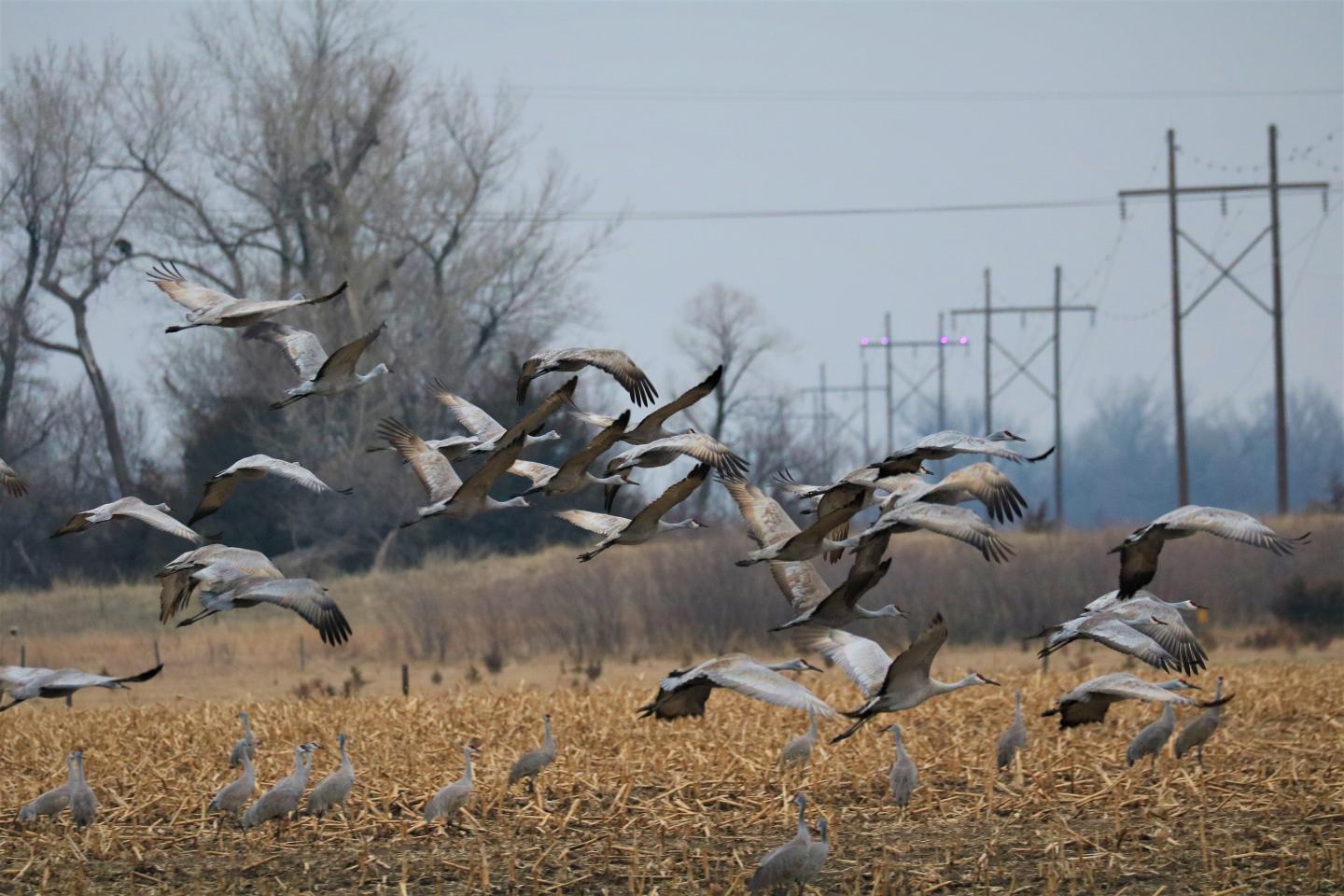
Crane species are declining around the world, and lethal collisions with power lines are an ongoing threat to many crane populations. Current techniques for marking power lines and making them more visible to cranes aren’t always effective, but new research published in The Condor: Ornithological Applications shows that adding UV lights–to which many birds are sensitive–can cut crane collisions with power lines by 98%.

EDM International’s James Dwyer and his colleagues created what they dubbed the Avian Collision Avoidance System, or ACAS, by mounting UV lights on power lines’ supporting structures and shining them on the lines at night. They tested its effectiveness in 2018 at Nebraska’s Iain Nicolson Audubon Center, where a power line crosses the Central Platte River in key habitat for migrating Sandhill Cranes. Randomly assigning the ACAS to be on or off each night, they observed the behavior of cranes flying along the river at dusk and during the night. They documented 98% fewer collisions and 82% fewer dangerous flights when the ACAS was on and showed that cranes reacted sooner and with more control to avoid hitting the power lines.

“This project came about as a result of years of studying avian collisions with power lines throughout North America. My studies included collisions involving numerous species and families of birds, even on lines modified to industry standards to mitigate avian collisions, and I thought perhaps there could be a more effective approach,” says Dwyer. “Even so, I did not imagine that the ACAS would have the effect that it did–a 98% reduction in collisions! I thought it would have some effect, but I didn’t dare think the ACAS would pretty much solve the Sandhill Crane collision problem at our study site on our first try.”

Conventional line markers were already in place on the power lines crossing the Central Platte River, and Dwyer and his colleagues speculate that the ACAS illuminated them and made them easier for cranes to see. “We don’t know how effective the ACAS will be on wires without line markers, so we’re testing that now,” says Dwyer.

“I hope to see the ACAS applied to and studied on other power lines and on communication towers to identify whether it is as effective with other species, habitats, and wire configurations,” he continues. “From there, if the ACAS proves broadly effective, I hope to see it made easily available to the global electric industry. I also very much hope to see collision studies expanded. Because large carcasses like those of cranes and waterbirds are more easily noticed than smaller species like sparrows and warblers, collision studies have mostly focused on those larger species, and I fear that we may not understand the true distribution of species and habitats involved in the global avian collision problem.”

###

“Near-ultraviolet light reduced Sandhill Crane collisions with a power line by 98%” will
be available May 6, 2019, at https://academic.oup.com/condor/article-lookup/doi/10.1093/condor/duz008.

About the journal: The Condor: Ornithological Applications is a peer-reviewed, international journal of ornithology, published by the American Ornithological Society. For the past two years, The Condor has had the number one impact factor among 27 ornithology journals.

Media Contact
Rebecca Heisman
[email protected]

Related Journal Article

http://dx.doi.org/10.1093/condor/duz008

Tags: BiodiversityBiologyEcology/EnvironmentPopulation BiologyZoology/Veterinary Science
Share12Tweet8Share2ShareShareShare2

Related Posts

Natural Hallucinogens: Evolution’s Ecological Tools, Not Mere Chemical Byproducts

June 25, 2026

This Famous Butterfly Revealed: Three Distinct Species Hidden in One

June 25, 2026

Scientists Attack Soybean Cyst Nematode by Starving Its Food Source

June 25, 2026

Decoding the Secret Code of a Crucial Immune Sensor

June 24, 2026
Please login to join discussion

POPULAR NEWS

  • Saying Goodbye to PGY-6: Pediatric Fellowship Realities

    103 shares
    Share 41 Tweet 26
  • Multi-Hospital Study Reveals Long Covid Burden Is Twice as High as Current Estimates

    92 shares
    Share 36 Tweet 23
  • Detection of EDCs in Breast Milk and Infant Urine Up to Six Months Highlights Early Exposure Risks

    77 shares
    Share 31 Tweet 19
  • New Drug Candidate Developed at McMaster Shows Potential for Treating Brain Cancer

    58 shares
    Share 23 Tweet 15

About

We bring you the latest biotechnology news from best research centers and universities around the world. Check our website.

Follow us

Recent News

Tracking Lanthanide-Labeled Microplastics in Plants

POSTECH Researchers Slash Cost of Reconstituted Cell-Free Systems by 95%

AI and Physics Collaborate to Design Advanced Hydrogen Storage Materials

Subscribe to Blog via Email

Success! An email was just sent to confirm your subscription. Please find the email now and click 'Confirm' to start subscribing.

Join 82 other subscribers
  • Contact Us

Bioengineer.org © Copyright 2023 All Rights Reserved.

Welcome Back!

Login to your account below

Forgotten Password?

Retrieve your password

Please enter your username or email address to reset your password.

Log In
No Result
View All Result
  • Homepages
    • Home Page 1
    • Home Page 2
  • News
  • National
  • Business
  • Health
  • Lifestyle
  • Science

Bioengineer.org © Copyright 2023 All Rights Reserved.