Researchers at Southern Illinois University and collaborating institutions have demonstrated that ultraviolet C (UV-C) radiation significantly reduces populations of Escherichia coli and Listeria monocytogenes on the surface of fresh strawberries. Published in the journal Food Safety and Risk, the study compares the efficacy of traditional mercury-vapor UV-C lamps with newer UV-C light-emitting diodes (LEDs). The team utilized predictive modeling to assess microbial inactivation rates and survival dynamics, providing a quantitative framework for optimizing UV-C treatment protocols in the fresh produce industry. This approach addresses the growing interest in non-chemical methods for controlling microbial contamination on food products without compromising quality.
Strawberries are particularly susceptible to microbial contamination due to their soft skin and porous surface, which can harbor pathogens that cause foodborne illness. The study aimed to investigate the effects of both UV-C lamps and UV-C LEDs on microbial reduction and to evaluate bacterial survival during refrigerated storage at 4 °C. By incorporating treatment parameters into predictive models, the researchers sought to provide insights into the effectiveness of UV-C radiation under various conditions. The results could assist local industry and farmers in developing effective strategies for reducing contamination risks associated with fresh berries.
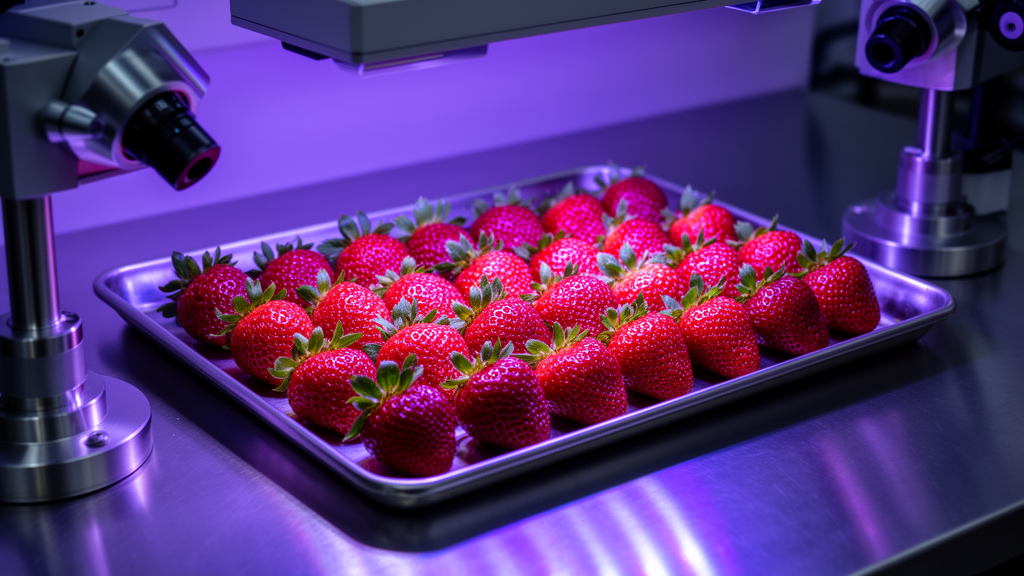
The experimental design involved inoculating fresh strawberries with either E. coli ATCC 35218 or Listeria monocytogenes PTA-5236. The E. coli strain used was non-pathogenic and served as a surrogate for E. coli O157:H7. Inoculated strawberries were stored at ambient temperature for three hours to allow bacterial attachment before treatment. The samples were then subjected to UV-C exposure using either a custom-built mercury lamp tunnel or a UV-C LED tunnel designed to accommodate clamshell boxes. The mercury lamp system emitted light at a wavelength of 253.7 nm with an intensity of 318 µW/cm², while the LED system utilized different configurations of top and diagonal lights at varying intensities.
Treatment durations ranged from five to 25 minutes, with strawberries flipped halfway through the process to ensure uniform exposure on all surfaces. For the UV-C lamp treatments, the maximum reduction in E. coli populations was 2.75 log CFU/g, achieved at the 25-minute mark. Similarly, Listeria monocytogenes populations were reduced by a maximum of 2.63 log CFU/g after 25 minutes. Statistical analysis indicated that microbial reduction was significantly higher than initial counts at all treatment times, although no significant additional reduction was observed for E. coli after 15 minutes. For Listeria monocytogenes, significant differences persisted between 15 and 25 minutes, suggesting a slightly different response to prolonged exposure.
The UV-C LED treatments also demonstrated effective microbial reduction, with the most significant results observed when all lights were activated. At the 25-minute mark, the maximum reduction for E. coli was 2.39 log CFU/g, and for Listeria monocytogenes, it was 2.15 log CFU/g. These reductions were lower than those achieved with the mercury lamps, but the LED system offered flexibility in light configuration. The study noted that the UV-C doses delivered by the lamp and LED systems were not equivalent, making direct comparisons of their inactivation efficiencies inappropriate. Nevertheless, both systems showed that longer treatment durations generally led to greater microbial inactivation.
Storage studies revealed that bacterial populations continued to decrease over time during refrigerated storage, even after UV-C treatment. Following a 25-minute UV-C lamp treatment, E. coli counts decreased to 3.57 log CFU/g by day 9, while Listeria monocytogenes counts declined to 3.72 log CFU/g by day 6. The persistence of bacteria during storage may be attributed to DNA repair mechanisms that allow for partial repair of UV-induced damage. However, the continuous decline suggests that the UV-C treatment induced irreversible cellular damage, limiting the ability of surviving bacteria to recover fully. E. coli exhibited greater resistance to UV-C treatments compared to Listeria monocytogenes, surviving longer during the storage period.
Predictive modeling was conducted using the USDA Integrated Pathogen Modeling Program (IPMP) 2013 to fit linear and Weibull models to the inactivation data. The Weibull model emerged as the preferred model, showing better fits for both treatment types and bacterial species. The model parameters indicated upward concavity (α < 1) for both bacteria, suggesting that surviving cells may adapt to the applied stress. The Weibull model’s ability to capture the non-linear nature of microbial reduction made it more suitable than the linear model, which showed higher variability and poorer fit for several conditions.
Validation of the models using independent data sets confirmed the reliability of the Weibull model. For E. coli, the model predicted survival with an accuracy factor of 1.026 and a bias factor of 1.002, indicating minimal error. For Listeria monocytogenes, the accuracy factor was 1.059 and the bias factor was 1.042. These values suggest that the model provides fail-safe predictions, with errors of approximately 2.6% and 5.9%, respectively. The high R² values of 0.99 and 0.96 for E. coli and Listeria monocytogenes further supported the model’s robustness in explaining the variance in microbial data.
The study highlights the potential of UV-C technology as a non-chemical method for enhancing food safety in fresh produce. While both mercury lamps and LEDs proved effective, the mercury lamps achieved slightly higher reductions in microbial populations. The findings underscore the importance of optimizing treatment parameters, such as duration and intensity, to maximize efficacy. The predictive models developed in this study can aid in the design of UV-C treatment protocols tailored to specific microorganisms and produce types.
Limitations of the study include the lack of physicochemical and sensory analyses to assess the impact of UV-C treatment on strawberry quality. Fruit quality was evaluated only visually, and further investigation is needed to determine how UV-C exposure affects texture, flavor, and nutritional content. Additionally, the study focused on two specific bacterial strains, and results may vary with different pathogens or strains. Future research should explore the optimization of UV-C dose distribution and treatment uniformity to enhance microbial reduction while maintaining product integrity.
The integration of predictive modeling with experimental data provides a comprehensive understanding of UV-C treatment dynamics. The Weibull model’s superior performance suggests that non-linear kinetics are essential for accurately predicting microbial survival after UV-C exposure. This insight is valuable for developing robust food safety strategies that account for the complex behavior of microorganisms on fresh produce surfaces. As the food industry seeks effective and safe methods for pathogen control, UV-C technology, supported by predictive modeling, offers a promising avenue for reducing the risk of foodborne illness.
Strawberries sourced near Carbondale, Illinois, were selected for uniform size, with damaged fruit discarded and baseline samples screened to confirm the absence of pre-existing pathogens. Cultures of non-pathogenic Escherichia coli in Tryptic Soy Broth and Listeria monocytogenes in brain heart infusion broth were incubated at 37 °C with shaking at 200 rpm for 24 hours, yielding suspensions exceeding 9 log CFU/mL. Following dip inoculation, bacterial attachment stabilized during a three-hour drying interval at 22 °C, establishing starting populations of 8.04 ± 0.19 log CFU/g for E. coli and 8.00 ± 0.08 log CFU/g for L. monocytogenes. Homogenized tissue samples were serially diluted in phosphate-buffered saline and plated onto selective media, maintaining an analytical limit of detection of 1.60 log CFU/g and a limit of quantification of approximately 3.0 log CFU/g.
The exposure apparatus employed distinct optical engineering to deliver controlled ultraviolet radiation. The mercury-vapor system, custom-built by DDK Scientific Corporation, housed four lamps measuring 60.9 centimeters in total length within a semi-circular polished aluminum tunnel, emitting 318 µW/cm² at 253.7 nm to achieve a 1.12 log CFU/g reduction of E. coli within two minutes. The custom LED system positioned a top array producing 0.108 mW/cm² alongside diagonal modules delivering up to 0.190 mW/cm² with an attached fan for cooling. Over 25 minutes, activating all LED modules provided a cumulative dose of 589.5 mJ/cm², whereas activating only diagonal or top arrays delivered 427.5 and 162.5 mJ/cm², yielding reductions of 1.54 and 1.42 log CFU/g for E. coli and 1.21 and 1.70 log CFU/g for L. monocytogenes.
Storage evaluations of shorter five-minute treatments revealed distinct survival trajectories under refrigeration at 4 °C. Following five-minute mercury lamp treatment, initial E. coli and L. monocytogenes populations of 6.29 and 6.24 log CFU/g remained detectable through days 12 and 9, respectively. Under five-minute LED exposure, E. coli populations rose slightly on day 3 before declining to 5.27 log CFU/g by day 15, while L. monocytogenes dropped to 4.31 log CFU/g by day 12. For 25-minute LED exposure, E. coli persisted to day 12 at 3.86 log CFU/g, whereas L. monocytogenes declined to 4.02 log CFU/g by day 6 before fruit spoilage occurred.
Model validation using independent summer strawberry samples exposed clear boundaries between modeling approaches. For mercury lamp treatments, the linear model yielded identical accuracy and bias factors of 1.510 and negative R² values, indicating that simple first-order kinetics fail to describe inactivation safely. Conversely, the Weibull model exhibited strong predictive accuracy across LED trials, demonstrating a 3.1 percent error for E. coli with an R² of 0.98, and capturing 87.6 percent of data variance for L. monocytogenes. Across tested conditions, Weibull shape parameters fell below one, ranging between 0.39 and 0.79, mathematically capturing the upward concavity characteristic of bacterial stress adaptation.
Subject of Research: Efficacy of UV-C lamps and LEDs on microbial reduction and survival modeling on fresh strawberries
Article Title: Modeling the effect of UV-C treatment on the survival of microorganisms on fresh strawberries
Article References: Pahariya, P., Alani, M. F., Joshi, P., Mishra, A., Fisher, D. J., & Choudhary, R. (2026). Modeling the effect of UV-C treatment on the survival of microorganisms on fresh strawberries. Food Safety and Risk, 13(1), Article 10. https://doi.org/10.1186/s40550-026-00132-6
Image Credits: AI Generated
DOI: 10.1186/s40550-026-00132-6
Keywords: UV-C treatment, strawberries, food safety, microbial reduction, predictive modeling, E. coli, Listeria monocytogenes, UV-C LEDs, mercury lamps, bacterial survival, Modeling, effect
News Source: Alan Morgan. (November 11, 2026). UV-C Light Reduces Bacteria on Strawberries, Modeling Shows. Scienmag.