


Credit: Simon Lee
EL PASO, Texas – A research team from The University of Texas at El Paso has made strides in understanding how memories are formed through the brain mechanisms of fruit flies, findings that could enhance our understanding of brain disorders such as post-traumatic stress disorder and substance addiction, according to an article published in the highly renowned Journal of Neuroscience.
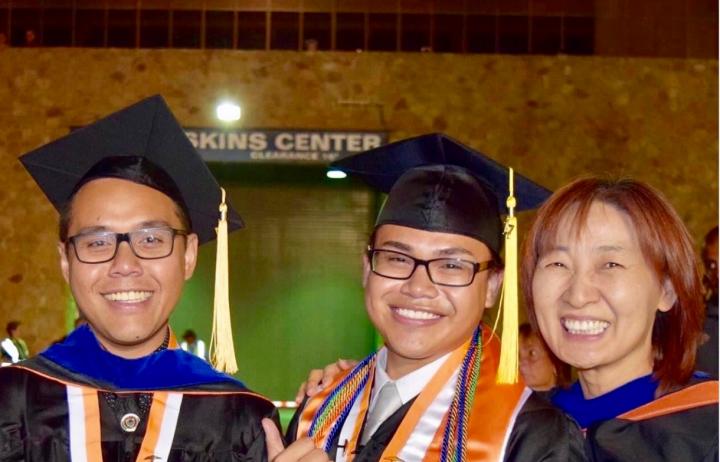
The article, titled “Concerted Actions of Octopamine and Dopamine Receptors Drive Olfactory Learning,” focuses on flexible behavioral choices that are shaped by experiences and cognitive memory processes of fruit flies in a laboratory setting. The study was led by Kyung-An Han, Ph.D., professor of biological sciences and director of the Master of Arts in Teaching Science (MATS) program at UTEP; brothers John Martin Sabandal, a UTEP graduate who is currently a doctoral student at Scripps Research Institute in Jupiter, Florida, and Paul Rafael Sabandal, Ph.D., a postdoctoral researcher in Han’s laboratory. Martin Sabandal was an undergraduate student in Han’s research lab when he performed research that contributed to the study. A former postdoctoral associate, Youngcho Kim, Ph.D., who is currently a faculty member at the University of Iowa Carver College of Medicine, is also a co-author of the study.
The research team identified the actions of the neurotransmitters octopamine and dopamine as a key neural mechanism for associative learning in fruit flies. This is vital for animals to appropriately respond to the cues predicting benefit or harm. If animals cannot promptly learn and remember the cues, they would not be able to survive or have a decent quality of life.
“I am beyond thrilled about this work getting published,” John Martin Sabandal said. “We expanded our knowledge about the importance of aminergic signaling for olfactory learning in fruit flies. This represents a significant finding in the invertebrate field since octopamine was previously shown to be only important for positively-reinforced learning. This publication was a culmination of the hard work spent during my undergraduate years at UTEP.”
Paul Sabandal said olfactory conditioning in fruit flies has greatly contributed to overall understanding about the mechanisms underlying associative learning and memory. Historically, in fruit flies, dopamine is implicated in both punishment- and reward-based learning while octopamine is widely considered to be essential only for reward.
“This pioneering work serves as an essential framework for future studies to delineate the signals and circuits that shape appropriate behavioral choices important for fitness and survival,” he said. “We strongly believe that our study advanced not only the learning and memory field, but may have implications on related disciplines including dementia and addiction.”
Han said the study may help enhance our understanding of the brain disorders with anomalous memories such as PTSD (augmented memory on traumatic events), addiction (intensified memory on drug-associated cues) or learning disabilities (impaired memory).
“Many aspects of our behaviors are the representations of our memories that are formed by associating information or stimuli that we experience,” Han said. “For example, celebrities are often featured in commercial advertisements, which is because we tend to associate their social status or star power with product values. This is a typical case of classical conditioning for associative learning and memory. Our study tackles the key question of how the association is occurring in the brain using the genetic model Drosophila melanogaster, or fruit flies.”
Kim added that fruit flies provided an excellent primer for the research team to uncover their findings.
“Associative learning is a fundamental form of behavioral plasticity,” Kim said. “Drosophila provides a powerful system to uncover the mechanisms for learning and memory.”
###
The University of Texas at El Paso is one of the largest and most successful Hispanic-serving institutions in the country, with a student body that is over 80% Hispanic. It enrolls more than 25,000 students in 166 bachelor’s, master’s and doctoral programs in 10 colleges and schools. With $108 million in total annual research expenditures, UTEP is ranked in the top 5% of research institutions nationally and fifth in Texas for federal research expenditures at public universities.
Media Contact
Victor H. Arreola
[email protected]
Original Source
http://www.
Related Journal Article
http://dx.



