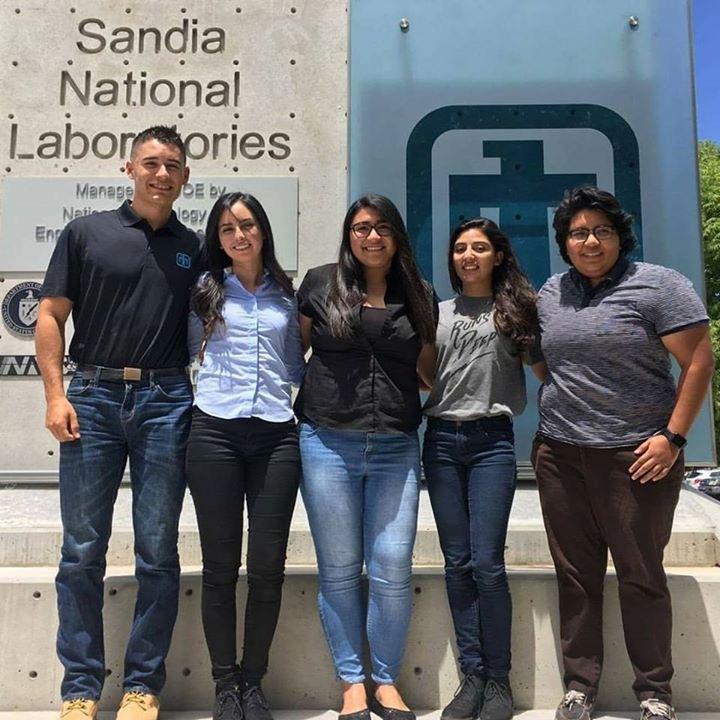
Credit: Norman Love.
EL PASO, Texas – Students from The University of Texas at El Paso will have more opportunities to train for competitive jobs in the energy industry through a $1 million grant from the National Nuclear Security Administration (NNSA).
The grant — part of a program that exposes underrepresented students to energy systems research and prepares them for the workforce — was awarded to Norman Love, Ph.D., associate dean for academic affairs and undergraduate studies with the College of Engineering and professor of mechanical engineering, in collaboration with the University’s Campus Office of Undergraduate Research Initiatives (COURI).
UTEP received a portion of the $5 million NNSA grant as a partner institution in the Consortium for Hybrid and Resilient Energy Systems (CHRES), led by Ana G. Méndez University in Puerto Rico. The consortium supports, educates and trains the next generation of Hispanic engineers and scientists in energy systems integration by providing year-round and summer research, internships, and co-ops for undergraduate and graduate students.
“This is a great, multifaceted opportunity for our students to expand their horizons and obtain training in an important national topic: energy,” said Patricia Nava, Ph.D., dean of UTEP’s College of Engineering. “Access to the national labs will facilitate research growth, in addition to expanding student employment opportunities. This project is an invaluable asset to our growing pipeline of students, providing entry to the professional workforce. This award will also enable us to fulfill the goal of creating technical expertise, as well as reinforcing our college’s status of being a top provider of diverse engineering talent to the nation.”
Love, who serves as the principal investigator of the UTEP grant, said that significant amounts of nuclear energy are still consumed in the United States and produce low carbon emissions. El Paso receives a large portion of its energy from nuclear power. Through this program, UTEP students will have the opportunity to gain skills and training to vie for jobs in this industry that needs skilled workers.
“Students who are underrepresented in the nuclear and in the energy industry have opportunities to compete and claim these jobs,” Love said. “These are students who might not otherwise have the opportunity to work with Sandia National Lab, Lawrence Livermore National Lab or the National Energy Technology Lab due to geography, or they may not even know that these labs are out there. This is a great opportunity for them, and our goal is to place these students in these labs and in the industry by recruiting and mentoring them while they’re at UTEP.”
A cohort of UTEP undergraduate and graduate students will be recruited to join the program annually and will learn topics related to hybrid resilient energy systems and gain exposure to innovative energy research. They also will receive training from COURI to hone their soft skills to become better writers and effectively present and share their research.
As part of the program, students will conduct research projects and be trained by UTEP faculty. In addition, students will take part in a 10-week summer exchange program at partnering institutions or participating national labs to gain additional training and professional development as well as build professional networks that will help them compete for jobs in the energy industry.
“This program helps elevate UTEP as a Hispanic-Serving Institution by collaborating with other Hispanic-Serving Institutions and three national labs,” said Lourdes Echegoyen, Ph.D., director of COURI at UTEP and grant co-principal investigator. “One goal of the Department of Energy is to increase the diversity of its workforce by increasing the number of Hispanic students in the energy industry. By collaborating with our partner universities and national labs, we can build a network for our students and help achieve that goal.”
###
The University of Texas at El Paso is one of the largest and most successful Hispanic-serving institutions in the country, with a student body that is 83% Hispanic. It enrolls nearly 25,000 students in 166 bachelor’s, master’s and doctoral programs in 10 colleges and schools. With more than $100 million in total annual research expenditures, UTEP is ranked in the top 5% of research institutions nationally and fifth in Texas for federal research expenditures at public universities.
Media Contact
Victor H. Arreola
[email protected]
Original Source
http://www.