• HOME
  • NEWS
  • EXPLORE
    • CAREER
      • Companies
      • Jobs
    • EVENTS
    • iGEM
      • News
      • Team
    • PHOTOS
    • VIDEO
    • WIKI
  • BLOG
  • COMMUNITY
    • FACEBOOK
    • INSTAGRAM
    • TWITTER
Friday, August 28, 2026
BIOENGINEER.ORG
No Result
View All Result
  • Login
  • HOME
  • NEWS
  • EXPLORE
    • CAREER
      • Companies
      • Jobs
        • Lecturer
        • PhD Studentship
        • Postdoc
        • Research Assistant
    • EVENTS
    • iGEM
      • News
      • Team
    • PHOTOS
    • VIDEO
    • WIKI
  • BLOG
  • COMMUNITY
    • FACEBOOK
    • INSTAGRAM
    • TWITTER
  • HOME
  • NEWS
  • EXPLORE
    • CAREER
      • Companies
      • Jobs
        • Lecturer
        • PhD Studentship
        • Postdoc
        • Research Assistant
    • EVENTS
    • iGEM
      • News
      • Team
    • PHOTOS
    • VIDEO
    • WIKI
  • BLOG
  • COMMUNITY
    • FACEBOOK
    • INSTAGRAM
    • TWITTER
No Result
View All Result
Bioengineer.org
No Result
View All Result
Home NEWS Science News

UTA expert in quantum optics and optical communications named Fellow of SPIE

Bioengineer by Bioengineer
January 9, 2020
in Science News
Reading Time: 2 mins read
0
IMAGE
Share on FacebookShare on TwitterShare on LinkedinShare on RedditShare on Telegram

High honor for electrical engineering professor
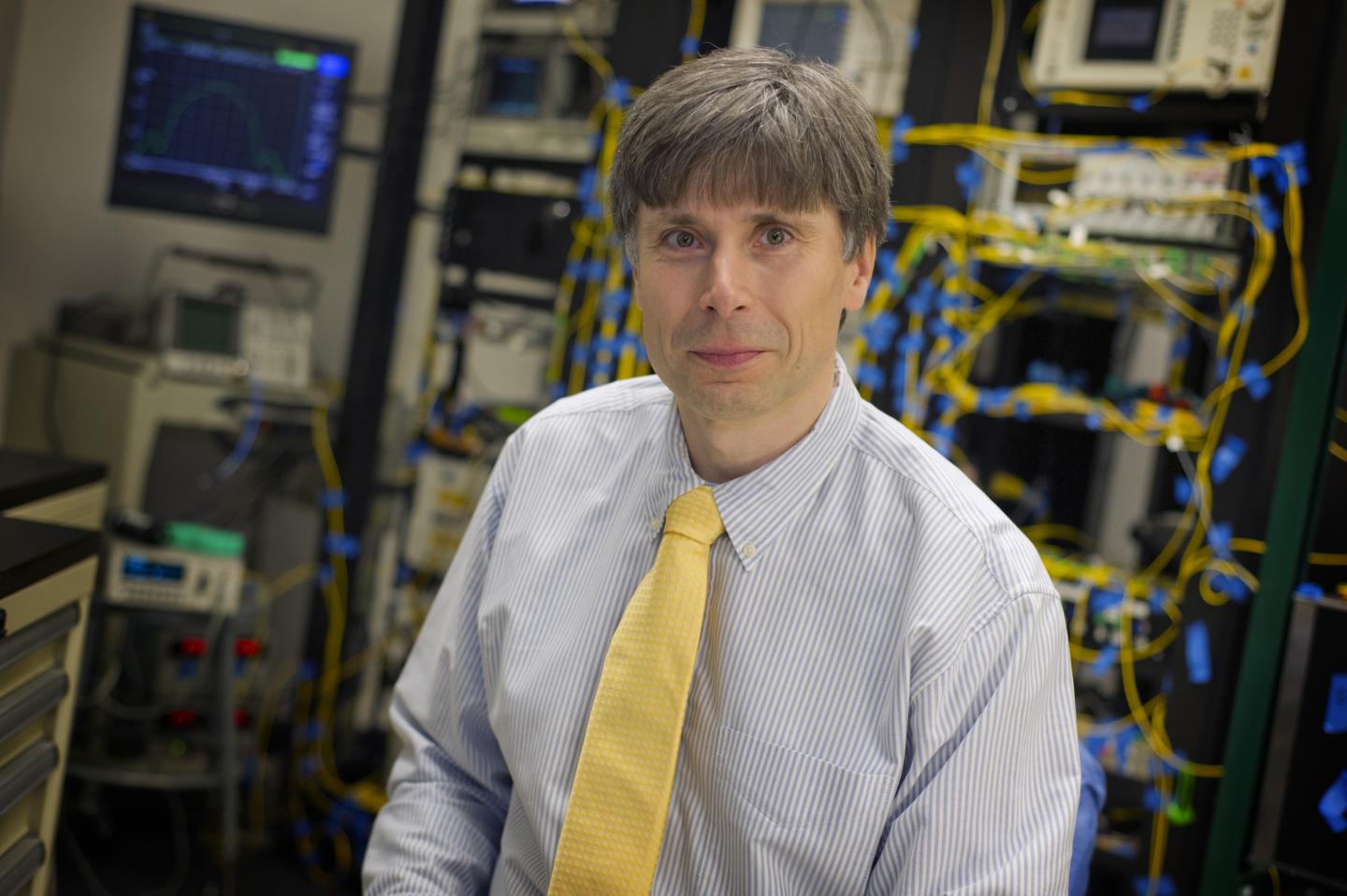
IMAGE

Credit: UT Arlington

An expert in classical and quantum communications and professor of electrical engineering at The University of Texas at Arlington has been named a Fellow of the International Society for Optics and Photonics (SPIE).

Michael Vasilyev is one of 72 newly elected Fellows and was recognized for his “achievements in nonlinear-optical signal processing.” He is the fourth current College of Engineering professor to be honored as a SPIE Fellow; the others are James Coleman, Robert Magnusson and Weidong Zhou.

The society, founded in 1955, has 20,000 members worldwide and serves 255,000 constituents from 183 countries.

Vasilyev said the honor recognizes the work of his students and collaborators on all-optical regenerators and phase-sensitive optical parametric amplifiers, which was published in leading optics and photonics journals such as Nature Communications.

“We have solved the fundamental problem of how to make these devices process more than one data channel at a time, which makes them relevant in practice,” Vasilyev said. “The multi-channel capability can drastically reduce the cost, size and power consumption of data networks or be used for noiseless amplification of faint images.”

Vasilyev, who has been at UTA since 2003, has written or contributed to more than 200 scientific papers, holds 10 U.S. and three international patents and was a recipient of the 2008 Defense Advanced Research Projects Agency Young Faculty Award. He also received the 2019 UTA Outstanding Research Achievement or Creative Accomplishment Award.

Peter Crouch, dean of the College of Engineering, said the recognition reflects the excellence of Vasilyev’s work.

“Dr. Vasilyev’s research bridges the gap between fundamental nonlinear and quantum optics on one side and practical high-speed communication systems on the other,” Crouch said. “It is of great importance in increasing the capacity and security of data networks, as our society is critically dependent on data for its everyday functions and future progress.”

UTA’s Department of Electrical Engineering has a robust photonics portfolio, boasting several leading researchers in the field.

  • Coleman’s work focuses on bringing light and electrical signals down to the integrated circuit.
  • Zhou works uses quantum sensors for detecting diseases and harmful gases in the air, as well as on-chip systems for use in health care applications.
  • Catrina Coleman works in the areas of photonic integration, semiconductor optoelectronic devices, diode lasers and mode-locked lasers.
  • Magnusson leads UTA’s Nanophotonics Device Group, which pursues theoretical and experimental research in periodic nanostructures, nanolithography, nanophotonics, nanoelectronics, nanoplasmonics and optical bio- and chemical sensors.
  • Alice Sun uses lasers to build sensors that detect harmful gases in the air, as well as portable sensors that can be used in a doctor’s office to non-invasively detect cancer and other diseases.

SPIE is a not-for-profit educational society organized to advance emerging light-based technologies through interdisciplinary information exchange, continuing education, publications, career development and advocacy.

###

Media Contact
Herb Booth
[email protected]
817-272-7075

Original Source

https://www.uta.edu/news/news-releases/2020/01/08/fellow-vasileyev

Tags: Electrical Engineering/ElectronicsSuperconductors/SemiconductorsTechnology/Engineering/Computer Science
Share12Tweet8Share2ShareShareShare2

Related Posts

Fluid Dynamics and Crystallization Control Enable Air-Processed, Fully Screen-Printed Perovskite Solar Cells

August 28, 2026
Universal Pipeline Enables High-Resolution GPCR Structure Determination

Universal Pipeline Enables High-Resolution GPCR Structure Determination

August 28, 2026

Photonic Computing Operates Entirely In Memory

August 28, 2026

Scientists synthesize Z-allylamines using masked alkenyl anions from alkynyl tetracoordinate boron compounds

August 28, 2026
Please login to join discussion

POPULAR NEWS

  • Fluid Dynamics and Crystallization Control Enable Air-Processed, Fully Screen-Printed Perovskite Solar Cells

    29 shares
    Share 12 Tweet 7
  • Universal Pipeline Enables High-Resolution GPCR Structure Determination

    29 shares
    Share 12 Tweet 7
  • Photonic Computing Operates Entirely In Memory

    29 shares
    Share 12 Tweet 7
  • Scientists synthesize Z-allylamines using masked alkenyl anions from alkynyl tetracoordinate boron compounds

    29 shares
    Share 12 Tweet 7

About

BIOENGINEER.ORG

We bring you the latest biotechnology news from best research centers and universities around the world. Check our website.

Follow us

Recent News

Fluid Dynamics and Crystallization Control Enable Air-Processed, Fully Screen-Printed Perovskite Solar Cells

Universal Pipeline Enables High-Resolution GPCR Structure Determination

Photonic Computing Operates Entirely In Memory

Subscribe to Blog via Email

Enter your email address to subscribe to this blog and receive notifications of new posts by email.

Join 85 other subscribers
  • Contact Us

Bioengineer.org © Copyright 2023 All Rights Reserved.

Welcome Back!

Login to your account below

Forgotten Password?

Retrieve your password

Please enter your username or email address to reset your password.

Log In
No Result
View All Result
  • Homepages
    • Home Page 1
    • Home Page 2
  • News
  • National
  • Business
  • Health
  • Lifestyle
  • Science

Bioengineer.org © Copyright 2023 All Rights Reserved.