• HOME
  • NEWS
  • EXPLORE
    • CAREER
      • Companies
      • Jobs
    • EVENTS
    • iGEM
      • News
      • Team
    • PHOTOS
    • VIDEO
    • WIKI
  • BLOG
  • COMMUNITY
    • FACEBOOK
    • INSTAGRAM
    • TWITTER
Tuesday, September 1, 2026
BIOENGINEER.ORG
No Result
View All Result
  • Login
  • HOME
  • NEWS
  • EXPLORE
    • CAREER
      • Companies
      • Jobs
        • Lecturer
        • PhD Studentship
        • Postdoc
        • Research Assistant
    • EVENTS
    • iGEM
      • News
      • Team
    • PHOTOS
    • VIDEO
    • WIKI
  • BLOG
  • COMMUNITY
    • FACEBOOK
    • INSTAGRAM
    • TWITTER
  • HOME
  • NEWS
  • EXPLORE
    • CAREER
      • Companies
      • Jobs
        • Lecturer
        • PhD Studentship
        • Postdoc
        • Research Assistant
    • EVENTS
    • iGEM
      • News
      • Team
    • PHOTOS
    • VIDEO
    • WIKI
  • BLOG
  • COMMUNITY
    • FACEBOOK
    • INSTAGRAM
    • TWITTER
No Result
View All Result
Bioengineer.org
No Result
View All Result
Home NEWS Science News Chemistry

USTC reveals the dynamics of bright-dark exciton transition in a semiconductor material

Bioengineer by Bioengineer
January 19, 2024
in Chemistry
Reading Time: 2 mins read
0
USTC Reveals the Dynamics of Bright-Dark Exciton Transition in a Semiconductor Material
Share on FacebookShare on TwitterShare on LinkedinShare on RedditShare on Telegram

A research team led by Prof. ZHAO Jin and Associate Prof. ZHENG Qijing from University of Science and Technology of China (USTC), in collaboration with Hrvoje Petek, a professor from the University of Pittsburgh, has uncovered the dynamics of bright-dark exciton transition in anatase TiO2. Their findings have been published in Proceedings of the National Academy of Sciences.
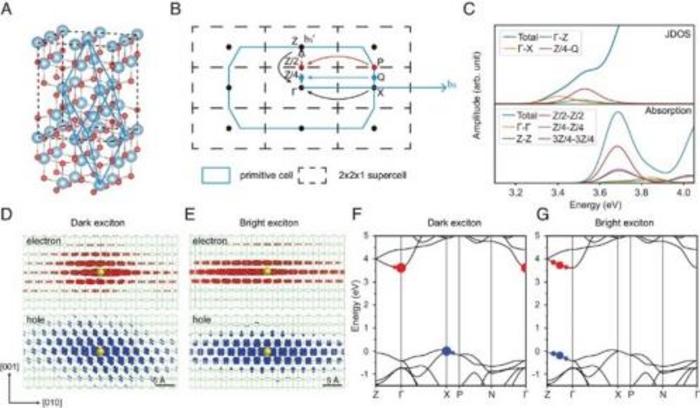
USTC Reveals the Dynamics of Bright-Dark Exciton Transition in a Semiconductor Material

Credit: USTC

A research team led by Prof. ZHAO Jin and Associate Prof. ZHENG Qijing from University of Science and Technology of China (USTC), in collaboration with Hrvoje Petek, a professor from the University of Pittsburgh, has uncovered the dynamics of bright-dark exciton transition in anatase TiO2. Their findings have been published in Proceedings of the National Academy of Sciences.

Excitons, quasi-particles formed by the binding of electrons and holes in condensed matter systems via Coulomb interaction, exhibit distinct properties as bright and dark excitons. While bright excitons directly couple with light and play a pivotal role in light absorption, dark excitons, with their relatively longer lifetimes, hold significance in quantum information processing, Bose-Einstein condensation, and light-energy harvesting.

This study, with the help of GW plus the real- time Bethe–Salpeter equation combined with the nonadiabatic molecular dynamics (GW + rtBSE- NAMD), explored the formation dynamics on how the optically excited bright to the strongly bound momentum-forbidden dark excitons in anatase TiO2, a semiconductor material renowned for its exceptional light absorption capabilities and its ability to activate bright excitons under light excitation. In the meantime, due to the material’s indirect band gap nature, bright excitons ultimately relax to the band edges, forming dark excitons.

The bright-dark exciton transition exhibited a novel pathway upon considering many-body effects within the excitons—the interaction between electrons and holes. This revelation unveiled an extended timescale for the transition process, where bright excitons transform into dark excitons within approximately 100 femtoseconds, several times fastaer than previously understood. Crucially, the many-body effects within excitons played a pivotal role during this transition.

This study sheds light on how semiconductor materials’ excitonic dynamics are affected by many-body interactions, offering crucial insights for designing light-based devices and energy materials. It also exemplifies the collaborative efforts and innovative computational approaches in unraveling the intricate dynamics of excitons, paving the way for advancements in material science and technology.


Journal

Proceedings of the National Academy of Sciences

DOI

10.1073/pnas.2307671120

Article Title

Ultrafast many-body bright–dark exciton transition in anatase TiO2

Article Publication Date

13-Nov-2023

Share12Tweet8Share2ShareShareShare2

Related Posts

β-Sitosterol from Ipomoea carnea Jacq. As a promising anti-inflammatory agent: Evidence from in silico modeling and in vitro validation

β-Sitosterol from Ipomoea carnea Jacq. As a promising anti-inflammatory agent: Evidence from in silico modeling and in vitro validation

August 31, 2026
Graded membranes point to a sustainable route for refining complex petroleum

Graded membranes point to a sustainable route for refining complex petroleum

August 31, 2026

Round-robin tests quantify catalyst activity and deactivation in CO2 hydrogenation modelling

August 30, 2026

Researchers reveal guiding principles for electrochemical synthesis of multimetallic nanocrystals

August 30, 2026

POPULAR NEWS

  • β-Sitosterol from Ipomoea carnea Jacq. As a promising anti-inflammatory agent: Evidence from in silico modeling and in vitro validation

    29 shares
    Share 12 Tweet 7
  • Design, fabrication and characterization of a wearable Fiber Bragg grating sensor for cardiorespiratory monitoring using finger plethysmography

    29 shares
    Share 12 Tweet 7
  • KAIST opens the era of industrial-scale microbial foods, proposing growth strategies for the next-generation protein market

    29 shares
    Share 12 Tweet 7
  • Virologist awarded $2 million NIH grant to investigate how virus-infected cells live and die

    29 shares
    Share 12 Tweet 7

About

We bring you the latest biotechnology news from best research centers and universities around the world. Check our website.

Follow us

Recent News

β-Sitosterol from Ipomoea carnea Jacq. As a promising anti-inflammatory agent: Evidence from in silico modeling and in vitro validation

Design, fabrication and characterization of a wearable Fiber Bragg grating sensor for cardiorespiratory monitoring using finger plethysmography

KAIST opens the era of industrial-scale microbial foods, proposing growth strategies for the next-generation protein market

Subscribe to Blog via Email

Success! An email was just sent to confirm your subscription. Please find the email now and click 'Confirm' to start subscribing.

Join 85 other subscribers
  • Contact Us

Bioengineer.org © Copyright 2023 All Rights Reserved.

Welcome Back!

Login to your account below

Forgotten Password?

Retrieve your password

Please enter your username or email address to reset your password.

Log In
No Result
View All Result
  • Homepages
    • Home Page 1
    • Home Page 2
  • News
  • National
  • Business
  • Health
  • Lifestyle
  • Science

Bioengineer.org © Copyright 2023 All Rights Reserved.