

• HOME
  • NEWS
  • EXPLORE
    • CAREER
      • Companies
      • Jobs
    • EVENTS
    • iGEM
      • News
      • Team
    • PHOTOS
    • VIDEO
    • WIKI
  • BLOG
  • COMMUNITY
    • FACEBOOK
    • INSTAGRAM
    • TWITTER
Saturday, May 23, 2026
BIOENGINEER.ORG
No Result
View All Result
  • Login
  • HOME
  • NEWS
  • EXPLORE
    • CAREER
      • Companies
      • Jobs
        • Lecturer
        • PhD Studentship
        • Postdoc
        • Research Assistant
    • EVENTS
    • iGEM
      • News
      • Team
    • PHOTOS
    • VIDEO
    • WIKI
  • BLOG
  • COMMUNITY
    • FACEBOOK
    • INSTAGRAM
    • TWITTER
  • HOME
  • NEWS
  • EXPLORE
    • CAREER
      • Companies
      • Jobs
        • Lecturer
        • PhD Studentship
        • Postdoc
        • Research Assistant
    • EVENTS
    • iGEM
      • News
      • Team
    • PHOTOS
    • VIDEO
    • WIKI
  • BLOG
  • COMMUNITY
    • FACEBOOK
    • INSTAGRAM
    • TWITTER
No Result
View All Result
Bioengineer.org
No Result
View All Result
Home NEWS Science News Biology

Using gold nanoparticles to trigger sequential unfolding of 3D structures

Bioengineer by Bioengineer
June 18, 2018
in Biology
Reading Time: 2 mins read
0
Share on FacebookShare on TwitterShare on LinkedinShare on RedditShare on Telegram
IMAGE

Credit: Sumeet Mishra

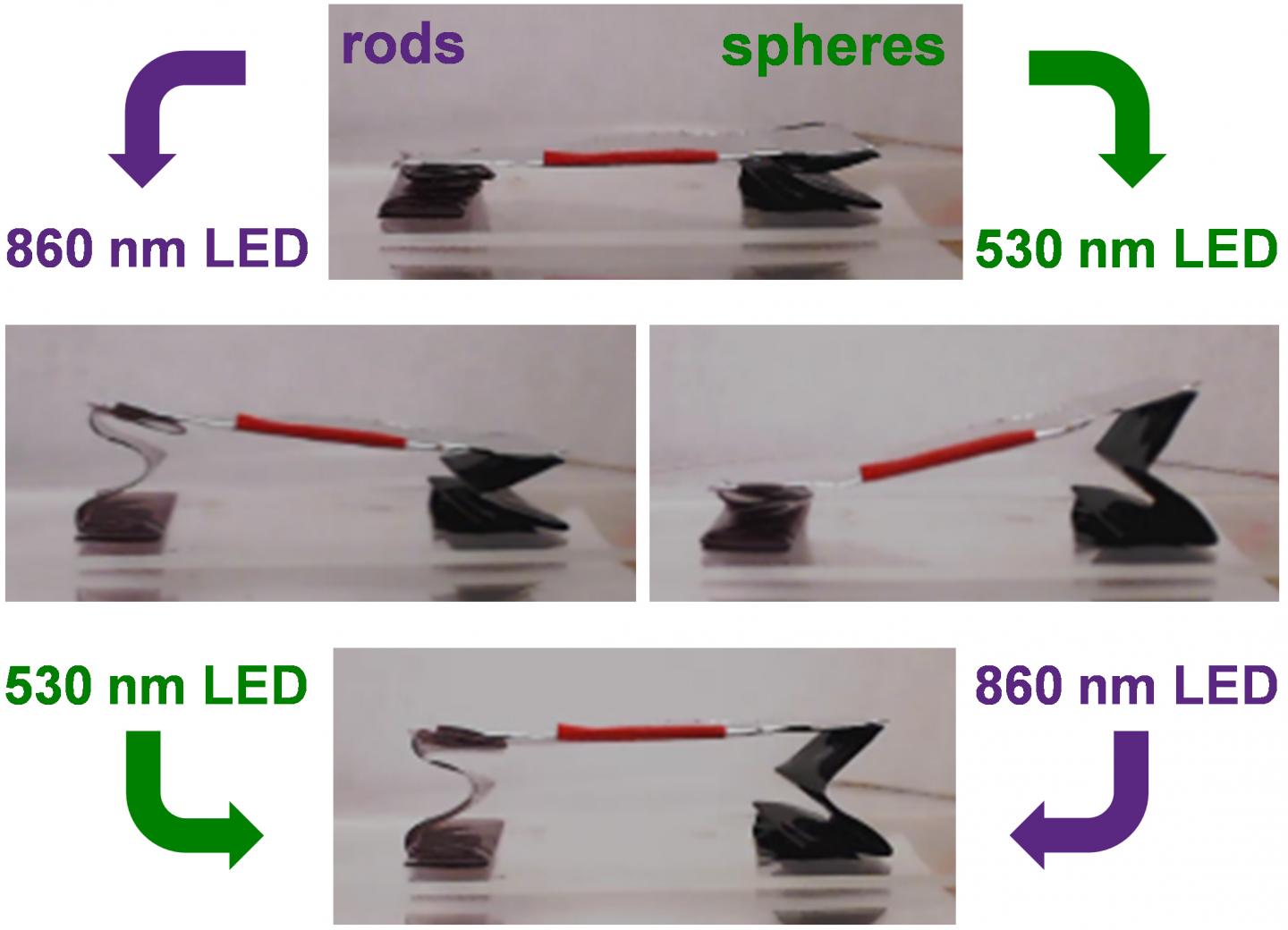
Researchers from North Carolina State University have developed a new technique that takes advantage of gold nanoparticles to trigger the sequential unfolding of three-dimensional structures using different wavelengths of light.

Specifically, the technique makes use of the fact that different shapes of gold nanoparticles convert different wavelengths of light into heat.

In this instance, researchers embedded gold nanospheres and nanorods into different areas of a shape memory polymer. The polymer can then be folded into a desired shape. When exposed to light wavelengths of 530 nanometers (nm), or green light, the folds in the part embedded with nanospheres unfold. When exposed to wavelengths of 860 nm, or near infrared, the nanorod-embedded regions unfold.

"This approach can be used at room temperature, and allows for significant flexibility, since you can control the wavelength that the material responds to by manipulating the shape of the gold nanoparticles," says Joe Tracy, an associate professor of materials science and engineering at NC State and corresponding author of a paper describing the work.

"This is an important advance because it directly connects the tunable optical properties of noble metal nanoparticles with remote triggering of sequential processes for applications in soft robotics, such as biomedical implants," Tracy says.

A related technique developed at NC State to direct sequential folding is to place colored inks on one side of prestretched polymers, which heat up and bend when exposed to different wavelengths of light.

###

The paper, "Sequential Actuation of Shape-Memory Polymers through Wavelength-Selective Photothermal Heating of Gold Nanospheres and Nanorods," is published in the journal Applied Nano Materials. First author of the paper is Sumeet Mishra, a former Ph.D. student at NC State. The work was supported by the National Science Foundation under grant DMR-1056653, and by the Research Triangle MRSEC – which is funded by NSF grant DMR-121107.

Media Contact

Matt Shipman
[email protected]
919-515-6386
@NCStateNews

Why Not Us?

Original Source

https://news.ncsu.edu/2018/06/gold-sequential-unfolding/ http://dx.doi.org/10.1021/acsanm.8b00394


Share13Tweet7Share2ShareShareShare1

Related Posts

Rising Sightings of Blue and Fin Whales in the South East Atlantic — Biology

Rising Sightings of Blue and Fin Whales in the South East Atlantic

May 23, 2026
New Maps Reveal How European Landscapes Can Simultaneously Promote Climate Action and Biodiversity Conservation — Biology

New Maps Reveal How European Landscapes Can Simultaneously Promote Climate Action and Biodiversity Conservation

May 22, 2026

University of Cincinnati Structural Biologists Achieve World First in Visualizing Crucial Cell Protein

May 22, 2026

Reducing Fertilizer Use Through Strategic Scientific Partnerships

May 22, 2026
Please login to join discussion

POPULAR NEWS

  • blank

    New Study Reveals Plants Can Detect the Sound of Rain

    734 shares
    Share 293 Tweet 183
  • ESMO 2025: mRNA COVID Vaccines Enhance Efficacy of Cancer Immunotherapy

    311 shares
    Share 124 Tweet 78
  • Research Indicates Potential Connection Between Prenatal Medication Exposure and Elevated Autism Risk

    847 shares
    Share 339 Tweet 212
  • Common Food Preservatives Associated with Elevated Blood Pressure and Increased Heart Disease Risk

    55 shares
    Share 22 Tweet 14

About

We bring you the latest biotechnology news from best research centers and universities around the world. Check our website.

Follow us

Recent News

Targeting S100A4–TLR4–TGF-β Axis in Diabetic Dupuytren’s

Long-Term AAV9 Gene Therapy for Spinal Muscular Atrophy

Lumacaftor/Ivacaftor Safe, Effective in Preschoolers: Study

Subscribe to Blog via Email

Enter your email address to subscribe to this blog and receive notifications of new posts by email.

Join 83 other subscribers
  • Contact Us

Bioengineer.org © Copyright 2023 All Rights Reserved.

Welcome Back!

Login to your account below

Forgotten Password?

Retrieve your password

Please enter your username or email address to reset your password.

Log In
No Result
View All Result
  • Homepages
    • Home Page 1
    • Home Page 2
  • News
  • National
  • Business
  • Health
  • Lifestyle
  • Science

Bioengineer.org © Copyright 2023 All Rights Reserved.