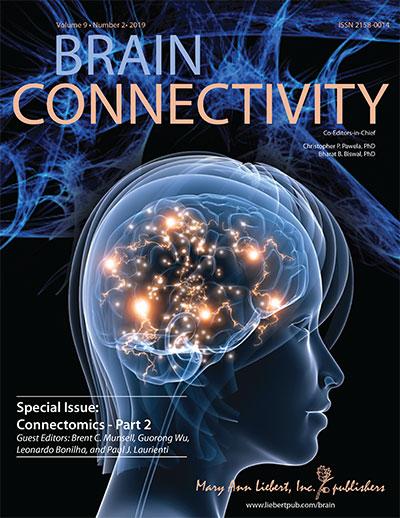
Credit: Mary Ann Liebert, Inc., publishers
New Rochelle, NY, March 26, 2019–Abnormalities in structural brain networks and how brain regions communicate may underlie a variety of disorders, including epilepsy, which is one focus of a two-part Special Issue on the Brain Connectome in Brain Connectivity, a peer-reviewed journal from Mary Ann Liebert, Inc., publishers. Click here to read the full-text articles free on the Brain Connectivity website through April 26, 2019.
The Special Issues were led by Guest Editors Brent Munsell, PhD, College of Charleston (SC), Guorong Wu, PhD, University of North Carolina at Chapel Hill, Leonardo Bonilha, MD, PhD, Medical University of South Carolina (Charleston), and Paul Laurienti, MD, PhD, Wake Forest School of Medicine (Winston-Salem, NC)
This second special issue includes the article entitled “Effective Connectivity within the Default Mode Network in Left Temporal Lobe Epilepsy: Findings from the Epilepsy Connectome Project,” –with results reported from the Epilepsy Connectome Project–contributed by Mary Meyerand, Jeffrey Binder and colleagues from University of Wisconsin-Madison, Medical College of Wisconsin (Milwaukee), and Froedtert Hospital (Milwaukee). Individuals with epilepsy can have memory impairment. Therefore, the researchers studied the default mode network that is a collection of brain regions involved in memory function. The results showed a difference in these memory-related connections between healthy individuals and individuals with epilepsy. The researchers identified an excitatory connection association with inhibition of formation of the left hippocampal region in patients with temporal lobe epilepsy.
In another article, “Comparison of Methods to Identify Molecules in Noisy or Incomplete Brain Networks,” Nitin Williams and colleagues from University of Helsinki (Finland), University of Genoa (Italy), Niguardo Hospital (Milan, Italy), HUS Medical Imaging Center (Helsinki, Finland), and University of Glasgow (UK) compare four different approaches to account for missing connections. The researchers offer their recommendations for what method is best to use in which setting to obtain the missing data.
###
About the Journal
Brain Connectivity is the essential peer-reviewed journal covering groundbreaking findings in the rapidly advancing field of connectivity research at the systems and network levels. Published 10 times per year in print and online, the Journal is under the leadership of Founding and Co-Editors-in-Chief Christopher Pawela, PhD, Assistant Professor, Medical College of Wisconsin, and Bharat Biswal, PhD, Professor of Biomedical Engineering, New Jersey Institute of Technology. It includes original peer-reviewed papers, review articles, point-counterpoint discussions on controversies in the field, and a product/technology review section. To ensure that scientific findings are rapidly disseminated, articles are published Instant Online within 72 hours of acceptance, with fully typeset, fast-track publication within 4 weeks. Tables of content and a sample issue may be viewed on the Brain Connectivity website.
About the Publisher
Mary Ann Liebert, Inc., publishers is a privately held, fully integrated media company known for establishing authoritative medical and biomedical peer-reviewed journals, including Journal of Neurotrauma and Therapeutic Hypothermia and Temperature Management. Its biotechnology trade magazine, GEN (Genetic Engineering & Biotechnology News), was the first in its field and is today the industry’s most widely read publication worldwide. A complete list of the firm’s 80 journals, newsmagazines, and books is available on the Mary Ann Liebert, Inc., publishers website.
Media Contact
Kathryn Ryan
[email protected]
Original Source
https:/