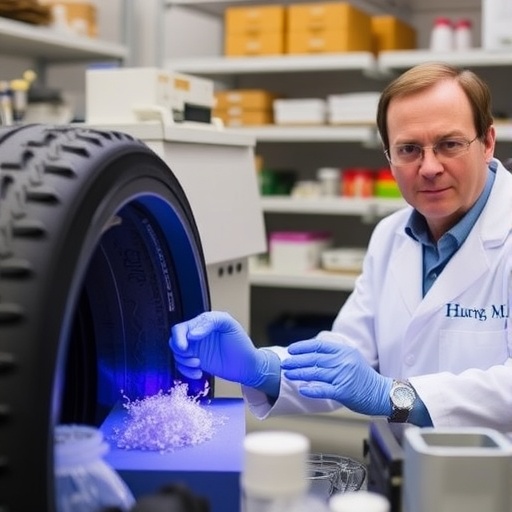
For nearly a century, reinforced rubber has been the unsung hero powering countless facets of modern life, from the tires rolling beneath our vehicles and aircraft to the seals safeguarding industrial machinery and the medical devices that save lives. Despite its critical role in one of the world’s largest material markets, the mystery behind why reinforced rubber behaves so extraordinarily well has persisted. Now, a team led by University of South Florida Professor David Simmons has shed unprecedented light on this enigmatic material, revolutionizing our understanding of reinforced rubber’s mechanical prowess.
The research, published in the prestigious Proceedings of the National Academy of Sciences, deploys cutting-edge computational simulations to unravel a mystery that has challenged materials scientists for decades. The question that has long tantalized researchers: how exactly do microscopic carbon black particles endow soft, pliable rubber with the remarkable ability to withstand heavy loads, such as the weight of fully loaded aircraft? The answer, it turns out, lies in the intrinsic mechanical interplay within the material—a phenomenon termed Poisson’s ratio mismatch.
Carbon black, a form of finely divided carbon that resembles soot, has traditionally been added to rubber formulations to dramatically enhance durability and strength, giving rise to the familiar black tires that endure the rigors of heat, wear, and mechanical stress. However, the underlying physics of this transformation remained an enigma, with competing hypotheses offering only partial explanations. Some scientists posited that carbon black particles form chain-like clusters within the rubber matrix, others suggested the particles act as adhesive “anchors” stiffening the rubber locally, while a separate theory contended that the reinforcement was a mere spatial effect forcing the rubber to stretch differently.
Simmons and his team transcended the limits of experimental observation by simulating reinforced rubber at an atomic scale, modeling the interactions of hundreds of thousands of atoms with unprecedented precision. By utilizing advanced molecular dynamics simulations, leveraging the powerful computational resources at USF’s high-performance clusters, and dedicating what would amount to 15 years of serial computer time, the researchers developed a model capable of capturing behaviors inaccessible to traditional laboratory techniques.
Central to their breakthrough is a nuanced understanding of Poisson’s ratio, a fundamental material property describing how a material’s dimensions change perpendicular to the direction of applied stretch. Rubber is near inherently incompressible; it preserves volume as it elongates, thinning out laterally to keep its bulk constant. Introducing carbon black disrupts this behavior. The particles act as rigid micro-scale inserts, resisting the expected thinning and effectively forcing the rubber matrix to expand in volume during stretching, a deformation that rubber fundamentally resists. This internal mechanical discord—rubber fighting against its own volumetric constraints—dramatically amplifies the material’s stiffness and load-bearing capacity.
Interestingly, this fresh insight does not discard previous theories but rather integrates them into a unifying framework. The molecular simulations revealed how network formation, particle adhesion effects, and simple volume displacement all contribute to reinforcing rubber, but these mechanisms fundamentally contribute to altering volume expansion behavior under strain. This holistic perspective resolves long-standing debates by showing that what once appeared as conflicting theories are, in fact, interrelated components of a larger, complex picture.
The iterative nature of the modeling process demonstrates the synergy between simulation and experimental data. Whenever the simulations failed to mirror real-world observations, the team refined their approach by incorporating additional mechanisms gleaned from decades of scientific literature. This recursive refinement eventually produced a highly predictive model that mirrors reality with remarkable fidelity, offering a potent tool for materials design.
These revelations herald transformative possibilities for the tire industry, which has traditionally relied on laborious trial-and-error methods to balance what industry experts call the “Magic Triangle” of performance: fuel efficiency, traction, and durability. Achieving simultaneous improvements across these three aspects has remained elusive, as optimizing one or two often sacrifices the third. The insights from Simmons’ team promise to rationalize and streamline this process, enabling engineers to design tires that grip wet roads more effectively, last longer, and contribute to greater fuel economy in a single, stable material formulation.
Beyond tires, the implications ripple across any domain dependent on reinforced rubber components — aerospace, energy infrastructure, chemical processing — where material failure can have catastrophic outcomes. The tragic Space Shuttle Challenger disaster, attributed to the failure of a rubber gasket under cold temperatures, underscores the critical need for better predictive design. With a deeper mechanistic understanding of how rubber composites behave, engineers can proactively design materials resilient to extreme environments, potentially averting such tragedies.
Simmons emphasizes that the newfound clarity into reinforced rubber’s mechanical behavior lays down a foundational framework for future innovations. The ability to predict how modifications at the nanoscale translate into macroscopic material properties ushers in a new era of materials science driven by rational design rather than empirical guesswork. This shift could not only revolutionize tire manufacturing but also enable the development of safer, more reliable components in medical devices, industrial seals, and flexible electronics.
Above all, the work exemplifies the power of computational modeling in solving real-world materials challenges. By simulating atomistic dynamics with unprecedented resolution and computational rigor, the USF team has turned a century-old mystery into a solved problem. The convergence of advanced simulation techniques and classical materials theory has yielded insights that will guide innovation for decades to come.
Looking forward, these findings may inspire new reinforced polymer composites beyond rubber, expanding possibilities in materials engineering at large. The model’s ability to capture volume expansion under strain presents opportunities to formulate novel elastomers with tailored mechanical properties, potentially offering breakthroughs in sectors as diverse as soft robotics, wearable technology, and energy storage.
In conclusion, the decades-long puzzle of reinforced rubber’s extraordinary strength has finally found its solution through molecular simulations revealing the crucial role of Poisson’s ratio mismatch. This phenomenon, previously hidden in the nanoscale intricacies of rubber’s microstructure, explains how the addition of carbon black transforms soft rubber into a robust material capable of supporting the relentless demands of modern industries. The research spearheaded by USF’s David Simmons thus marks a landmark achievement in materials science, promising safer, stronger, and more sustainable materials for the future.
Subject of Research: Reinforced rubber material science and molecular mechanics
Article Title: Glassy interphases reinforce elastomeric nanocomposites by enhancing volume expansion under strain
News Publication Date: April 15, 2026
Web References:
DOI link to article
University of South Florida Engineering Prof. David Simmons
Proceedings of the National Academy of Sciences
Poisson’s ratio explanation (PMC)
NASA Challenger Disaster
References: Proceeding of the National Academy of Sciences, DOI: 10.1073/pnas.2528108123/-/DCSupplemental
Image Credits: University of South Florida (USF)
Keywords
Reinforced rubber, carbon black, molecular dynamics simulations, Poisson’s ratio mismatch, elastomer mechanics, tire engineering, computational materials science, volume expansion, nanocomposites, materials design, durability, elasticity
Tags: advances in polymer sciencecarbon black in rubbercomputational simulations in materials sciencemechanical properties of rubberPoisson’s ratio mismatchreinforced rubber materialsrubber durability enhancementrubber in industrial applicationsrubber in medical devicesrubber reinforcement mechanismsrubber tire technologyUniversity of South Florida materials research