University of Rhode Island students and faculty members in multiple health disciplines will soon have access to state-of-the-art neuroscientific technology to enhance classroom lessons and research education, thanks to a grant from the Champlin Foundation.
Credit: Submitted Photo
University of Rhode Island students and faculty members in multiple health disciplines will soon have access to state-of-the-art neuroscientific technology to enhance classroom lessons and research education, thanks to a grant from the Champlin Foundation.
College of Health Sciences Professors Mariusz Furmanek and Alisa Baron, along with collaborators Mark Hartman, Nicole Logan, Ellen McGough and Kunal Mankodiya, will establish a Neuro-Learning Center that includes some of the most cutting-edge equipment available to neuroscientific researchers, allowing for the non-invasive study of relationships between brain activity and behavior, functional brain mapping, and mechanisms of neuroplasticity. The equipment will be available to undergraduate and graduate students as well as faculty in such disciplines as communicative disorders, physical therapy, kinesiology and biomedical engineering.
“We are planning to establish the Neuro-Learning Center, which will allow that interdisciplinary interaction with faculty members from different departments,” Furmanek said. “In the majority of institutions, these are only used for research. Primarily, we would use them for education. There is, of course, a research component with this equipment, but the primary goal is to educate our students in neuroscience and knowledge about the brain.”
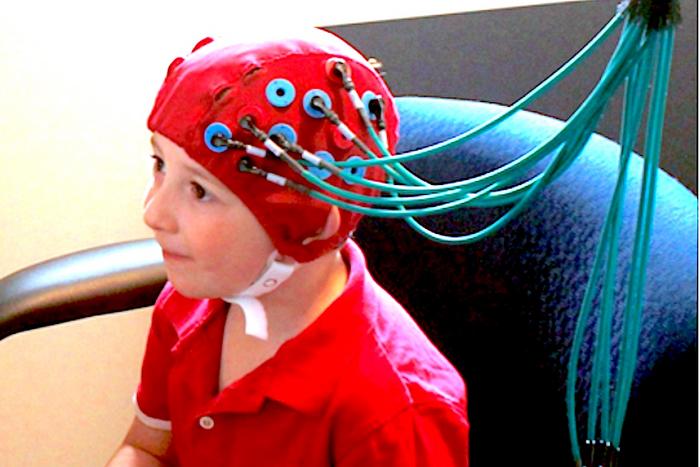
The non-invasive technology includes a Transcranial Magnetic Stimulation system, which uses low-intensity magnetic stimulation to facilitate or inhibit neural activity in areas of the brain; and a functional Near Infrared Spectroscopy system (fNIRS), which is an advanced neuroimaging technique used to measure brain activity by monitoring changes in blood flow in the brain. The TMS is used in conjunction with a NeuroNavigation System to target specific areas of the brain for neurostimulation. Basically, the technology will allow students to look at specific areas of the brain and determine which areas of the brain are active and which should be stimulated.
“It’s a cap that’s put on the head and it can be configured in any way depending on the part of the brain you want to look at,” Baron said of the fNIRS system. “You put the sources and detectors in the areas you are interested in on the scalp, and when a participant does a particular task, you can analyze the data to see what part of the brain lights up—the part of the brain that has more blood circulating to it. That shows the part of the brain that is the most active in trying to process that information from whatever task you’re asking the participant to do. This is a non-invasive system that’s used across the lifespan, which is a big benefit since a lot of people think of an MRI when thinking about neuroimaging techniques, having to put people into a scanner that’s quite loud and not child friendly.”
The systems are essential to study, diagnose and treat neurological diseases, such as depression, Alzheimer’s, Parkinson’s, stroke and more. Both systems can be used together by multiple clinicians. For example, the fNIRS system can identify parts of the brain that have died or have decreased function due to a stroke. Physical therapists can then use the TMS system to apply stimulation to those parts of the brain. If needed, a neurosurgeon would use the NeuroNavigation system to improve precision and safety of surgery, then a speech language pathologist could use fNIRS again to examine the post-procedure brain activity and its impact on communication.
“Such a collaborative and interdisciplinary approach will be emphasized when teaching our students to ensure the patient’s comprehensive care and recovery,” the professors wrote in their funding proposal. “There have been rapid advancements in the neuroscience field, including the types of equipment used. University courses and the training they provide must simultaneously evolve to ensure students are familiar with the techniques and technologies that will be utilized during their careers in patient care and research.”
Having the advanced equipment available to undergraduate students will be unique to URI. Furmanek and Baron are unaware of any other institutions that have the equipment for training undergraduate students and early-career graduate students, despite their widespread use by researchers and clinicians in the field. As important as the research capabilities is the educational component for students seeking careers in multiple health disciplines.
“The huge benefit to these systems is their portability. We can actually take them into the classroom so students can see how to use it, how to put it on someone, how to analyze the data, all in the classroom without having to pull them out of the class into the lab,” Baron said. “A lot of these technologies are only available in laboratory spaces, which creates a lot of inequity for students. We’re getting students access to these technologies early so they can understand and get comfortable using them, so that’s one more marketable skill when they go on the job market.”
Baron and Furmanek expect to begin acquiring the advanced technology in the spring, and expect to have it available for classroom use by fall 2024. The Neuro-Learning Center and the equipment will be housed between Furmanek’s and Baron’s labs in Independence Square on the Kingston campus.