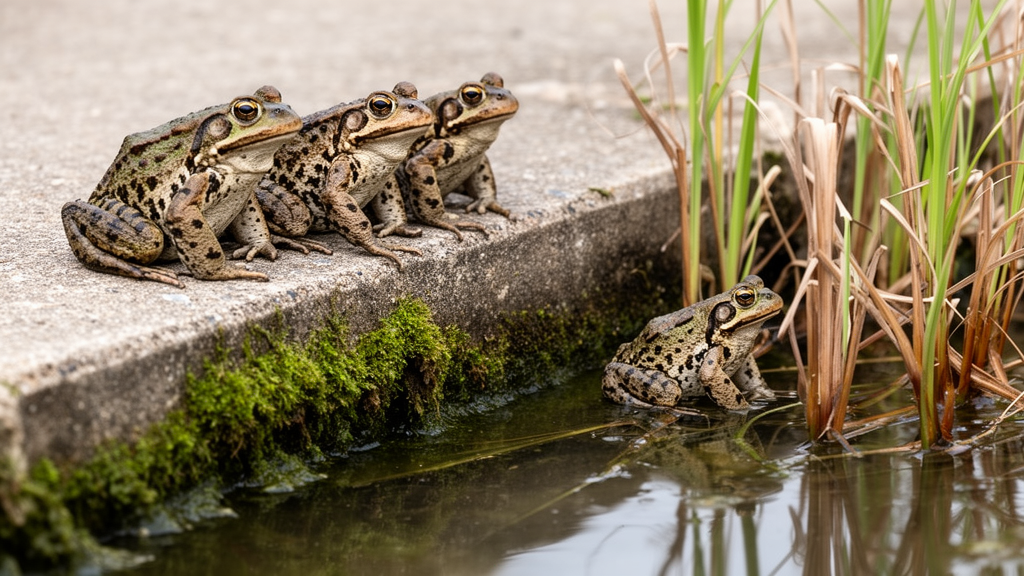
In a comparative ecological investigation conducted across Central Texas, researchers Jessica L. Powell, A. Kaya Clove, and Caitlin R. Gabor from the Department of Biology at Texas State University examined how watershed urbanization alters antipredator behavior and relative abundance in two co-occurring native anurans. The researchers contrasted the larval and population responses of the Gulf Coast toad, scientifically known as Incilius nebulifer, against those of the Rio Grande leopard frog, Rana berlandieri. By assessing aquatic field conditions, running controlled behavioral trials on captured tadpoles, and analyzing citizen science distribution records, the team revealed marked differences in how these two species navigate human-altered environments. While the Gulf Coast toad demonstrated sustained activity, consistent physical dimensions, and elevated occurrence throughout increasingly developed watersheds, the Rio Grande leopard frog displayed substantial declines in larval movement, reduced developmental size, and diminished population prevalence across matching gradients of impervious cover.
Urban expansion and changing environmental regimes systematically restructure freshwater networks by transforming temperature regimes, hydrology, and baseline habitat structure. Across watershed basins, the replacement of permeable soil and vegetative ground with impermeable artificial surfaces such as pavement, commercial buildings, and roadway infrastructure prevents rainfall from infiltrating into the subsurface. This alteration accelerates surface runoff, intensifies the flashiness of storm flows, and exacerbates stream erosion and morphological simplification. Furthermore, extensive impervious cover absorbs environmental heat, warming freshwater bodies above baseline conditions observed in rural catchments. While urbanization frequently drives widespread amphibian declines due to their biphasic life cycles and ectothermic physiology, certain native species function as urban adapters capable of maintaining stable populations in disturbed waterways. Understanding the distinct behavioral, morphological, and ecological tolerances that separate resilient organisms from sensitive taxa offers essential insight into community reorganizations occurring within rapidly urbanizing watersheds.
To evaluate these dynamics, the Texas State University researchers selected two sympatric species that differ substantially in their fundamental natural history and larval life cycles. Incilius nebulifer exhibits a brief larval period spanning approximately 28 days and regularly exploits temporary, highly disturbed aquatic sites for breeding, supported by physiological resilience to anthropogenic disturbance. Conversely, Rana berlandieri typically relies on more permanent water bodies to accommodate an extended larval development period lasting approximately three to four months. This prolonged developmental timeline in aquatic reservoirs potentially exposes leopard frog larvae to heightened risks associated with pollutant accumulation, structural habitat loss, and hydrologic instability. The investigative team sampled aquatic habitats spanning an urbanization gradient across Hays, Travis, and Kerr counties, categorizing water bodies by hydrological permanence and measuring environmental parameters including water temperature, pH, total dissolved solids, and structural complexity.
Quantifying local habitat parameters demonstrated pronounced environmental shifts driven by the intensity of watershed development. Principal component analysis of water quality metrics, encompassing pH, water temperature, and total dissolved solids, revealed that the primary component accounted for 69.6 percent of environmental variation among collection sites. Statistical modeling indicated that watershed impervious surface cover was negatively associated with water quality and habitat complexity, while showing a strong positive association with elevated water temperatures. Annual precipitation, derived from remote sensing databases, did not correlate with watershed urbanization levels, though it exhibited a significant relationship with baseline water quality. Physical habitat complexity, measured by evaluating pixel color variation and standard deviation across underwater video footage, dropped sharply in watersheds dominated by paved surfaces, confirming that urban runoff and flash flooding actively strip away microhabitat heterogeneity and shelter.
To determine whether urban degradation disrupts vital antipredator behaviors, the researchers conducted controlled behavioral trials with thirty tadpoles of each species, spanning Gosner developmental stages 26 through 30. Individual larvae were placed within isolated water containers containing dechlorinated water to eliminate foreign olfactory cues, equipped with standardized plastic shelters. After an initial acclimation period, baseline swimming, resting, and hiding durations were recorded via digital video for five minutes. Half of the larvae then received chemical cues collected from green sunfish, Lepomis cyanellus, a native predatory fish species maintained on a controlled diet, while the remaining individuals received a sham cue of treated tap water. Following chemical introduction and system flushes, larval responses were tracked for an additional five minutes to determine whether urban origin or chemical degradation diminished defensive refuge use or freezing behavior.
Statistical evaluation of behavioral video records demonstrated that exposure to green sunfish chemical cues did not significantly alter swimming movement or refuge use in either amphibian species. Repeated measures analyses revealed no significant main effects of predator cue treatment or stage on activity, nor were there significant interactions between cue exposure and collection site. The authors noted that while predatory fish were present at most field localities, tadpoles occupying shallow littoral edges may naturally experience reduced predation pressure from larger sunfish, potentially lessening their behavioral dependence on dissolved fish scents. Alternatively, these anuran larvae may rely more heavily on visual stimuli, physical vibrations, or alarm cues emitted by injured conspecifics. Furthermore, chemical unpalatability and skin toxins typical of bufonids like Incilius nebulifer often deter aquatic predators, reducing the selective necessity of behavioral avoidance maneuvers compared to species lacking chemical defenses.
Although chemical cues failed to trigger antipredator shifts, the broader environmental gradient linked to urbanization exerted powerful, divergent effects on baseline larval behavior and morphology between the two species. In multivariate mixed-effects models evaluating watershed impervious cover, local urbanization within 1000 meters, habitat complexity, pH, and dissolved solids, the primary environmental component interacted significantly with genus identity. Incilius nebulifer tadpoles maintained statistically indistinguishable levels of baseline movement across all sampling populations regardless of catchment development. In contrast, Rana berlandieri tadpoles exhibited dramatic, statistically significant reductions in active movement that tracked increasing watershed urbanization. Linear model selection identified impervious surface cover as the single best predictor of movement suppression in leopard frog tadpoles, documenting pronounced reductions in physical activity across urbanized streams.
Parallel divergences emerged in physical larval dimensions measured via ImageJ digital photographic analysis, which quantified snout-vent length, total length, and dorsal surface area as a reliable proxy for body mass. Across the collection gradient, Incilius nebulifer larvae maintained uniform physical sizes irrespective of local watershed alteration. By comparison, Rana berlandieri tadpoles collected from rural environments, such as those from reference streams and laboratory-reared stocks originating from non-urban waters, were significantly larger than conspecifics inhabiting developed drainage basins. Statistical modeling confirmed a significant negative relationship between watershed impervious cover and leopard frog dorsal surface area. Because larval swimming activity directly facilitates aquatic foraging, suppressed movement in degraded waters reduces caloric intake, slowing development and resulting in stunted body size prior to metamorphosis.
The consequences of suppressed activity and diminished size for Rana berlandieri are particularly severe given its protracted larval period. When developing within intermittent or ephemeral waterways, delayed growth and sluggish movement elevate the probability that larvae will fail to complete metamorphosis before seasonal drying occurs, leading to desiccation and mortality. Field surveys highlighted this ecological bottleneck: researchers were completely unable to locate sufficient populations of Rana berlandieri larvae for experimental testing in watersheds exceeding approximately 25 percent impervious cover. In contrast, viable populations of Incilius nebulifer tadpoles remained widespread and abundant across heavily altered drainage basins, persisting in sites exhibiting up to 78 percent impervious cover.
To assess whether these localized larval outcomes corresponded to landscape-level population patterns, the authors examined confirmed research-grade iNaturalist records across Central Texas from 2024 through 2025. Watersheds were categorized into low, moderate, and high urbanization tiers, standardized to six observations per watershed using rarefaction to eliminate observation frequency biases. Analysis revealed significant compositional restructuring across urbanization tiers. The mean rarefied abundance of Incilius nebulifer rose from 3.52 in rural catchments to 4.63 in suburban zones and 5.27 in urban areas, whereas Rana berlandieri declined from 2.48 to 1.37 and finally to 0.73. Significant shifts in relative species abundance occurred between rural and suburban classifications, with toad dominance persisting through the most urbanized landscapes.
The observed demographic divergence suggests that Incilius nebulifer may benefit from competitive release as sensitive competitors disappear from degraded waterways. Because Rana berlandieri larvae require stable, high-quality aquatic refugia, their exclusion from urbanized channels leaves available resources open to the rapid-developing, disturbance-resilient toad. However, the study authors emphasize that citizen science datasets carry inherent observational caveats, as differences in public access, human traffic, and species detectability may influence reporting rates across urban corridors. Additionally, the experimental behavior trials relied on modest larval sample sizes from four primary populations per species, requiring measured interpretation regarding specific physiological mechanisms.
Collectively, the empirical findings demonstrate that watershed urbanization creates species-specific sorting among sympatric amphibians, operating through morphological, behavioral, and hydrological constraints rather than simple chemical predator masking. The sharp decline of Rana berlandieri at modest urbanization thresholds provides empirical backing for conservation frameworks advocating that impervious watershed cover be kept below 10 to 15 percent to safeguard freshwater diversity. As human development and climate-induced thermal extremes continue to alter urban streams, accounting for species-specific ecological thresholds remains essential for freshwater habitat conservation and urban environmental management.
Subject of Research: Species-specific behavioral, morphological, and abundance impacts of watershed urbanization on sympatric Texas anurans
Article Title: Frogs and the city: investigating species-specific impacts of urbanization on behavior and abundance in sympatric anurans
Article References: Powell, J. L., Clove, A. K., & Gabor, C. R. (2026). Frogs and the city: investigating species-specific impacts of urbanization on behavior and abundance in sympatric anurans. Frontiers in Amphibian and Reptile Science, 4, 1986873. https://doi.org/10.3389/famrs.2026.1986873
Image Credits: AI Generated
DOI: 10.3389/famrs.2026.1986873
Keywords: Incilius nebulifer, Rana berlandieri, urbanization, watershed development, impervious cover, amphibian ecology, tadpole behavior, antipredator response, water quality, habitat complexity, Lepomis cyanellus, Central Texas, urban stream syndrome, citizen science, iNaturalist, larval development
News Source: Drew Townsend. (November 19, 2026). Urban Watershed Development Alters Leopard Frog Abundance While Gulf Coast Toads Persist. Scienmag.