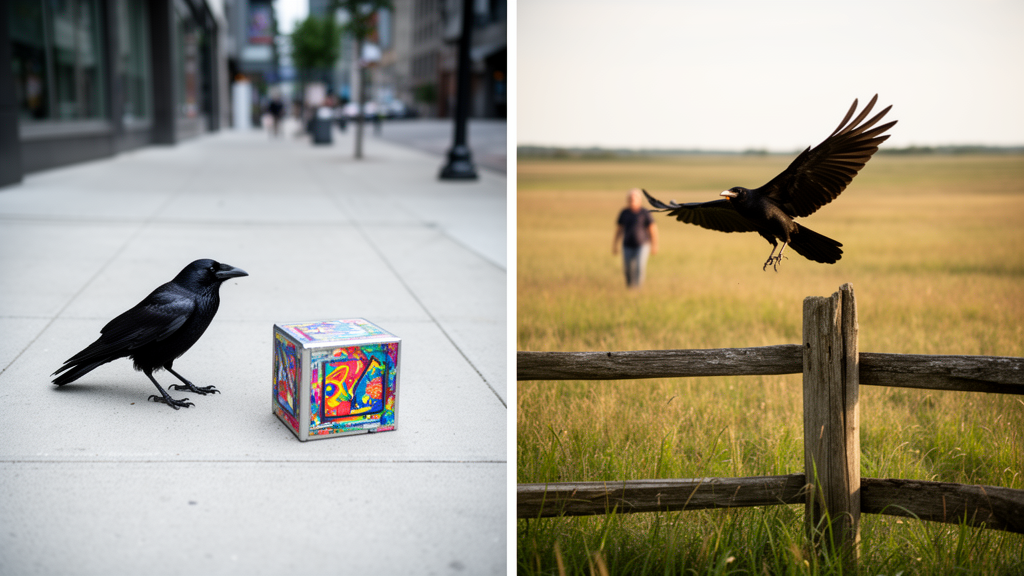
American crows living in urban and rural environments react differently to unfamiliar objects and human presence based on their past experiences, according to a study by biologists at Binghamton University, State University of New York. Published in the journal Behavioral Ecology, the experimental research examined how lived experience shapes both neophobia—the natural hesitation observed when encountering new things—and behavioral reactions to human gaze cues. Led by biologist Dave J. Colucci, PhD ’25, along with co-author Anne Clark, an Associate Professor Emerita of Biological Sciences, the investigation demonstrated that crows from urban and rural habitats do not perceive their surrounding world in the same way.
Neophobia represents an evolutionary hesitation when encountering novel objects or situations, and all animals, including humans, experience this wariness. Corvids worldwide are renowned for their exceptional intelligence, problem-solving skills, and curiosity, yet they simultaneously exhibit pronounced neophobia. Clark noted that flight gives these birds a substantial survival advantage, allowing them to retreat to a discreet vantage point to observe phenomena safely before taking action, which likely contributes to their celebrated problem-solving capabilities. Colucci explained that crows are both cautious of unfamiliar things and intensely curious, allowing them to overcome their apprehension when advantageous opportunities arise.
To evaluate how experience influences aversion to novelty and responses to people, the research team studied twenty crow families across upstate New York. The sample comprised ten urban crow families located in the Ithaca area and ten rural crow families inhabiting nearby Dryden. During the initial phase of the experimental project, the researchers habituated both groups to human interaction by providing them with their preferred food, whole peanuts in the shell. Once the crow families established a consistent feeding routine and grew accustomed to the feedings, the researchers introduced specific test objects placed directly alongside the peanuts to measure the birds’ willingness to approach.
The researchers tested responses using four distinct items: a natural rock, an ear of corn, a paper takeout food box, and a wooden lamp base. Familiar objects elicited minimal hesitation from the crows: both urban and rural families approached the rock without concern, rural crows quickly accepted the ear of corn, and urban crows displayed little wariness toward the paper takeout box. In contrast, unfamiliar objects provoked pronounced aversion. Urban crows hesitated considerably when encountering the ear of corn, rural crows were cautious around the takeout box, and both groups displayed elevated wariness toward the wooden lamp base. Colucci stated that the experimental design aimed to demonstrate that aversion decreases alongside the amount of experience crows have had with specific objects. While crows residing near fast-food restaurants such as McDonald’s or Arby’s learn to recognize specific commercial packaging, the takeout container used in the study was generic and brand-neutral.
The experimental trials revealed that urban crows exhibited higher levels of neophobia than rural crows when presented with novel objects such as corn and wooden lamp bases. This finding proved surprising because numerous prior studies concluded that urban birds generally display less neophobia than rural counterparts. However, those previous investigations rarely controlled for an animal’s prior experience with the novel objects being tested. The researchers noted that this vigilance mirrors the behavior of human city dwellers, who stay peripherally alert to unusual occurrences and respond accordingly. Clark explained that urban crows are social animals that forage in groups and actively watch one another, pointing out that in an environment offering abundant resources alongside novel threats, maintaining uncertainty about safety is an effective strategy.
Although rural crows demonstrated less hesitation toward novel feeding objects, a separate experiment revealed that they were considerably more fearful of humans than their urban peers. The researchers evaluated the birds’ reactions to the human gaze, discovering that urban crows closely monitor the direction an approaching human is looking. If a human is not looking directly at them, urban crows are far less likely to fly away. By contrast, rural crows fled at a much greater distance regardless of the direction the approaching human looked. The researchers noted that this divergence likely stems from direct human threats, as crows are considered a nuisance species and face a higher risk of being shot in rural agricultural areas.
Clark described the rural crows’ rapid flight as a blunt anti-predator strategy that avoids taking chances to assess safety when humans appear. In contrast, urban crows could not survive effectively on the ground if they fled from every passing human, leading them to actively collect useful behavioral information regarding individual human gaze and threat levels. Together, both experiments underscore the critical role that lived experience plays when animals encounter new phenomena within their habitats. The authors concluded that the findings illustrate how wildlife can adapt successfully to expanding urbanization without altering their fundamental attributes, highlighting the broader mechanisms organisms use to survive within an ever-changing world.
Subject of Research: Behavioral differences and neophobia in urban and rural American crows
Article Title: City crows and country crows don’t see the world the same way
Article References: City crows and country crows don’t see the world the same way. Original publication (Bibliographic details unavailable.)
Image Credits: AI Generated
DOI: Not provided
Keywords: American crows, Behavioral Ecology, neophobia, urban wildlife, rural crows, Binghamton University, Dave J. Colucci, Anne Clark, human gaze, novel object aversion, corvid behavior, anti-predator strategy, urbanization adaptation, animal cognition, Ithaca New York, Dryden New York, object familiarity
News Source: Gavin Prescott. (November 16, 2026). Urban Crows Display More Object Neophobia While Rural Crows Flee Humans. Scienmag.