• HOME
  • NEWS
  • EXPLORE
    • CAREER
      • Companies
      • Jobs
    • EVENTS
    • iGEM
      • News
      • Team
    • PHOTOS
    • VIDEO
    • WIKI
  • BLOG
  • COMMUNITY
    • FACEBOOK
    • INSTAGRAM
    • TWITTER
Thursday, October 8, 2026
BIOENGINEER.ORG
No Result
View All Result
  • Login
  • HOME
  • NEWS
  • EXPLORE
    • CAREER
      • Companies
      • Jobs
        • Lecturer
        • PhD Studentship
        • Postdoc
        • Research Assistant
    • EVENTS
    • iGEM
      • News
      • Team
    • PHOTOS
    • VIDEO
    • WIKI
  • BLOG
  • COMMUNITY
    • FACEBOOK
    • INSTAGRAM
    • TWITTER
No Result
View All Result
Bioengineer.org
No Result
View All Result
Home NEWS Science News Chemistry

Upconversion of infrared photons enables rapid organic synthesis under sunlight

Bioengineer by Bioengineer
February 6, 2023
in Chemistry
Reading Time: 2 mins read
0
Upconversion of infrared photons enables rapid organic synthesis under sunlight
Share on FacebookShare on TwitterShare on LinkedinShare on RedditShare on Telegram

A research group led by Prof. WU Kaifeng from the Dalian Institute of Chemical Physics (DICP) of the Chinese Academy of Sciences (CAS) has reported the efficient near-infrared photon upconversion sensitized by lead-free semiconductor nanocrystals, and demonstrated its novel application in solar synthesis.
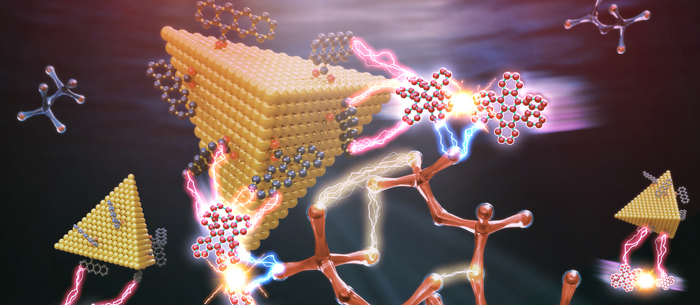
Upconversion of infrared photons enables rapid organic synthesis under sunlight

Credit: DICP

A research group led by Prof. WU Kaifeng from the Dalian Institute of Chemical Physics (DICP) of the Chinese Academy of Sciences (CAS) has reported the efficient near-infrared photon upconversion sensitized by lead-free semiconductor nanocrystals, and demonstrated its novel application in solar synthesis.

The study was published in Nature Photonics on Feb. 6.

Upconversion of near-infrared photons to visible photons can boost the performance of photovoltaics, photoredox-catalysis and phototheranostics. Sensitized triplet-fusion is a promising means for photon upconversion.

However, current photosensitizers capable of near-infrared absorption often contain either precious or toxic elements, for example, palladium- or platinum-complexes and lead chalcogenide nanocrystals.

In this study, the researchers reported zinc-doped CuInSe2 nanocrystals as a low-cost and environmentally-benign sensitizer for near-infrared-to-visible upconversion, which achieved external quantum efficiency of 16.7% for this spectral range.

This upconversion system was further merged with photoredox catalysis, enabling reductive dehalogenation, amine oxidation, carbon-oxygen bond formation and photopolymerization efficiently driven by near-infrared photons. 

More importantly, thanks to the broadband light capturing of the near-infrared nanocrystals, these reactions were remarkably rapid under indoor sunlight, enabling, for example, polymerization of acrylates within just 30 seconds.

“Organic synthesis under sunlight, or solar synthesis, has been a century-long idea, which was pioneered by Ciamician et al. But organic chemists’ vision has been limited to utilizing visible photons in sunlight,” said Prof. WU. “Our study extends the reach of solar synthesis to both visible and near-infrared photons abundant in sunlight, which is poised to strongly boost this technology.”


Journal

Nature Photonics

DOI

10.1038/s41566-023-01156-6

Method of Research

Commentary/editorial

Subject of Research

Not applicable

Article Title

Near-infrared photon upconversion and solar synthesis using lead-free nanocrystals

Article Publication Date

6-Feb-2023

Share12Tweet8Share2ShareShareShare2

Related Posts

Tree Seed Compound Karanjin Pushes Cancer Cells Into Oxidative Overload and Self-Destruction

Tree Seed Compound Karanjin Pushes Cancer Cells Into Oxidative Overload and Self-Destruction

October 8, 2026
Hidden Nitrogen Sites Turn Simple Carbon Into a Powerful Antibiotic-Degrading Catalyst

Hidden Nitrogen Sites Turn Simple Carbon Into a Powerful Antibiotic-Degrading Catalyst

October 8, 2026

Smart battery architecture bypasses weak cells to extend EV battery life by 20 percent

October 8, 2026

Cage-Like Crystal Could Do It All: New Simulation Points to a Four-in-One Energy Material

October 8, 2026

POPULAR NEWS

  • Alloys That Shrink Their Own Grains: New PIX Mechanism Refines Metals With Heat Alone

    Alloys That Shrink Their Own Grains: New PIX Mechanism Refines Metals With Heat Alone

    29 shares
    Share 12 Tweet 7
  • Endurance Exercise Reshapes the Liver in Males and Females Through Distinct Molecular Routes

    29 shares
    Share 12 Tweet 7
  • Single Transcription Factor PU.1 Rapidly Converts Fibroblasts into Macrophage-Lineage Cells

    29 shares
    Share 12 Tweet 7
  • New Scale Measures How Ready Nurse Educators Really Are for the AI Era

    29 shares
    Share 12 Tweet 7

About

We bring you the latest biotechnology news from best research centers and universities around the world. Check our website.

Follow us

Recent News

Alloys That Shrink Their Own Grains: New PIX Mechanism Refines Metals With Heat Alone

Endurance Exercise Reshapes the Liver in Males and Females Through Distinct Molecular Routes

Single Transcription Factor PU.1 Rapidly Converts Fibroblasts into Macrophage-Lineage Cells

Subscribe to Blog via Email

Success! An email was just sent to confirm your subscription. Please find the email now and click 'Confirm' to start subscribing.

Join 85 other subscribers
  • Contact Us

Bioengineer.org © Copyright 2023 All Rights Reserved.

Welcome Back!

Login to your account below

Forgotten Password?

Retrieve your password

Please enter your username or email address to reset your password.

Log In
No Result
View All Result
  • Homepages
    • Home Page 1
    • Home Page 2
  • News
  • National
  • Business
  • Health
  • Lifestyle
  • Science

Bioengineer.org © Copyright 2023 All Rights Reserved.