Ciliate protozoa possess the remarkable ability to reproduce through both asexual and sexual means. Their distinctive sexual process involves conjugation and autogamy, and they wield a secret weapon: extraordinary nuclear dimorphism. Within each cell resides both a germline micronucleus (MIC) and a somatic macronucleus (MAC). When subjected to fluorescent staining, their sexual processes transform into a captivating kaleidoscope of vibrant colors, creating a cellular carnival of vibrant colors.
Credit: Xue Zhang
Ciliate protozoa possess the remarkable ability to reproduce through both asexual and sexual means. Their distinctive sexual process involves conjugation and autogamy, and they wield a secret weapon: extraordinary nuclear dimorphism. Within each cell resides both a germline micronucleus (MIC) and a somatic macronucleus (MAC). When subjected to fluorescent staining, their sexual processes transform into a captivating kaleidoscope of vibrant colors, creating a cellular carnival of vibrant colors.
To investigate these processes in closely related species, an international team of researchers focused on Paramecium jenningsi, a relative within P. aurelia complex (a star in the cellular cosmos).
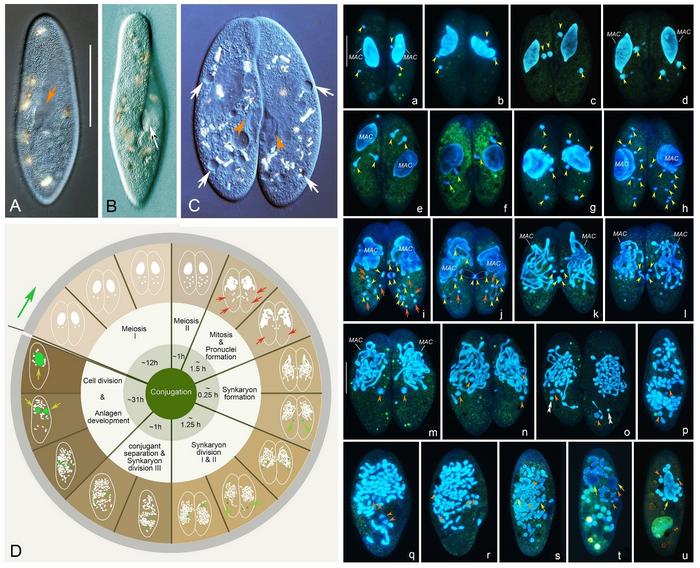
The team found that in P. jenningsi, the conjugation process unfolds over approximately 48 hours, encompassing three prezygotic divisions (meiosis I, II, and mitosis) and three postzygotic divisions. Notably, during this process, the MICs are predominantly characterized by the “parachute” phase occurring at the prophase of meiosis I.
“Following meiosis II, a variable number of nuclei undergo the third prezygotic division. The two resulting products near the paroral cone subsequently evolve into the genetically identical migratory and stationary pronuclei,” shared the study’s co-first author Ruitao Gong.
Further, the synkaryon, formed during conjugation, undergoes three divisions, giving rise to the MIC and MAC anlagen. Interestingly, only one nuclear product from the first postzygotic division proceeds to complete the subsequent two divisions.
“An additional cell division becomes necessary to finalize the last phase of conjugation. During this step, two MIC anlagen undergo mitotic division, while two MAC anlagen are distributed between the daughter cells without division,” added Xue Zhang, the other co-first author.
This study, published in the KeAi journal Water Biology and Security, provides a new model ciliate for further investigation of nuclear selection and differentiation, as well as nuclear morphology during meiosis.
“The process of conjugation in ciliates is truly remarkable. In fact, in other species, we have observed that individuals lacking micronuclei can also engage in conjugation,” said Zhang.
###
Contact the author: Yaohan Jiang ([email protected]), Institute of Evolution & Marine Biodiversity, Ocean University of China, Qingdao 266003, China.
The publisher KeAi was established by Elsevier and China Science Publishing & Media Ltd to unfold quality research globally. In 2013, our focus shifted to open access publishing. We now proudly publish more than 100 world-class, open access, English language journals, spanning all scientific disciplines. Many of these are titles we publish in partnership with prestigious societies and academic institutions, such as the National Natural Science Foundation of China (NSFC).
Journal
Water Biology and Security
DOI
10.1016/j.watbs.2023.100201
Method of Research
Observational study
Subject of Research
Cells
Article Title
Nuclear events during conjugation in the poorly studied model ciliate Paramecium jenningsi[J]
COI Statement
The authors declare that they have no known competing financial interests or personal relationships that could have appeared to influence the work reported in this paper. Weibo Song is an editorial board member for Water Biology and Security and was not involved in the editorial review or the decision to publish this article.