• HOME
  • NEWS
  • EXPLORE
    • CAREER
      • Companies
      • Jobs
    • EVENTS
    • iGEM
      • News
      • Team
    • PHOTOS
    • VIDEO
    • WIKI
  • BLOG
  • COMMUNITY
    • FACEBOOK
    • INSTAGRAM
    • TWITTER
Monday, June 1, 2026
BIOENGINEER.ORG
No Result
View All Result
  • Login
  • HOME
  • NEWS
  • EXPLORE
    • CAREER
      • Companies
      • Jobs
        • Lecturer
        • PhD Studentship
        • Postdoc
        • Research Assistant
    • EVENTS
    • iGEM
      • News
      • Team
    • PHOTOS
    • VIDEO
    • WIKI
  • BLOG
  • COMMUNITY
    • FACEBOOK
    • INSTAGRAM
    • TWITTER
  • HOME
  • NEWS
  • EXPLORE
    • CAREER
      • Companies
      • Jobs
        • Lecturer
        • PhD Studentship
        • Postdoc
        • Research Assistant
    • EVENTS
    • iGEM
      • News
      • Team
    • PHOTOS
    • VIDEO
    • WIKI
  • BLOG
  • COMMUNITY
    • FACEBOOK
    • INSTAGRAM
    • TWITTER
No Result
View All Result
Bioengineer.org
No Result
View All Result
Home NEWS Science News

Unveiling the lionfish invasion in the Mediterranean Sea

Bioengineer by Bioengineer
April 25, 2024
in Science News
Reading Time: 3 mins read
0
Lionfish (Pterois miles) photographed in Greece.
Share on FacebookShare on TwitterShare on LinkedinShare on RedditShare on Telegram

Researchers from Wageningen University and Research, the Netherlands, have published a comprehensive study on the invasion of lionfish in the Mediterranean Sea, highlighting a rapid spread and the potential ecological impacts.
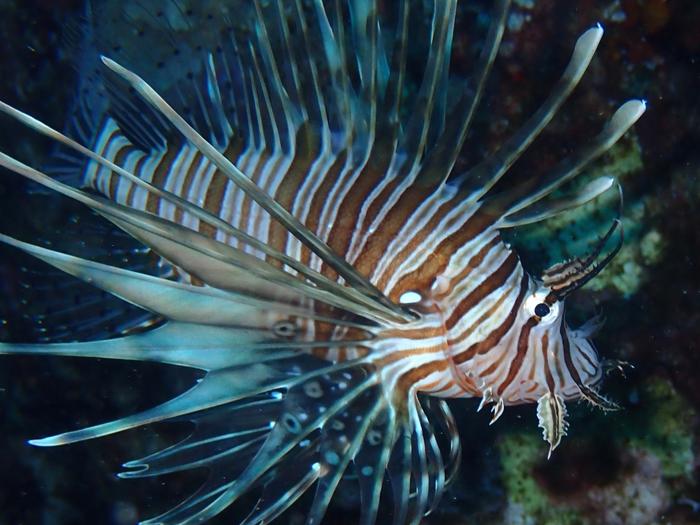
Lionfish (Pterois miles) photographed in Greece.

Credit: Pierre mkrs via Wikimedia commons

Researchers from Wageningen University and Research, the Netherlands, have published a comprehensive study on the invasion of lionfish in the Mediterranean Sea, highlighting a rapid spread and the potential ecological impacts.

Published in the open-access journal NeoBiota, the research shows the lionfish species Pterois miles has significantly expanded its territory in the Mediterranean since the invasion began around ten years ago. The invasive species has established presence in the eastern Mediterranean, with observations now extending to colder waters previously thought to be unsuitable for the species.

Originating from the Indo-Pacific region, the lionfish species Pterois miles and Pterois volitans  are regarded as the most successful invasive fishes in marine ecosystems, with the capacity to drastically affect local fish communities and biodiversity in invaded areas.

Lionfish are generalist predators and impact ecosystems by preying extensively on local fishes, including endemics of high conservation value. As they are unaccustomed to lionfish, native prey species usually do not flee from this new predator.

“After years studying these predators, I find it amazing how they can easily adjust to so many different environments and be successful in areas that are so different from the ones where they evolve,” says lead author Davide Bottacini.

“It is always impressive to see how such a flamboyant and–to us–conspicuous predator can approach its prey without being noticed,” he continues.

As the largest enclosed sea on earth, the Mediterranean is a unique ecosystem. It is a highly biodiverse basin home to more than 11,000 animal species, some of which are found nowhere else in the world. Genetic studies revealed that lionfish found in the Mediterranean originate from the Red Sea and likely entered through the Suez Canal.

Through a detailed review of existing scientific data, the researchers identified gaps in our understanding of the lionfish’s interactions with Mediterranean ecosystems and have proposed future research directions to address these challenges. Such information provides insights vital for biodiversity conservation and will have practical implications for policy makers aiming to devise sound and efficient mitigation plans.

The study also highlights the crucial role of citizen science initiatives in tracking and reporting sightings of lionfish, providing valuable data that supports ongoing research efforts. Such community involvement is essential for enhancing understanding of the invasion dynamics and devising effective control measures.

Original source

Bottacini D, Pollux BJA, Nijland R, Jansen PA, Naguib M, Kotrschal A (2024) Lionfish (Pterois miles) in the Mediterranean Sea: a review of the available knowledge with an update on the invasion front. NeoBiota 92: 233–257. https://doi.org/10.3897/neobiota.92.110442


Journal

NeoBiota

DOI

10.3897/neobiota.92.110442

Article Title

Lionfish (Pterois miles) in the Mediterranean Sea: a review of the available knowledge with an update on the invasion front

Article Publication Date

25-Apr-2024

Share12Tweet8Share2ShareShareShare2

Related Posts

Impact of Immigration Restrictions on the US Healthcare Workforce

May 31, 2026

Study Reveals Cancer Diagnostic Delays Linked to Population-Based Screening Using Cell-Free DNA Multicancer Early Detection Test

May 31, 2026

Innovative AI Technique Predicts Radiation Dosage Prior to Treatment in Advanced Prostate Cancer

May 31, 2026

COXFA4L2 Boosts Cytochrome C Oxidase in Leigh Syndrome

May 31, 2026

POPULAR NEWS

  • ESMO 2025: mRNA COVID Vaccines Enhance Efficacy of Cancer Immunotherapy

    319 shares
    Share 128 Tweet 80
  • Multi-Hospital Study Reveals Long Covid Burden Is Twice as High as Current Estimates

    81 shares
    Share 32 Tweet 20
  • Common Food Preservatives Associated with Elevated Blood Pressure and Increased Heart Disease Risk

    56 shares
    Share 22 Tweet 14
  • AI-Powered Atlas Uncovers Extensive Whole-Body Damage Linked to Obesity

    53 shares
    Share 21 Tweet 13

About

We bring you the latest biotechnology news from best research centers and universities around the world. Check our website.

Follow us

Recent News

Impact of Immigration Restrictions on the US Healthcare Workforce

Study Reveals Cancer Diagnostic Delays Linked to Population-Based Screening Using Cell-Free DNA Multicancer Early Detection Test

Innovative AI Technique Predicts Radiation Dosage Prior to Treatment in Advanced Prostate Cancer

Subscribe to Blog via Email

Success! An email was just sent to confirm your subscription. Please find the email now and click 'Confirm' to start subscribing.

Join 82 other subscribers
  • Contact Us

Bioengineer.org © Copyright 2023 All Rights Reserved.

Welcome Back!

Login to your account below

Forgotten Password?

Retrieve your password

Please enter your username or email address to reset your password.

Log In
No Result
View All Result
  • Homepages
    • Home Page 1
    • Home Page 2
  • News
  • National
  • Business
  • Health
  • Lifestyle
  • Science

Bioengineer.org © Copyright 2023 All Rights Reserved.