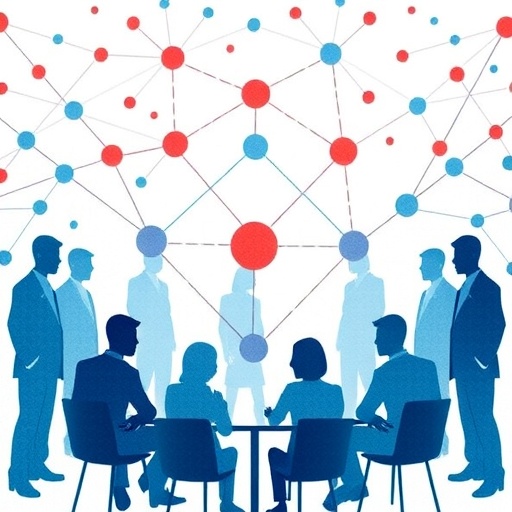
In the intricate dance of human social interaction, understanding the unseen architecture that governs group dynamics presents one of the most challenging frontiers in cognitive science. A groundbreaking study, published in Nature Communications in 2026 by Davis, Jara-Ettinger, and Dunham, unveils a novel approach to deciphering the internal structure of groups by merging statistical learning with causal reasoning. This integration offers unprecedented insight into how individuals intuitively infer the latent frameworks within which social entities operate, promising profound implications for fields ranging from psychology and sociology to artificial intelligence.
At the heart of this study lies a compelling question: how do people, often implicitly and with limited data, grasp the underlying structure of complex groups? Traditional approaches have largely treated the problem through the lens of either statistical pattern recognition or causal inference alone. However, the authors argue that these two cognitive processes must work in tandem to yield a nuanced understanding. Statistical learning enables the detection of patterns and regularities, but without causal reasoning, these patterns remain superficial. Conversely, causal reasoning without statistical grounding risks being speculative. By integrating these cognitive strategies, the research presents a powerful framework for revealing the hidden scaffolding of group interactions.
The researchers employed sophisticated computational models that simulate how humans might learn group structures from observed social behaviors and interactions. These models are capable of capturing both the probabilistic associations between individuals—such as who tends to interact with whom—and the causal relationships that explain why these interactions occur in a particular manner. Through iterative learning processes, the artificial systems iteratively refine their understanding, aligning more closely with human intuition about group membership and roles.
An essential innovation in this work is the operationalization of causal reasoning within a statistical learning paradigm. The team used Bayesian inference methods, which are particularly well-suited to integrate prior knowledge with incoming data, to mimic human predictive capabilities. This allows the model not only to detect that certain individuals form a cohesive subgroup but also to infer the underlying causes—be they shared goals, hierarchical structures, or communication pathways—that bring them together. This dual capacity bridges a critical gap between observable social phenomena and the latent mechanisms driving them.
Experiments conducted with human participants validated the computational models, providing robust evidence that people indeed integrate statistical evidence with causal reasoning when interpreting group structures. Participants were presented with scenarios involving social networks, varying in complexity and transparency, and asked to identify subgroup boundaries and hierarchies. Their responses closely mirrored the model predictions, confirming the psychological plausibility of the proposed framework. This validation underscores the potential for these findings to inform not only theoretical paradigms but also practical applications in social cognition.
The implications for artificial intelligence are particularly striking. Current AI systems often struggle with understanding and predicting social group formation, as they typically rely on either purely statistical approaches such as clustering algorithms or rule-based causal models. The hybrid approach showcased here offers a template for designing AI that better emulates human social reasoning, enabling machines to navigate social contexts with greater subtlety and accuracy, from robotic team collaboration to advanced social media analytics.
Moreover, the insights gained from this research could revolutionize educational and organizational strategies. In education, understanding how students perceive group dynamics can inform collaborative learning frameworks, optimizing team formation to enhance engagement and learning outcomes. Similarly, organizational leaders might develop more effective team-building practices by recognizing the causal underpinnings of natural group structures, leading to more cohesive and productive work units.
This research also opens the door to novel interventions in mental health, particularly in disorders where social cognition is impaired, such as autism spectrum conditions. By elucidating the cognitive mechanisms through which group perceptions are constructed, targeted therapies can be developed to support individuals struggling to navigate social complexities, thereby improving their social integration and quality of life.
The methodology behind this work is equally notable for its rigor and versatility. The models were tested against a wide array of group formation scenarios, including cases with ambiguous boundaries, overlapping memberships, and dynamic evolution over time. Such extensive testing ensures that the framework is not confined to simplistic or idealized groups but is applicable to the messy, fluid social realities that characterize human interactions.
An additional strength of the study is its interdisciplinary nature, bridging cognitive psychology, computational modeling, and social science. By synthesizing perspectives and methodologies from these diverse fields, the researchers constructed a robust theoretical architecture capable of addressing a multifaceted problem. This cross-pollination exemplifies the future of scientific inquiry, where complex societal questions demand collaboratively crafted solutions.
The study also draws attention to a fundamental aspect of human cognition: the drive to infer causality as a means of understanding and predicting the social environment. Unlike mere pattern detection, causal reasoning imbues the social landscape with meaning, allowing individuals to anticipate changes, assign responsibility, and navigate social hierarchies. By capturing this process computationally, the research not only enhances our theoretical comprehension but also equips technology to resonate with inherently human modes of thought.
While the study marks a significant advance, it also paves the way for future inquiries. One avenue for extension involves scaling the models to accommodate vast, real-world social networks, including online communities where group boundaries are often nebulous and multifaceted. Incorporating temporal dynamics more explicitly could further refine predictions about the evolution of group structures. Additionally, integrating emotional and motivational dimensions of social behavior might yield even richer models that approach the full complexity of human sociality.
From a philosophical standpoint, the findings invite reconsideration of how we conceptualize social groups themselves. If internal structure emerges as a product of intertwined statistical and causal processes, then group membership is less a fixed attribute and more a dynamic construct continuously negotiated by individuals’ perceptions and interactions. This perspective aligns with contemporary social theories emphasizing fluidity and context-dependence in social identities.
In sum, Davis, Jara-Ettinger, and Dunham’s innovative study offers a compelling framework that fuses statistical learning with causal reasoning to unlock the hidden architectures of social groups. By capturing the cognitive underpinnings of how humans perceive and interpret group structures, the research provides both theoretical insight and practical tools with far-reaching implications. As social interactions become increasingly mediated by technology, understanding these mechanisms will be essential for fostering harmonious, effective human-machine collaboration and for advancing our broader grasp of social cognition.
The integration of statistical and causal approaches represents a paradigm shift, signaling a move toward more holistic models of cognition and social understanding. In a world where social groups shape identities, influence decisions, and drive collective action, decoding their internal fabric stands as a critical endeavor. This study not only illuminates that fabric but also charts a path forward, guiding researchers and practitioners alike toward deeper engagement with the complexities of group life.
Subject of Research:
Article Title:
Article References:
Davis, I., Jara-Ettinger, J. & Dunham, Y. Inferring the internal structure of groups through the integration of statistical learning and causal reasoning. Nat Commun (2026). https://doi.org/10.1038/s41467-026-68754-0
Image Credits: AI Generated
Tags: artificial intelligence and social understandingcausal reasoning in human interactioncognitive processes in group dynamicsgroup dynamics analysisimplications of group architectureinterdisciplinary approach to group behaviorlatent frameworks in social entitiesmerging statistical and causal insightsnovel methodologies in social researchstatistical learning in social psychologystudying human social interactionunderstanding group structures in cognitive science