A research team led by Peter M. Simon, Maximilian Berndt, Marius Schmitz, Marcel Wagner, and Jan C. Aurich has demonstrated a digital twin framework for drilling tool condition monitoring that identifies progressive wear and sudden failure using an unsupervised convolutional autoencoder. In conventional industrial manufacturing, cutting tools are frequently discarded after consuming only fifty to eighty percent of their useful operating life to avert unpredicted breakage, or conversely run past optimal boundaries and risk catastrophic failure. By integrating an unsupervised neural network that trains exclusively on regular operating signals, the researchers established an anomaly detection system capable of monitoring tool degradation and transferring across distinct workpiece alloys and cutting parameters without requiring labeled failure datasets or destructive run-to-failure experiments.
Tool condition monitoring serves as an essential component of modern machining operations, yet conventional implementations face practical deployment barriers on the factory floor. Traditional direct wear measurements necessitate stopping production machinery to perform microscopic optical assessments, causing substantial downtime. Indirect monitoring techniques that record physical signals such as cutting forces, acoustic emissions, or vibrations often demand intrusive, costly sensors that are challenging to deploy across brownfield industrial fleets. Furthermore, typical data-driven monitoring models rely on supervised learning paradigms that require extensive libraries of labeled wear measurements and run-to-failure records. In industrial drilling, where tools experience combinations of gradual flank wear and sudden shaft fractures, obtaining comprehensive failure labels across diverse cutting regimes remains technically difficult and commercially prohibitive.
To overcome these integration challenges, the researchers formulated a five-dimensional digital twin architecture based on physical entities, virtual representations, digital storage, services, and communication links. Rather than striving for fully automated closed-loop machine control that bypasses human judgment, the framework establishes a closed human-in-the-loop control interface. Preprocessed sensor measurements stream from physical cutting machinery to an edge computational device, where the virtual model calculates wear-sensitive metrics. The service layer interprets these quantitative analytical signals against statistical decision thresholds and communicates recommended tool replacements to human machine operators. This design maintains operator oversight, enabling technicians to integrate contextual production schedules and qualitative workpiece demands while operating within brownfield shop-floor constraints.
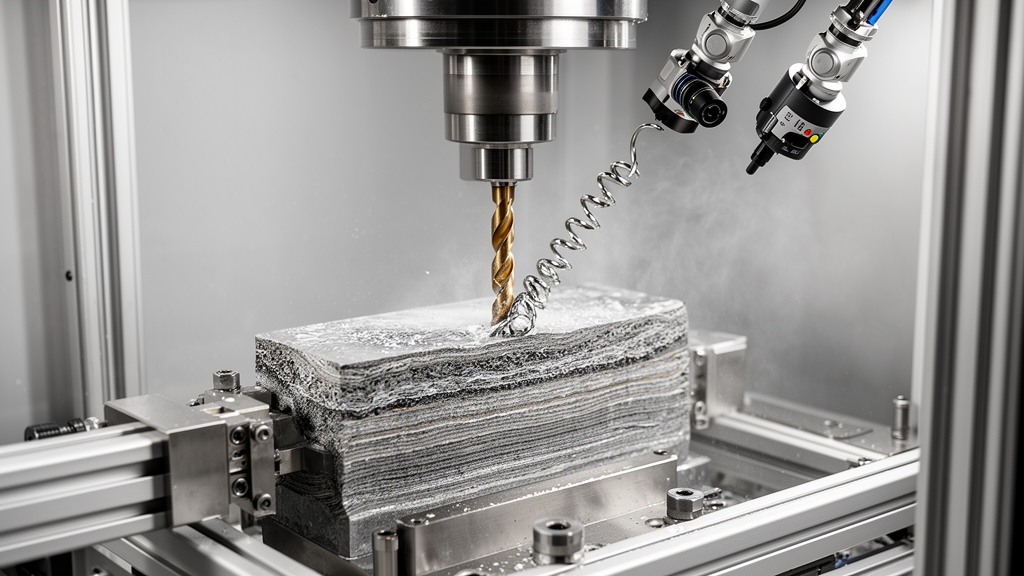
The physical validation of the framework was conducted on a five-axis Deckel Maho Gildemeister DMU 70 eVolution machining center. The baseline experimental trials utilized pre-hardened Toolox33 tool steel workpieces measuring 270 by 260 by 30 millimeters. Blind holes with a depth of 24 millimeters were machined using an AlTiN-coated cemented carbide twist drill with an eight-millimeter diameter, two cutting edges, a point angle of 140 degrees, a helix angle of 30 degrees, a primary clearance angle of 10 degrees, and a secondary clearance angle of 25 degrees. The operational cutting speed was set to 100 meters per minute with a feed rate of 0.15 millimeters per revolution. Machining operations continued through tool life until complete shaft shear fracture occurred after 5,950 consecutive drilling operations, encompassing a total feed path of approximately 142.8 meters.
Data acquisition was achieved using non-invasive current transformers installed between the machine frequency converter and the electric motor drives, avoiding expensive external force dynamometers. Two transformers recorded phase currents of the spindle and the feed-axis drive at a sampling rate of 10 kilohertz. The recorded signals were conditioned with a low-pass filter set at a cutoff frequency of 500 hertz and uniformly downsampled to 500 hertz to compress transmission volume while preserving signal waveforms. Using Kirchhoff’s current law, the third phase current was calculated from the measured phases, and an orthogonal Clarke transformation was computed to derive the absolute current magnitude. This Clarke-transformed scalar current served as the primary process representation, capturing wear-dependent electrical load dynamics directly from standard motor wiring.
The virtual entity incorporates a one-dimensional convolutional autoencoder developed to learn the compact structural characteristics of normal machining. The network encoder comprises two strided convolutional layers with 16 and 32 filters, using kernel sizes of seven and five, batch normalization, and rectified linear unit activations. This feeds into a 32-dimensional dense bottleneck layer that compresses the signal representations, followed by a mirrored decoder employing transposed convolutions and a final sigmoid activation function. The model was trained using the AdamW optimizer and mean squared error reconstruction loss on 256-sample segments extracted exclusively from steady-state cutting phases. To isolate steady-state drilling from entry and exit transients, binary segmentation change point detection was executed on the smoothed spindle current, after which the corresponding feed-axis absolute current segments were processed.
Transforming continuous model reconstruction errors into reliable tool replacement advice required a dedicated multi-stage service algorithm. For each hole drilled, the service extracts the maximum jump feature, defined as the largest absolute difference between reconstruction errors of consecutive windows within the operation. A sliding window of five operations calculates the change rate of this feature, functioning as a high-pass filter that suppresses gradual baseline thermal drift while amplifying rapid variations. An adaptive detection threshold is derived from the baseline mean plus a scaled standard deviation using a sensitivity multiplier set to ten. To eliminate spurious false alarms caused by transient chip evacuation anomalies or material inhomogeneities, a persistence rule mandates that at least three out of ten consecutive drilling cycles must surpass the threshold before an actionable tool replacement recommendation is triggered.
Evaluated on the 5,950-hole reference dataset, the persistent change-rate service signaled anomalous tool deterioration at 81.2 percent of the tool’s total operational life, leaving approximately 26.8 meters of remaining feed path and 1,119 drilling cycles as a safe operational margin prior to structural breakage. In comparison, direct application of a standard statistical threshold to raw mean reconstruction errors produced an overly conservative warning at only 33.6 percent of tool life, leaving substantial tooling capacity unutilized. Microscopic photographic inspection of the cutting edges confirmed that early holes exhibited pristine geometry, initial flank deterioration emerged near 67 meters of feed path, and substantial cutting edge material loss developed past 100 meters, mirroring the progressive rise in autoencoder reconstruction error.
To evaluate model transferability without parameter retuning, the identical configuration was applied to two independent validation datasets involving 1.4404 AISI 316L austenitic stainless steel. Machining parameters were altered to a reduced cutting speed of 60 meters per minute and feed rates of 0.15 and 0.20 millimeters per revolution, reaching tool failure at 43.0 meters (1,791 holes) and 25.5 meters (1,064 holes). Unlike the gradual wear seen in tool steel, stainless steel machining triggered sudden catastrophic breakage. The autoencoder system maintained zero false positives throughout the stable cutting periods and signaled anomalies at 95.4 percent and 98.7 percent of tool life, providing warning margins of approximately 82 and 14 operations prior to failure. A conventional root mean square current baseline failed to generalize across these conditions, producing premature warnings or missing sudden failures entirely due to elevated baseline variance in stainless steel.
The authors note several technical boundaries in their experimental investigation. While the model successfully transferred across two distinct workpiece metals and differing cutting speeds without recalibration, the empirical evaluation was confined to a single tool diameter of eight millimeters and a single machine tool center. The analysis was also conducted offline on recorded operational data, meaning that live multi-machine latency and edge data throughput remain to be evaluated in continuous factory production. Additionally, monitoring relied exclusively on motor current measurements during steady-state cutting phases, excluding entry transients and non-cutting machine downtime. Future research directions outlined by the authors include deploying the architecture across multiple tool geometries, integrating complementary acoustic emission or vibration sensors, and investigating standardized Asset Administration Shell submodels for fleet-level industrial implementations.
Subject of Research: Digital twin and unsupervised anomaly detection for drilling tool condition monitoring
Article Title: Towards the digital twin of a cutting tool: Evaluation of an anomaly detection based drilling tool condition monitoring system
Article References: Simon, P. M., Berndt, M., Schmitz, M., Wagner, M., & Aurich, J. C. (2027). Towards the digital twin of a cutting tool: Evaluation of an anomaly detection based drilling tool condition monitoring system. Digital Engineering, 12, Article 100130. https://doi.org/10.1016/j.dte.2026.100130
Image Credits: AI Generated
DOI: 10.1016/j.dte.2026.100130
Keywords: Digital Twin, Tool Condition Monitoring, Anomaly Detection, Convolutional Autoencoder, Drilling Operations, Motor Current, Manufacturing Engineering, Predictive Maintenance, Edge Computing, Statistical Process Control, Workpiece Materials, Tool Wear, Industry 4.0, Machine Learning, PyTorch, ONNX, Shewhart Limits
News Source: Denise Maddox. (November 26, 2026). Unsupervised Autoencoder Detects Drilling Anomalies Across Materials Without Failure Training. Scienmag.