• HOME
  • NEWS
  • EXPLORE
    • CAREER
      • Companies
      • Jobs
    • EVENTS
    • iGEM
      • News
      • Team
    • PHOTOS
    • VIDEO
    • WIKI
  • BLOG
  • COMMUNITY
    • FACEBOOK
    • INSTAGRAM
    • TWITTER
Saturday, March 28, 2026
BIOENGINEER.ORG
No Result
View All Result
  • Login
  • HOME
  • NEWS
  • EXPLORE
    • CAREER
      • Companies
      • Jobs
        • Lecturer
        • PhD Studentship
        • Postdoc
        • Research Assistant
    • EVENTS
    • iGEM
      • News
      • Team
    • PHOTOS
    • VIDEO
    • WIKI
  • BLOG
  • COMMUNITY
    • FACEBOOK
    • INSTAGRAM
    • TWITTER
  • HOME
  • NEWS
  • EXPLORE
    • CAREER
      • Companies
      • Jobs
        • Lecturer
        • PhD Studentship
        • Postdoc
        • Research Assistant
    • EVENTS
    • iGEM
      • News
      • Team
    • PHOTOS
    • VIDEO
    • WIKI
  • BLOG
  • COMMUNITY
    • FACEBOOK
    • INSTAGRAM
    • TWITTER
No Result
View All Result
Bioengineer.org
No Result
View All Result
Home NEWS Science News Chemistry

Unraveling the optical parameters: New method to optimize plasmon enhanced spectroscopy

Bioengineer by Bioengineer
March 19, 2020
in Chemistry
Reading Time: 2 mins read
0
IMAGE
Share on FacebookShare on TwitterShare on LinkedinShare on RedditShare on Telegram

IMAGE

Credit: by Marie Richard-Lacroix and Volker Deckert


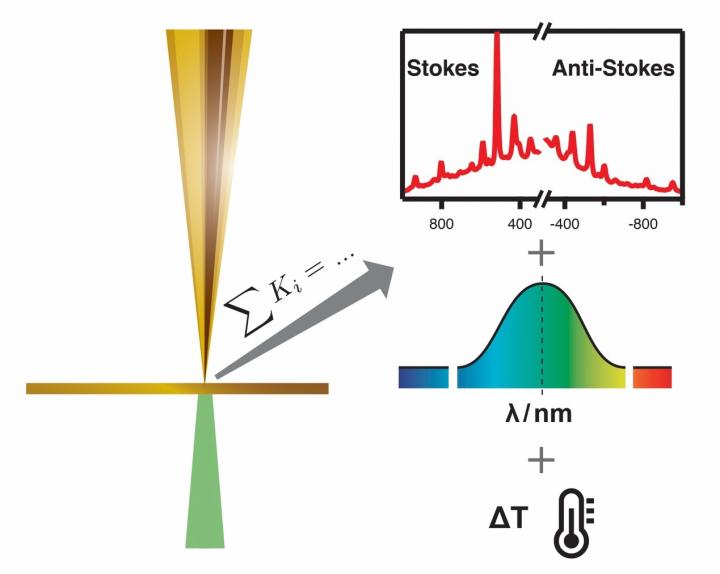
For exploring the nanoscale far beyond the optical resolution limit, tip-enhanced Raman spectroscopy (TERS) is widely recognized as an essential yet still emergent technique. Using this marker-free spectroscopic method scientists gain insights into the structural and chemical composition of surfaces with nanoscale resolution, which are not accessible with other methods. Examples where such nanoscale resolution spectroscopies are crucial are structure investigations, of novel materials (e.g. diamond layers, 2D materials etc.), of protein aggregates, discussed as triggers for diseases like diabetes type II or Alzheimer’s, or even of catalytical reactions at work. However, scientists’ lack of comprehension of crucial parameters of the actual probe still limits the potential of TERS as a user-friendly analytical tool. Until now scientists have not been able to unravel the most fundamentally relevant experimental parameters as the tip’s surface plasmon resonance, heating due to near-field temperature rise, and the link towards spatial resolution.

In a new paper in “Light: Science & Application”, a research team from Jena, Germany now presents the first accessible method to gain unprecedented insights into the plasmonic activity of a single nanoparticle during a typical TERS experiment. Prof. Volker Deckert from the Leibniz Institute of Photonic Technology, Jena, and Dr. Marie Richard-Lacroix from the Friedrich Schiller University Jena propose a straightforward and purely experimental method to assess the plasmon resonance and near-field temperature experienced exclusively by the molecules directly contributing to the TERS signal. Using standard TERS experimental equipment, the scientists evaluate the detailed near-field optical response, both at the molecular level and as a function of time by probing simultaneously the Stokes and anti-Stokes spectral intensities. This enables them to characterize the optical properties of each individual TERS tip during the measurement.

“The proposed method could be a major step to improve the usability of TERS in day-to-day operation”, Prof. Deckert explains. “The actual conditions to which the molecules are submitted from one experiment to the next can now be investigated and optimized directly, in real-time, and at the sample scale.” This is especially relevant when it comes to examining biological samples like e.g. proteins which cannot tolerate high temperatures.

“To the best of our knowledge, no other accessible methodology opens up access to such a wealth of information on the plasmonic activity during a typical TERS experiment”, Dr. Richard-Lacroix says.

“We believe that this methodology will contribute to improve the accuracy of theoretical models and facilitate any experimental plasmonic investigation and the application of TERS in the field of nanoscale thermometry”, the scientists foresee.

###

Media Contact
Marie Richard-Lacroix
[email protected]

Related Journal Article

http://dx.doi.org/10.1038/s41377-020-0260-9

Tags: Chemistry/Physics/Materials SciencesOptics
Share13Tweet8Share2ShareShareShare2

Related Posts

Isolated H2-Reduced Clusters Boost CO2-to-Methanol Catalysis

Isolated H2-Reduced Clusters Boost CO2-to-Methanol Catalysis

March 25, 2026
blank

Physicists Identify Electronic Drivers Behind Flat Band Quantum Materials

March 21, 2026

Würzburg Chemistry Professor Claudia Höbartner Receives Prestigious Honor

March 20, 2026

Scientists Reveal How Magnets Control Metamaterial Behavior

March 20, 2026
Please login to join discussion

POPULAR NEWS

  • blank

    Revolutionary AI Model Enhances Precision in Detecting Food Contamination

    96 shares
    Share 38 Tweet 24
  • Imagine a Social Media Feed That Challenges Your Views Instead of Reinforcing Them

    1003 shares
    Share 397 Tweet 248
  • Uncovering Functions of Cavernous Malformation Proteins in Organoids

    54 shares
    Share 22 Tweet 14
  • Promising Outcomes from First Clinical Trials of Gene Regulation in Epilepsy

    51 shares
    Share 20 Tweet 13

About

We bring you the latest biotechnology news from best research centers and universities around the world. Check our website.

Follow us

Recent News

In-Sensor Cryptography Links Physical Process to Digital Identity

Can Psychosocial Factors Influence Cancer Risk?

Depression Factors in Elderly: Pre vs. Post-COVID Analysis

Subscribe to Blog via Email

Success! An email was just sent to confirm your subscription. Please find the email now and click 'Confirm' to start subscribing.

Join 78 other subscribers
  • Contact Us

Bioengineer.org © Copyright 2023 All Rights Reserved.

Welcome Back!

Login to your account below

Forgotten Password?

Retrieve your password

Please enter your username or email address to reset your password.

Log In
No Result
View All Result
  • Homepages
    • Home Page 1
    • Home Page 2
  • News
  • National
  • Business
  • Health
  • Lifestyle
  • Science

Bioengineer.org © Copyright 2023 All Rights Reserved.