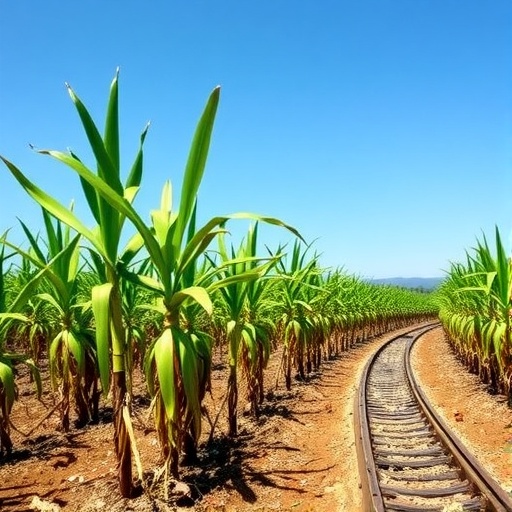
In a groundbreaking study published in Nature, researchers have illuminated the intricate genetic foundations that underpin modern sugarcane cultivars, revealing the pivotal role of the cultivar POJ2878 within global breeding programs. This comprehensive investigation encompassed 573 geographically diverse sugarcane samples, meticulously dissecting the genetic contributions of POJ2878 and unveiling breeder-favored haplotypes that drive important agronomic traits such as sucrose accumulation and environmental adaptability.
The study harnessed identity-by-descent (IBD) analysis, a cutting-edge genomic tool, to quantify shared genetic segments between POJ2878 and numerous global cultivars. Astonishingly, over 95% of the cultivars exhibited more than 821.6 megabases (Mb) of shared IBD sequences with POJ2878. This finding underscores POJ2878’s entrenched presence in sugarcane breeding worldwide, serving as an invaluable genetic reservoir from which breeders have drawn extensively.
Genome-wide patterns further revealed that POJ2878’s genetic influence permeates an impressive 98.15% of the sugarcane genomic landscape across various cultivars. The densest 5% of IBD regions, spanning nearly 475 Mb, were identified as hotspots harboring over 28,000 protein-coding genes. These regions represent breeder-favored haplotypes selectively retained during domestication and cultivar improvement due to their positive contributions to yield and stress resilience.
Notably, the genes embedded in these haplotype-rich loci are significantly enriched for biological processes directly related to starch and sucrose metabolism—pathways critical for sugarcane’s economic value. Key enzymatic players such as sucrose synthase (SUS), sucrose-phosphate phosphatase (SPP), and sucrose phosphate synthase (SPS), alongside sucrose transporter proteins SWEET14, SWEET15, and SUT, were prominent within these regions. Their collective functional repertoire facilitates efficient carbohydrate synthesis and transport, optimizing sucrose accumulation.
Crucially, the researchers performed allele-specific expression profiling across vital sugarcane tissues—including stems and leaves—to determine functional activity of these haplotypes. Results indicated that many of these preferred haplotypes exhibited active transcription but did not necessarily represent the highest or lowest expression levels among alternative alleles. This nuanced expression dynamic highlights a balance exploited by breeders—a reservoir of variant alleles that may contribute variably to overall metabolic flux and plant development.
A particularly compelling case emerged around the SUS2 gene, which presents four distinct haplotypes arising from the two progenitor subgenomes: a single favorable haplotype from Saccharum spontaneum (Ss_hap1) and three from S. officinarum (So_hap1–3). This Ss_hap1 haplotype harbors hallmark structural variants including a 27-base pair insertion and a 255-base pair deletion within coding exons, which the researchers uniquely tracked using k-mer analysis for copy number estimation.
Strikingly, the copy number of Ss_hap1 across cultivars was strongly correlated with sucrose content measured 270 days post-planting. Cultivars carrying between one and three copies displayed notably higher sugar levels, evidencing this haplotype’s functional advantage. However, intriguingly, greater copy numbers beyond this threshold did not proportionally augment sucrose content, suggesting that excessive S. spontaneum genetic contributions might impose detrimental effects on complex polyploid sugarcane physiology.
Further dissection of population structure unveiled marked differences in POJ2878 utilization between Chinese and non-Chinese cultivars. Non-Chinese cultivars exhibited significantly higher average IBD densities (~0.20) compared to Chinese counterparts (~0.18), reflecting broader integration of POJ2878 genomic segments outside China. Moreover, the nature of selected genomic regions diverged, with Chinese breeding programs enriching for genes responsive to herbicide treatment, while non-Chinese programs favored genes involved in abiotic stress response pathways.
This divergence in selective pressures underscores region-specific adaptation strategies within global breeding schemes, revealing how local agroecological contexts shape the exploitation of shared genetic resources. Collectively, these insights expose POJ2878’s depth of influence in modern sugarcane genetic architecture and highlight the complex interplay of haplotype variation, gene expression, and trait optimization in a polyploid framework.
The technological advancements used in this research, including large-scale IBD mapping, haplotype phasing, and allele-specific expression analyses, set new benchmarks for dissecting the polyploid genomes typical of important crops like sugarcane. By linking structural genomic variation with phenotypic traits such as sucrose yield, this work provides a compelling template for precision breeding that navigates the complexities of polyploidy and heterozygosity.
Furthermore, the revelation that breeder-favored haplotypes are not always associated with maximal gene expression invites re-evaluation of traditional breeding paradigms, placing emphasis on haplotype balance and nuanced regulatory control over simple expression magnitude. This could encourage breeders to exploit intermediate alleles and alternative haplotypes with untapped potential, fostering greater genetic diversity and resilience.
The discovery of extensive IBD sharing across global populations also opens avenues for global cooperation in sugarcane improvement, leveraging POJ2878 as a genetic cornerstone. Breeders might harness these insights to accelerate the introgression of valuable haplotypes into emerging cultivars while fine-tuning genomic compositions to local environmental constraints and agricultural practices.
In conclusion, this seminal study provides a detailed molecular roadmap charting how a single cultivar, POJ2878, has shaped the genomics of sugarcane production worldwide. Through comprehensive genomics, functional analyses, and population comparisons, the research dissects key haplotypes controlling sucrose metabolism and environmental adaptability, laying fertile ground for next-generation sugarcane breeding that blends tradition with innovation within a complex polyploid genetic framework.
Subject of Research: Genetic architecture and contribution of the sugarcane cultivar POJ2878 to modern cultivars.
Article Title: Genetic architecture of sugarcane traits in a polyploid genomics framework.
Article References:
Wang, J., Li, X., Wang, Y. et al. Genetic architecture of sugarcane traits in a polyploid genomics framework. Nature (2026). https://doi.org/10.1038/s41586-026-10576-7
DOI: https://doi.org/10.1038/s41586-026-10576-7
Tags: breeder-favored haplotypes in cropsenvironmental adaptability in sugarcanegenome-wide sugarcane genetic patternshaplotype mapping in sugarcaneidentity-by-descent analysis in cropsPOJ2878 sugarcane cultivarsucrose accumulation geneticssugarcane breeding programssugarcane domestication geneticssugarcane genetic diversitysugarcane polyploid genomicssugarcane stress resilience genes