• HOME
  • NEWS
  • EXPLORE
    • CAREER
      • Companies
      • Jobs
    • EVENTS
    • iGEM
      • News
      • Team
    • PHOTOS
    • VIDEO
    • WIKI
  • BLOG
  • COMMUNITY
    • FACEBOOK
    • INSTAGRAM
    • TWITTER
Saturday, February 7, 2026
BIOENGINEER.ORG
No Result
View All Result
  • Login
  • HOME
  • NEWS
  • EXPLORE
    • CAREER
      • Companies
      • Jobs
        • Lecturer
        • PhD Studentship
        • Postdoc
        • Research Assistant
    • EVENTS
    • iGEM
      • News
      • Team
    • PHOTOS
    • VIDEO
    • WIKI
  • BLOG
  • COMMUNITY
    • FACEBOOK
    • INSTAGRAM
    • TWITTER
  • HOME
  • NEWS
  • EXPLORE
    • CAREER
      • Companies
      • Jobs
        • Lecturer
        • PhD Studentship
        • Postdoc
        • Research Assistant
    • EVENTS
    • iGEM
      • News
      • Team
    • PHOTOS
    • VIDEO
    • WIKI
  • BLOG
  • COMMUNITY
    • FACEBOOK
    • INSTAGRAM
    • TWITTER
No Result
View All Result
Bioengineer.org
No Result
View All Result
Home NEWS Science News Chemistry

Unraveling gene expression

Bioengineer by Bioengineer
November 21, 2019
in Chemistry
Reading Time: 2 mins read
0
IMAGE
Share on FacebookShare on TwitterShare on LinkedinShare on RedditShare on Telegram

IMAGE

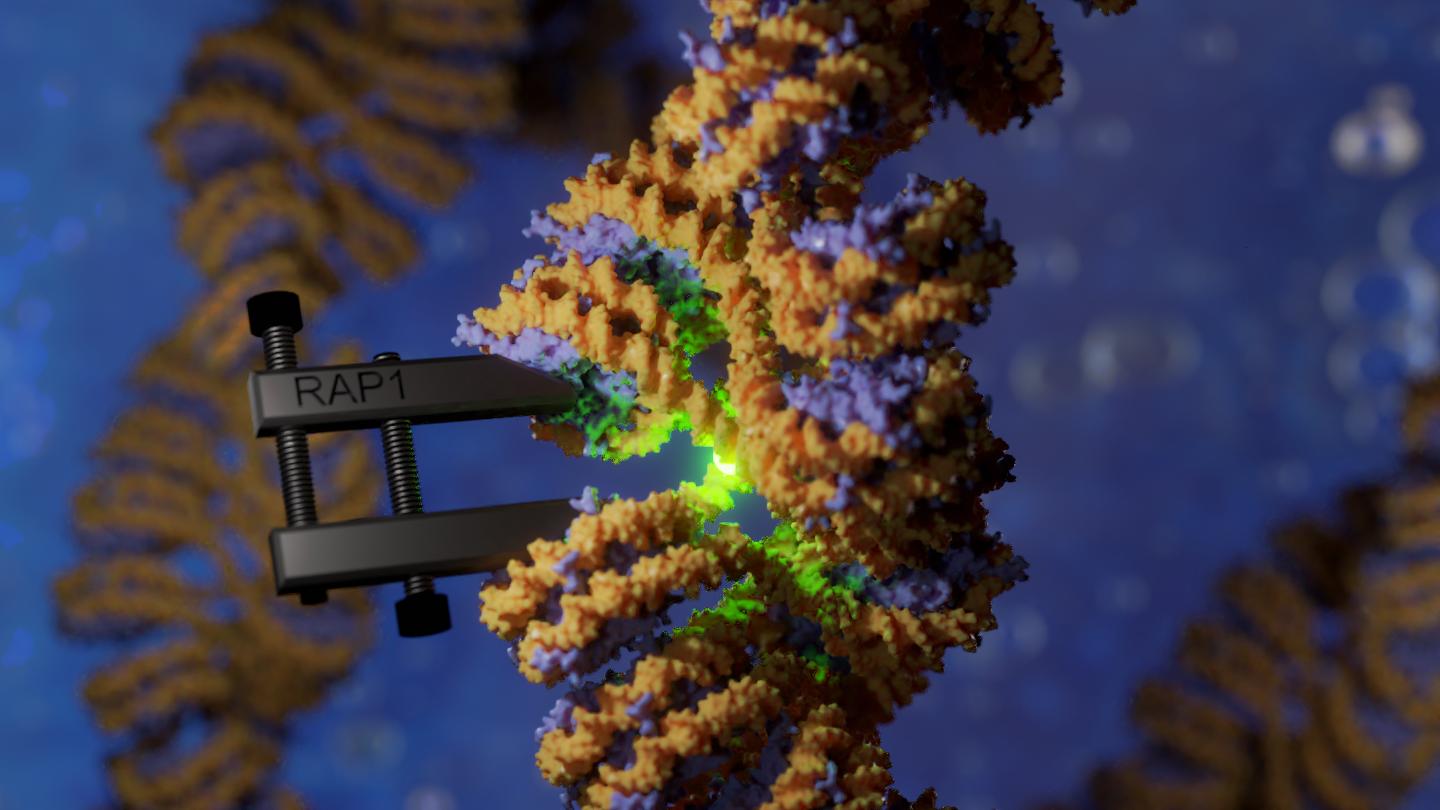
Credit: Beat Fierz, EPFL


The DNA of a single cell is 2-3 meters long end-to-end. To fit and function, DNA is packaged around specialized proteins. These DNA-protein complexes are called nucleosomes, and they are a small part of a larger structure called chromatin. Nucleosomes can be thought of as the cell’s DNA storage and protection unit.

When a particular gene needs to be expressed, the cell requires access to the protected DNA within chromatin. This means that the chromatin structure must be opened and the nucleosomes must be removed to expose the underlying target gene.

This takes place in the orchestrated process of “chromatin remodeling”, which regulates gene expression and involves a multitude of actors. Unravelling this pivotal step not only furthers our fundamental understanding, but may also help in the development of genetic engineering tools.

Now the lab of Beat Fierz at EPFL, has been able to uncover the first steps in the chromatin-opening process at the level of a single molecule, using a combination of chemical biology and biophysical methods. Published in Molecular Cell, the work looks at the role of a group of proteins called “pioneer transcription factors”. These proteins bind to specific DNA regions within chromatin that are themselves shielded from other proteins. Little is known about how these factors overcome the barriers of the chromatin maze.

Fierz’s lab looked at yeast, which is a model organism for human genetics. The method involved replicating the architecture of yeast genes, combined with single-molecule fluorescence. The researchers studied a yeast pioneer transcription factor called Rap1, and found that it choreographs chromatin remodeling, allowing access to other proteins required for gene expression that were previously obstructed.

To do this, Rap1 first binds chromatin and then influences the action of a large molecular machine called “Remodeling the Structure of Chromatin” (RSC), displacing nucleosomes and paving the way to the now-exposed DNA for other proteins involved in controlling gene expression.

By revealing the physico-chemical mechanism of how Rap1 gains access to chromatin and opens it up, the EPFL study proposes a biological model for other pioneer transcription factors, but also provides the tools for investigating them at the level of a single molecule.

###

Other contributors

University of Geneva

Ludwig Maximilian University of Munich

Reference

Maxime Mivelaz, Anne-Marinette Cao, Slawomir Kubik, Sevil Zencir, Ruud Hovius, Iuliia Boichenko, Anna Maria Stachowicz, Christoph F. Kurat, David Shore, Beat Fierz. Chromatin fiber invasion and nucleosome displacement by the Rap1 transcription factor. Molecular Cell 21 November 2019. DOI: 10.1016/j.molcel.2019.10.025

Media Contact
Nik Papageorgiou
[email protected]
41-216-932-105

Related Journal Article

http://dx.doi.org/10.1016/j.molcel.2019.10.025

Tags: BiochemistryBiologyBiomechanics/BiophysicsCell BiologyChemistry/Physics/Materials SciencesGeneticsMolecular Biology
Share12Tweet8Share2ShareShareShare2

Related Posts

blank

Breakthrough in Environmental Cleanup: Scientists Develop Solar-Activated Biochar for Faster Remediation

February 7, 2026
blank

Cutting Costs: Making Hydrogen Fuel Cells More Affordable

February 6, 2026

Scientists Develop Hand-Held “Levitating” Time Crystals

February 6, 2026

Observing a Key Green-Energy Catalyst Dissolve Atom by Atom

February 6, 2026
Please login to join discussion

POPULAR NEWS

  • Robotic Ureteral Reconstruction: A Novel Approach

    Robotic Ureteral Reconstruction: A Novel Approach

    82 shares
    Share 33 Tweet 21
  • Digital Privacy: Health Data Control in Incarceration

    63 shares
    Share 25 Tweet 16
  • Study Reveals Lipid Accumulation in ME/CFS Cells

    57 shares
    Share 23 Tweet 14
  • Breakthrough in RNA Research Accelerates Medical Innovations Timeline

    53 shares
    Share 21 Tweet 13

About

We bring you the latest biotechnology news from best research centers and universities around the world. Check our website.

Follow us

Recent News

Decoding Prostate Cancer Origins via snFLARE-seq, mxFRIZNGRND

Digital Health Perspectives from Baltic Sea Experts

Florida Cane Toad: Complex Spread and Selective Evolution

Subscribe to Blog via Email

Enter your email address to subscribe to this blog and receive notifications of new posts by email.

Join 73 other subscribers
  • Contact Us

Bioengineer.org © Copyright 2023 All Rights Reserved.

Welcome Back!

Login to your account below

Forgotten Password?

Retrieve your password

Please enter your username or email address to reset your password.

Log In
No Result
View All Result
  • Homepages
    • Home Page 1
    • Home Page 2
  • News
  • National
  • Business
  • Health
  • Lifestyle
  • Science

Bioengineer.org © Copyright 2023 All Rights Reserved.