• HOME
  • NEWS
  • EXPLORE
    • CAREER
      • Companies
      • Jobs
    • EVENTS
    • iGEM
      • News
      • Team
    • PHOTOS
    • VIDEO
    • WIKI
  • BLOG
  • COMMUNITY
    • FACEBOOK
    • INSTAGRAM
    • TWITTER
Monday, October 5, 2026
BIOENGINEER.ORG
No Result
View All Result
  • Login
  • HOME
  • NEWS
  • EXPLORE
    • CAREER
      • Companies
      • Jobs
        • Lecturer
        • PhD Studentship
        • Postdoc
        • Research Assistant
    • EVENTS
    • iGEM
      • News
      • Team
    • PHOTOS
    • VIDEO
    • WIKI
  • BLOG
  • COMMUNITY
    • FACEBOOK
    • INSTAGRAM
    • TWITTER
  • HOME
  • NEWS
  • EXPLORE
    • CAREER
      • Companies
      • Jobs
        • Lecturer
        • PhD Studentship
        • Postdoc
        • Research Assistant
    • EVENTS
    • iGEM
      • News
      • Team
    • PHOTOS
    • VIDEO
    • WIKI
  • BLOG
  • COMMUNITY
    • FACEBOOK
    • INSTAGRAM
    • TWITTER
No Result
View All Result
Bioengineer.org
No Result
View All Result
Home NEWS Science News Chemistry

University of Notre Dame-developed home lead screening kits shown to be highly accurate

Bioengineer by Bioengineer
February 13, 2020
in Chemistry
Reading Time: 3 mins read
0
IMAGE
Share on FacebookShare on TwitterShare on LinkedinShare on RedditShare on Telegram

IMAGE

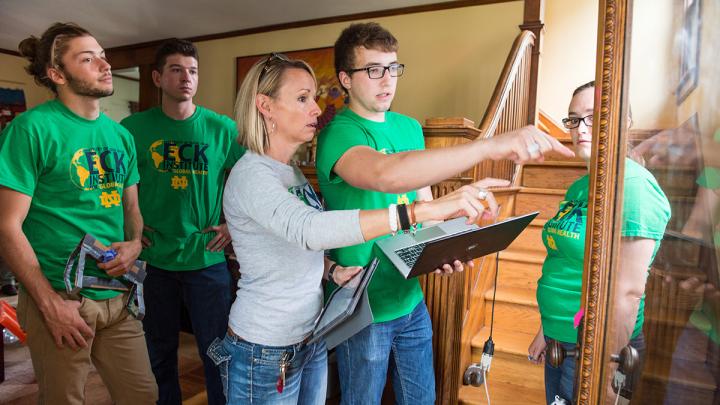
Credit: Photo by Barbara Johnston/University of Notre Dame.

An inexpensive lead sample collection kit distributed to homes in St. Joseph County is comparable in accuracy and sensitivity to more costly in-home analysis, according to research published this month in the Journal of Environmental Research.

The Notre Dame Lead Innovation Team (ND LIT), central to the research, began its focus in 2016 to uncover hidden lead threats in homes before children are poisoned from their environments. The team is ready to take the next step toward distributing the screening kits for eventual nationwide use.

“Folks don’t have an inexpensive or quick method to test for lead,” said Heidi Beidinger-Burnett, assistant professor in the Department of Biological Sciences. “You have to call the health department, and it takes weeks to complete the entire process. Or if you have some money, it’s $200 to $300 to have a private risk assessor come out to your house.”

With the kit developed at Notre Dame — which costs about $10 to manufacture –people can have results within a week, and are given do-it-yourself strategies to mitigate lead risks in their homes, Beidinger-Burnett said. The kit contains tools to collect samples from paint, soil and dust, and was distributed to 45 households during the summer of 2018 to screen homes for lead exposure risks.

Researchers observed how homeowners used the kit to collect three soil samples, two paint samples and three dust samples from inside and around their homes, according to the study. The team analyzed data in the laboratory of Marya Lieberman, professor in the Department of Chemistry and Biochemistry, using a portable X-ray fluorescence (XRF) spectrometer and compared those results with results from in-home XRF analysis.

The study showed the kits to be accurate about 96 percent of the time. Results also showed that the kit was both sensitive and specific, meaning that it identified samples that were above EPA thresholds as leaded, and didn’t “cry wolf” by identifying non-leaded samples as leaded.

Paint chips were the only samples in which the lead testing kit was less sensitive than the in-home analysis. Because samples were collected using a card with double-sided tape, the tape sometimes retrieved only a small sample, or an oddly shaped paint chip, that didn’t encompass the whole beam area of the lab’s instrument. The team has since solved the problem by reporting the result as an “insufficient sample” if the paint chip is not large enough.

“The benefits to this country — and globally — of an inexpensive lead screening kit are huge,” said Meghanne Tighe, lead author on the study and a third-year graduate student in the Lieberman and Peaslee laboratories.

In addition to Lieberman and Beidinger-Burnett, who are both affiliated with the Eck Institute for Global Health, and several graduate students, other members of ND LIT include Graham Peaslee, professor in the Department of Physics, Matthew Sisk, assistant librarian and Geographic Information Systems specialist for Hesburgh Libraries and Chris Knaub, Project Manager.

With plans to scale up the number of kits in use, the team is seeking manufacturing partners and exploring distribution methods. The researchers have built an inexpensive automated system that can analyze the samples. The automated XRF system, which can run hundreds of samples per day, can be replicated and installed in labs throughout the country, Tighe said.

###

Media Contact
Jessica Sieff
[email protected]
574-631-3933

Original Source

https://news.nd.edu/news/university-of-notre-dame-developed-home-lead-screening-kits-shown-to-be-highly-accurate/

Related Journal Article

http://dx.doi.org/10.1016/j.envres.2019.108892

Tags: Chemistry/Physics/Materials Sciences
Share12Tweet8Share2ShareShareShare2

Related Posts

Fermented Fish Mint Emerges as a Powerful Shield for Meat Proteins

Fermented Fish Mint Emerges as a Powerful Shield for Meat Proteins

October 5, 2026
Clove-Derived Flame Retardant Gives Polyester Fabrics a Fire-Resistant, Eco-Friendly Coat

Clove-Derived Flame Retardant Gives Polyester Fabrics a Fire-Resistant, Eco-Friendly Coat

October 5, 2026

Castor Plant Chemistry Shows Surprising Anti-Inflammatory Power in Lab Tests

October 5, 2026

Physicists Use Rotating Light to Reveal Hidden Eight-Pole Magnetism in Crystals

October 5, 2026
Please login to join discussion

POPULAR NEWS

  • Alloys That Shrink Their Own Grains: New PIX Mechanism Refines Metals With Heat Alone

    Alloys That Shrink Their Own Grains: New PIX Mechanism Refines Metals With Heat Alone

    29 shares
    Share 12 Tweet 7
  • Endurance Exercise Reshapes the Liver in Males and Females Through Distinct Molecular Routes

    29 shares
    Share 12 Tweet 7
  • Single Transcription Factor PU.1 Rapidly Converts Fibroblasts into Macrophage-Lineage Cells

    29 shares
    Share 12 Tweet 7
  • New Scale Measures How Ready Nurse Educators Really Are for the AI Era

    29 shares
    Share 12 Tweet 7

About

We bring you the latest biotechnology news from best research centers and universities around the world. Check our website.

Follow us

Recent News

Alloys That Shrink Their Own Grains: New PIX Mechanism Refines Metals With Heat Alone

Endurance Exercise Reshapes the Liver in Males and Females Through Distinct Molecular Routes

Single Transcription Factor PU.1 Rapidly Converts Fibroblasts into Macrophage-Lineage Cells

Subscribe to Blog via Email

Success! An email was just sent to confirm your subscription. Please find the email now and click 'Confirm' to start subscribing.

Join 85 other subscribers
  • Contact Us

Bioengineer.org © Copyright 2023 All Rights Reserved.

Welcome Back!

Login to your account below

Forgotten Password?

Retrieve your password

Please enter your username or email address to reset your password.

Log In
No Result
View All Result
  • Homepages
    • Home Page 1
    • Home Page 2
  • News
  • National
  • Business
  • Health
  • Lifestyle
  • Science

Bioengineer.org © Copyright 2023 All Rights Reserved.