

• HOME
  • NEWS
  • EXPLORE
    • CAREER
      • Companies
      • Jobs
    • EVENTS
    • iGEM
      • News
      • Team
    • PHOTOS
    • VIDEO
    • WIKI
  • BLOG
  • COMMUNITY
    • FACEBOOK
    • INSTAGRAM
    • TWITTER
Thursday, August 20, 2026
BIOENGINEER.ORG
No Result
View All Result
  • Login
  • HOME
  • NEWS
  • EXPLORE
    • CAREER
      • Companies
      • Jobs
        • Lecturer
        • PhD Studentship
        • Postdoc
        • Research Assistant
    • EVENTS
    • iGEM
      • News
      • Team
    • PHOTOS
    • VIDEO
    • WIKI
  • BLOG
  • COMMUNITY
    • FACEBOOK
    • INSTAGRAM
    • TWITTER
  • HOME
  • NEWS
  • EXPLORE
    • CAREER
      • Companies
      • Jobs
        • Lecturer
        • PhD Studentship
        • Postdoc
        • Research Assistant
    • EVENTS
    • iGEM
      • News
      • Team
    • PHOTOS
    • VIDEO
    • WIKI
  • BLOG
  • COMMUNITY
    • FACEBOOK
    • INSTAGRAM
    • TWITTER
No Result
View All Result
Bioengineer.org
No Result
View All Result
Home Headlines

UNIST student receives AMOREPACIFIC Great Global Next Generation…

Bioengineer.org by Bioengineer.org
January 26, 2018
in Headlines, Health, Science News
Reading Time: 2 mins read
0
Share on FacebookShare on TwitterShare on LinkedinShare on RedditShare on Telegram
IMAGE

Credit: Han Bin Jeong (UNIST)

Han Bin Jeong, a doctoral student in the School of Life Sciences at UNIST, has been selected to receive the 2017 AMOREPACIFIC Great Global Next Generation Research Award in recognition of her recent publication on mass-transfer studies for membrane contact sites (MCSs) within eukaryotic cells.
The AMOREPACIFIC Great Global Next Generation Research Awards is designed to recognize the contributions of Korean researchers, working in molecular and cellular biology fields. Supported by AmorePacific Corporation, the Korean Society for Molecular and Cellular Biology (KSMCB) will select five young researchers and provide them with research grants worth ten million KRW each year for the next five years.

The eligibility for nomination is limited to full-time and part-time researchers at no higher than doctoral level, as well as graduate students and doctoral students who are the first authors of the paper published annually in the fields of molecular and cellular biology.

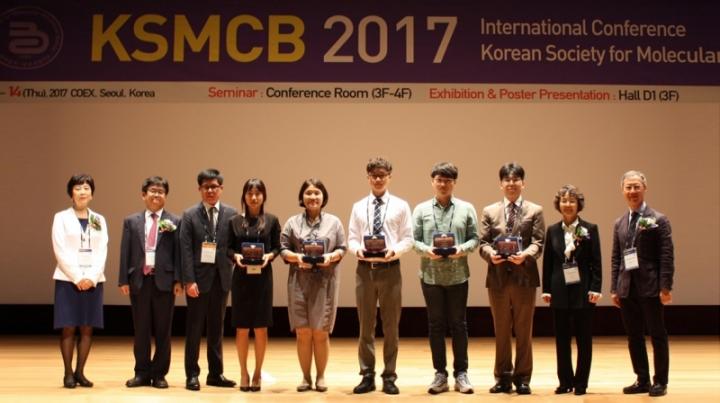
The award ceremony took place in the conference room of COEX, as part of an international annual meeting, organized by the Korean Society for Molecular and Cellular Biology on Tuesday, September 12, 2017. At the ceremony, ten million KRW in research funding was given to five young researchers. During the conference, the award recipients, including Han Bin also had a chance to present their research. lecture on the research results.

Han Bin joined Professor Changwook Lee's team in her second year of undergraduate studies in 2011. This award has been given to her in recognition of her recent publication in the June issue of the journal Proceedings of the National Academy of Sciences (PNAS), entitled "Mechanistic insight into the nucleus-vacuole junction based on the Vac8p-Nvj1p crystal structure." The study provides insight into understanding how Vac8p recognizes Nvj1p, and how the resulting protein complex physically mediates this organelle contact site and promotes the molecular events that occur at these specialized intracellular zones.

"I feel extremely honored to receive this award," says Han Bin. "I was nervous at first, but I was proud to be able to give a lecture on my area of expertise."

###

Other recipients include Dr. JungAh Kim in KAIST Graduate School of Nano Science and Technology, Dr. JiEun Oh of Yale School of Medicine, Dr. HyunCheol Lee in the College of Veterinary Medicine at Chungnam National Unviersity, and Dr. BongKi Cho in the Department of Brain Science at DGIST.

Media Contact

JooHyeon Heo
[email protected]
82-522-171-223

home

Original Source

UNIST Student Receives AMOREPACIFIC Great Global Next Generation Research Award

Share12Tweet8Share2ShareShareShare2

Related Posts

New benchmarks measure how effectively neuromorphic devices emulate biological brains

New benchmarks measure how effectively neuromorphic devices emulate biological brains

August 20, 2026

Scientists map B7-H3 across tumour stroma, blood vessels and immune cells

August 20, 2026

Oxygen vacancies enable rapid ion transport in advanced battery materials

August 20, 2026

Study uncovers overlooked DNA mutation pattern linked to colorectal cancer

August 20, 2026
Please login to join discussion

POPULAR NEWS

  • New benchmarks measure how effectively neuromorphic devices emulate biological brains

    29 shares
    Share 12 Tweet 7
  • Scientists map B7-H3 across tumour stroma, blood vessels and immune cells

    29 shares
    Share 12 Tweet 7
  • Oxygen vacancies enable rapid ion transport in advanced battery materials

    29 shares
    Share 12 Tweet 7
  • Study uncovers overlooked DNA mutation pattern linked to colorectal cancer

    29 shares
    Share 12 Tweet 7

About

We bring you the latest biotechnology news from best research centers and universities around the world. Check our website.

Follow us

Recent News

New benchmarks measure how effectively neuromorphic devices emulate biological brains

Scientists map B7-H3 across tumour stroma, blood vessels and immune cells

Oxygen vacancies enable rapid ion transport in advanced battery materials

Subscribe to Blog via Email

Enter your email address to subscribe to this blog and receive notifications of new posts by email.

Join 85 other subscribers
  • Contact Us

Bioengineer.org © Copyright 2023 All Rights Reserved.

Welcome Back!

Login to your account below

Forgotten Password?

Retrieve your password

Please enter your username or email address to reset your password.

Log In
No Result
View All Result
  • Homepages
    • Home Page 1
    • Home Page 2
  • News
  • National
  • Business
  • Health
  • Lifestyle
  • Science

Bioengineer.org © Copyright 2023 All Rights Reserved.
