


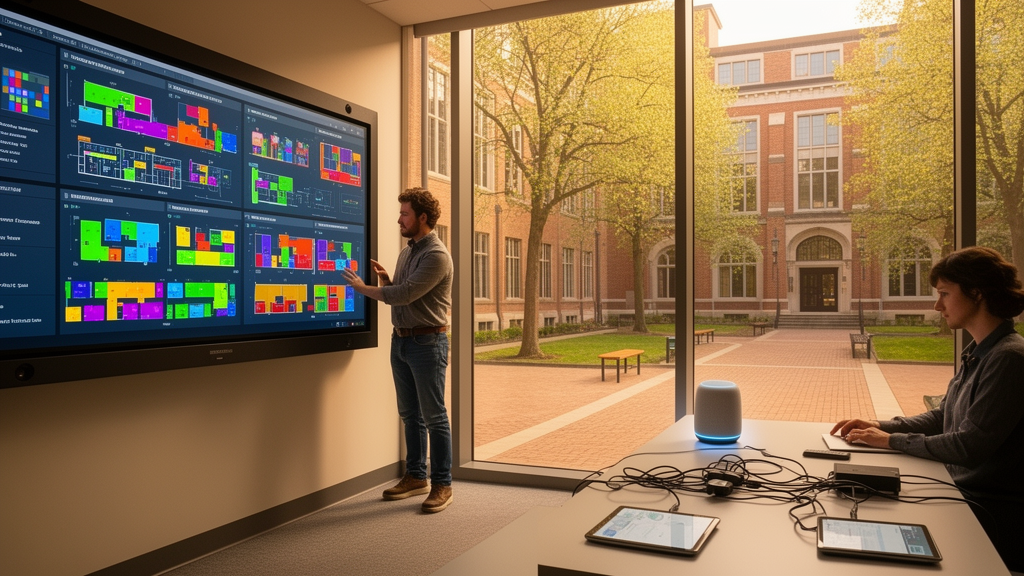
Smart buildings are stuffed with sensors, yet the data they generate rarely adds up to a coherent picture of how the building is actually used. Researchers at Aalborg University have now built and tested a system that stitches together five separate building data streams into one queryable platform, and then asked whether modern open-source artificial intelligence models can use it to answer real facility management questions. The answer, published in the journal Discover Sensors, is a qualified yes: the platform works, but the AI needs a human supervisor.
The study took place at AAU Innovate, a multi-functional innovation building at Aalborg University that hosts events, meetings, workshops, laboratories and startup spaces, and welcomes roughly 2000 to 3000 visitors on a typical semester week. Like most modern buildings, it runs a patchwork of independently deployed systems: building management sensors measuring motion, carbon dioxide and temperature; Microsoft 365 room calendars; infrared entrance counters at three main doors; coffee machine logs; and facility management records describing rooms and floor plans. These systems speak incompatible protocols, from DALI for lighting to proprietary REST interfaces, creating exactly the data silos that have long frustrated building analytics.
To break the silos, the team built a federated GraphQL architecture. GraphQL, a query language originally developed at Facebook, lets a client request exactly the data fields it needs, and its schemas are self-documenting and directly inspectable. Using Apollo Federation, each of the five data sources was implemented as an independent subgraph, with the facility management system serving as the spatial backbone: core entities such as Building, Floor and Room are defined there, and other subgraphs extend them, so a single query can travel from a room’s identity to its motion sensor telemetry. An Apollo Gateway composes the subgraphs into one unified supergraph, and each subgraph runs in its own container, so new data sources can be added without touching existing services.
With the platform running, the researchers formulated five practical questions together with the building’s operators, each rooted in a genuine management concern. Which days had the most visitors and what events drove them? What is the average meeting room usage during work hours, and when does it peak? How many meetings included external partners? Which rooms show the most and least activity year to date? And did converting the underused IT lab into a prototype lab in January 2025 actually increase its usage? An expert author with full system knowledge answered all five by writing Python scripts against the platform, establishing both that the integrated data suffices and a ground truth for comparison.
The expert findings were revealing. The busiest day of the study period was April 29, 2025, with 1057 entrance counts, driven by Energy Research Day 2025, while the historical peak was October 2, 2024, with 1109 entries during Science Day. Average meeting room utilization during work hours from 2022 to 2025 was just 8 percent, peaking at 32.32 percent in late 2023 before declining; at no point were more than 14 of 26 meeting rooms in simultaneous use, contradicting persistent complaints that rooms are scarce. Meetings with external partners numbered 1146 in 2023 but fell to 823 in 2024, though the authors note calendar data underestimates large events. The IT lab conversion produced a 66 percent average increase in active hours over February to April 2025 compared with the same months in 2024.
The second half of the study tested whether large language models could replicate this analysis. Because building data could not leave university-governed infrastructure, only self-hosted open-source models were considered. Four candidates, Qwen3, LLaMA 4 Maverick, Mistral Large 2 and the tool-calling specialist Watt-tool-70B, were screened on a trial question, and Qwen3 was selected for full evaluation. The models accessed the platform through the Model Context Protocol, a standard introduced by Anthropic in late 2024 that exposes the GraphQL endpoint as two generic tools: schema introspection and query execution. Each of the five questions was attempted three to four times and scored against six criteria, from understanding the question to producing a correct final answer.
The results were sobering for anyone hoping for autonomous building analysts. Qwen3 achieved complete success on only one of five questions, the simplest one, counting meetings with external partners, and it did so in 8 minutes and 7 seconds, faster than the expert’s 30 minutes. It managed partial success on two harder questions and failed outright on two. The failures had identifiable causes: context window overflow when processing large telemetry datasets, loss of state across multi-turn interactions, hallucinated GraphQL fields, and breakdowns in multi-step reasoning. On the two hardest questions the model was even given pre-extracted data files, a favorable condition, and still could not fully complete them without significant guidance.
The authors argue this pattern reflects task structure rather than raw model capability. Prior studies reporting 95 percent or higher accuracy for LLMs on building tasks evaluated well-scoped classification problems or pre-defined queries, where success criteria are explicit. Exploratory utilization analysis demands chaining schema introspection, query construction, data retrieval, aggregation and interpretation, while retaining context across turns. The study’s 20 percent complete success rate on such tasks, against the expert’s five out of five on the identical platform, isolates the gap precisely: every shortfall was attributable to the language model interface, not the data infrastructure.
The practical conclusion is that LLM-assisted workflows under expert supervision, rather than fully autonomous agents, are the viable near-term approach. A technically proficient user can have the model draft analysis scripts quickly and check them, while non-technical facility managers are better served by pre-built queries and dashboards for now. The researchers also stress the limits of generalization: the evaluation covered a single building, used a qualitative rubric with no statistical tests, and was restricted to locally hostable models by data governance rules, so frontier commercial models might perform better.
The work also carries lessons for sensor networks themselves. PIR motion detectors cannot see stationary people, and the system’s 10 to 15 minute data aggregation window only partially compensates, so PIR-based occupancy estimates represent a lower bound on true presence. Entrance counters cover only three of the building’s doors, and both coffee machine logs and facility management spreadsheets require manual updates. Yet the federated design itself proved portable in principle: any system with a programmatic interface can be wrapped as a subgraph, and multi-building extension is listed as a priority for future work, alongside server-side aggregation fields that would spare both the database and the language model from drowning in raw telemetry.
Subject of Research: Federated integration of heterogeneous smart building sensor data and evaluation of open-source LLMs for facility utilization analysis
Article Title: Federated GraphQL integration of heterogeneous building sensor data for LLM-assisted utilization analysis in smart buildings
Article References: Depuydt, L. J., & Nielsen, J. J. (2026). Federated GraphQL integration of heterogeneous building sensor data for LLM-assisted utilization analysis in smart buildings. Discover Sensors, 2(1), Article 51. https://doi.org/10.1007/s44397-026-00081-x
Image Credits: AI Generated
DOI: 10.1007/s44397-026-00081-x
Keywords: smart buildings, GraphQL federation, large language models, Model Context Protocol, facility management, space utilization, wireless sensor networks, data integration, occupancy detection, Qwen3, Aalborg University, building analytics
News Source: Denise Maddox. (October 28, 2026). Unified Building Data Platform Tested Against AI Assistants in Real University Deployment. Scienmag.



