DURHAM, N.H.—Researchers at the University of New Hampshire will receive a five-year grant totaling $2.8 million from the National Institutes of Health (NIH) to develop and test social assistive robots to aid in the care of individuals with Alzheimer’s disease and related dementia in the comfort of their own homes.
Credit: UNH
DURHAM, N.H.—Researchers at the University of New Hampshire will receive a five-year grant totaling $2.8 million from the National Institutes of Health (NIH) to develop and test social assistive robots to aid in the care of individuals with Alzheimer’s disease and related dementia in the comfort of their own homes.
“Caring for aging adults, especially those dealing with progressive Alzheimer’s and dementia, can place a high burden on family caregivers who cannot be with their care recipients 24/7,” said Sajay Arthanat, professor of occupational therapy. “The ultimate goal of this research is to help support those caregivers while keeping their family member healthy and active at home.”
The interdisciplinary team of researchers created a prototype robot that has been tested in a controlled lab setting. The new grant from the NIH’s National Institute on Aging would help build on their success by creating a technological framework to develop social assistive robots with more capabilities and test them in home settings. This would include compatibility with commercial devices already found in homes, like motion control cameras and sensors, to keep older adults safe and in line with their health care. For example, if a patient does not take their medication on time, a sensor strategically placed by their pill bottle would track the lack of movement—indicating the patient didn’t take their medicine— and would alert the assistive robot. The robot would then initiate a vocal reminder to the patient. If, after a few attempts, the patient does not respond by taking their medicine, the robot would alert a remote human caregiver who would be able to intervene.
“With this grant, we will be able to further develop the robot’s technological framework from not only using smart home devices but also artificial intelligence and wearables, like a smart watch, to help gauge the patient’s activity level, health management and connectedness with caregivers,” said Momotaz Begum, assistant professor of computer science.
While this research is focused on robots to aid with Alzheimer’s and dementia care, researchers hope it may have other future applications and benefit seniors by letting them age safely in their homes.
The University of New Hampshire inspires innovation and transforms lives in our state, nation and world. More than 16,000 students from all 50 states and 71 countries engage with an award-winning faculty in top-ranked programs in business, engineering, law, health and human services, liberal arts and the sciences across more than 200 programs of study. A Carnegie Classification R1 institution, UNH partners with NASA, NOAA, NSF and NIH, and received $260 million in competitive external funding in FY21 to further explore and define the frontiers of land, sea and space.
###
PHOTOS AND VIDEO FOR DOWNLOAD
Video: https://www.youtube.com/watch?v=YRrHj6lVp2A&t=11s
Courtesy credit: UNH
Photo 1:
https://www.unh.edu/unhtoday/sites/default/files/media/assisstive_robot_and_researchers.jpg
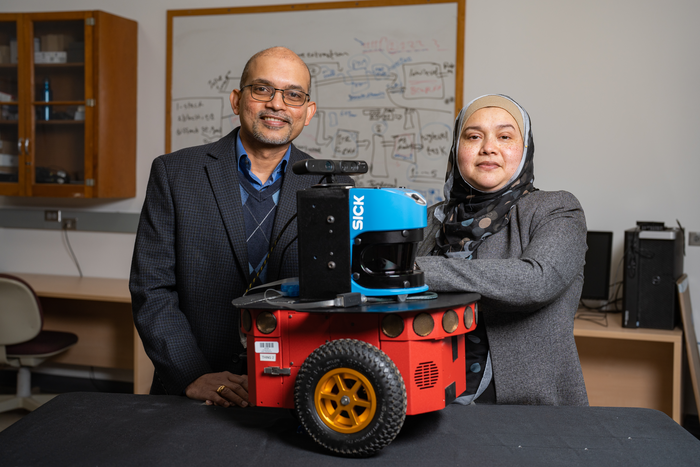
Caption: Sajay Arthanat, professor of occupational therapy (left) and Momotaz Begum, assistant professor of computer science (right) co-principal investigators with prototype of robot for aging patients with Alzheimer’s Disease and related dementia.
Photo credit: UNH
Photo 2:
https://www.unh.edu/unhtoday/sites/default/files/media/assisstive_robot_and_mock_patient.jpg
Caption: During a lab test, the assistive robot prototype warns a researcher, posing as a patient, that they have missed a medication dose.
Photo credit: UNH