Escherichia coli (E. coli) are bacteria that live all around and inside of us. Most E. coli are harmless, but some strains can cause illness, and can even, in extreme cases, be deadly. With recent outbreaks of E. coli around the world, there is a fear of acquiring an infection from these bacteria. An important component of fighting these kinds of bad bacteria is a better understanding of how bacteria divide and multiply. In each bacterium, a large protein complex – called the divisome – governs cell division. The divisome assembles in the middle of the cell to divide the cell and later disassembles to recycle the proteins.
A group of scientists at Okinawa Institute of Science and Technology Graduate University (OIST) and collaborators at Stockholm University showed for the first time how this big protein complex inside living E. coli cells disassembles after each round of division. They have recently published their results in Molecular Microbiology.
"The assembly of this protein complex has been pretty well-studied," Bill Söderström, OIST postdoctoral scholar and first author, said. "However, the disassembly process was largely unknown and we wanted to see whether the process is random or if there is some higher order to it."
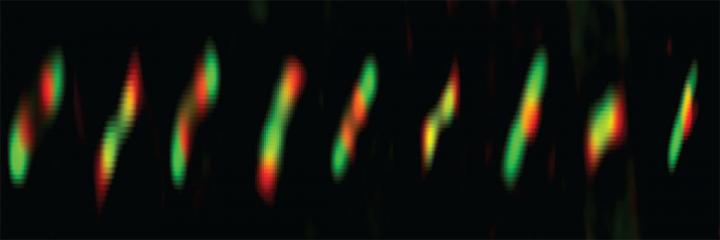
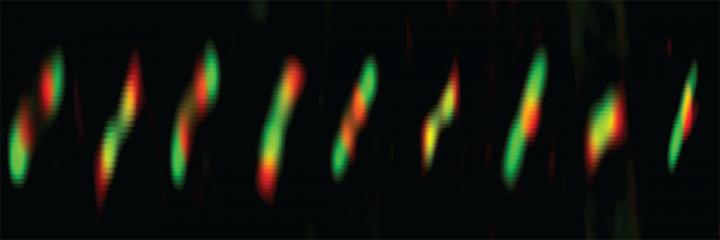
In order to visualize what happens inside this protein complex, the researchers made the divisome proteins express fluorescence. Then, they looked at pairs of proteins in the complex using super-resolution microscopy – a special kind of microscopy technique that can discern much smaller things than a traditional optical microscope can – to systematically identify when each protein disassembled. The researchers found that the disassembly process occurred in a controlled order that was very similar to that of the assembly process, following a first-in-first-out principle.
"This outlines in which order the proteins disassemble and it is reproducible," Ulf Skoglund, author and head of OIST's Structural Cellular Biology Unit said. "This is extremely important in helping us to define in which order events are happening."
This technique also allowed the researchers to get initial insights into the way the proteins were organized within the complex and, by extension, how they interacted with each other by identifying an inner and outer ring of different protein groups within the larger complex. The identification of the rings and ordered disassembly process lets the researchers identify where individual proteins are within the bacteria and at what time they stop interacting with each other. Combined, these discoveries are a step towards a more complete understanding of the structure and function of how bacteria divides.
"The more of the steps that you can effectively outline, the more components you can affect with something," Skoglund said. "Then, you can focus on more important and functionally dependent steps and have more options to interact with the system."
This means that in a world where antibiotic resistant bacteria is becoming a real problem, this information could be very useful in creating new methods to target harmful bacteria. By understanding the structure and function of the bacterial division machinery, it could help to pinpoint what to target and at what time during the division process.
"You really can use the knowledge of this protein complex to identify new ways to combat harmful bacteria," Söderström said.
###
Media Contact
Kaoru Natori
[email protected]
@oistedu
http://www.oist.jp/