In a new study, researchers have made significant strides in understanding the relationship between hydrogen partial pressure and the performance of Proton Exchange Membrane Fuel Cells (PEMFCs). Their findings could revolutionize fuel cell quality testing by simplifying processes, reducing costs, and enhancing safety measures. Their work was published in the journal Industrial Chemistry & Materials on October 4th.
Credit: Felix Haimerl, Technical University of Munich, BMW AG, Germany and Aliaksandr S. Bandarenka, Technical University of Munich, Germany.
In a new study, researchers have made significant strides in understanding the relationship between hydrogen partial pressure and the performance of Proton Exchange Membrane Fuel Cells (PEMFCs). Their findings could revolutionize fuel cell quality testing by simplifying processes, reducing costs, and enhancing safety measures. Their work was published in the journal Industrial Chemistry & Materials on October 4th.
“We aim to significantly reduce the costs for quality testing of PEM fuel cells by exploring new strategies without the usage of pure hydrogen,” explains Felix Haimerl from the BMW AG. Quality testing at reduced hydrogen concentrations in the anode stream can reduce the safety requirements and the associated costs for testing stations. The research team has, in a first step, investigated the impact of reduced hydrogen partial pressures on the performance of PEM fuel cells. Their analysis reveals deviations on the anode side and a global decrease in electrochemical efficiency.
Proton Exchange Membrane (PEM) fuel cells operate on the principle of electrochemical conversion, using hydrogen and oxygen to produce electricity, with the only byproducts being heat and water. Their efficiency, often exceeding 50%, makes them a compelling choice for a wide range of applications, as they maintain this efficiency across various operating conditions. Notably, PEM fuel cells offer a promising and clean alternative to fossil fuel combustion for various transport applications.
As the industry transitions from the development phase to mass production of PEMFCs, there is an increasing need to establish stable and cost-effective manufacturing processes. One significant challenge is the rigorous quality testing these fuel cells must undergo. Currently, state-of-the-art quality control procedures predominantly rely on hydrogen operation, which raises safety concerns and, in turn, contributes to the high costs associated with testing stations.
Testing procedures at reduced hydrogen partial pressure could avoid some of these issues. However, since the cathode side in a PEM fuel cell is usually rate-determining, few studies investigate the impact of reduced hydrogen partial pressure on the fuel cell performance.
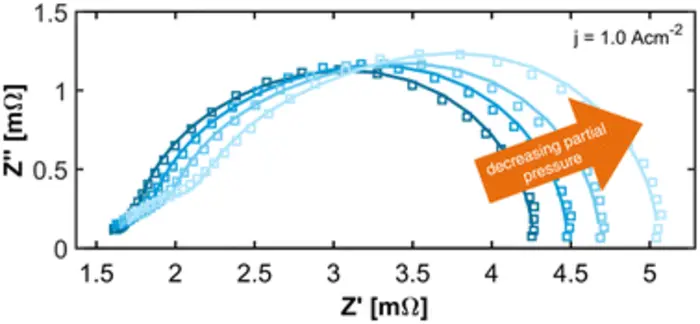
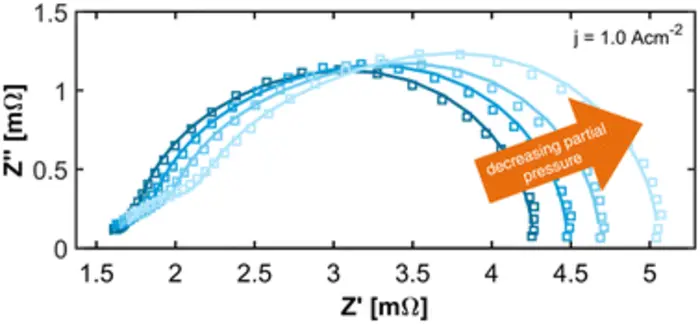
Haimerl and colleagues were able to elucidate the effect of reduced hydrogen partial pressure on the fuel cell performance. Their research involved comprehensive experiments, recording polarization curves and impedance spectra over a wide range of hydrogen partial pressure levels, from 36 kPa to 190 kPa. By diluting the hydrogen stream with nitrogen while maintaining a constant hydrogen flow, the researchers were able to separate the effect of hydrogen partial pressure from hydrogen starvation effects. The results revealed a pronounced decline in PEMFC performance as hydrogen partial pressure decreased, with this effect becoming more pronounced at higher current densities. The impedance spectra analysis offers insights into the mechanisms underlying the performance decline. To interpret the impedance data, the researchers introduced an equivalent circuit model, which demonstrated good agreement with the experimental results. This equivalent circuit model unveiled an exponential relationship between charge transfer resistance at the anode and hydrogen partial pressure.
The study is a significant breakthrough in our understanding of how hydrogen partial pressure impacts PEMFC performance. The researchers aim to build on the gained knowledge and further evaluate the application of low hydrogen partial pressures in quality testing. “We are currently conducting experiments on faulty fuel cells to test if we can actually detect typical faults at reduced hydrogen concentrations,” said Haimerl. Ultimately, the results might pave the way for simplifying fuel cell quality testing, cost reduction, and reduced safety requirements.
The research team includes researchers from the Technical University of Munich, the Technical University Braunschweig, and the BMW AG. Namely, Felix Haimerl (Technical University Munich / BMW AG), Sunil Kumar (Technical University Braunschweig), Michael Heere (Technical University Braunschweig), and Aliaksandr S. Bandarenka (Technical University Munich) were involved in the experiments and conceptualizing.
This research is funded by the Deutsche Forschungsgemeinschaft (DFG, German Research Foundation) under Germany’s Excellence Strategy – EXC 2089/1 – 390776260 (e-conversion) & – EXC 2163/1 – 390881007 (Sustainable and Energy Efficient Aviation).
Industrial Chemistry & Materials is a peer-reviewed interdisciplinary academic journal published by Royal Society of Chemistry (RSC) with APCs currently waived. Icm publishes significant innovative research and major technological breakthroughs in all aspects of industrial chemistry and materials, especially the important innovation of the low-carbon chemical industry, energy, and functional materials.
Journal
Industrial Chemistry and Materials
DOI
10.1039/D3IM00075C
Method of Research
Experimental study
Subject of Research
Not applicable
Article Title
Electrochemical impedance spectroscopy of PEM fuel cells at low hydrogen partial pressures: efficient cell tests for mass production
Article Publication Date
4-Oct-2023