• HOME
  • NEWS
  • EXPLORE
    • CAREER
      • Companies
      • Jobs
    • EVENTS
    • iGEM
      • News
      • Team
    • PHOTOS
    • VIDEO
    • WIKI
  • BLOG
  • COMMUNITY
    • FACEBOOK
    • INSTAGRAM
    • TWITTER
Sunday, November 15, 2026
BIOENGINEER.ORG
No Result
View All Result
  • Login
  • HOME
  • NEWS
  • EXPLORE
    • CAREER
      • Companies
      • Jobs
        • Lecturer
        • PhD Studentship
        • Postdoc
        • Research Assistant
    • EVENTS
    • iGEM
      • News
      • Team
    • PHOTOS
    • VIDEO
    • WIKI
  • BLOG
  • COMMUNITY
    • FACEBOOK
    • INSTAGRAM
    • TWITTER
No Result
View All Result
Bioengineer.org
No Result
View All Result
Home NEWS Science News

Understanding how electrons ‘dance’ in topological semimetals

Bioengineer by Bioengineer
March 18, 2021
in Science News
Reading Time: 2 mins read
0
IMAGE
Share on FacebookShare on TwitterShare on LinkedinShare on RedditShare on Telegram

UH physicist earns NSF CAREER Award to investigate materials’ fundamental aspects
IMAGE

Credit: Preeti Gore

Semimetals lie between metals and non-metals in terms of their physical properties ¬- such as their shine and ability to conduct heat and electricity – and have long been studied by scientists. Recently, a new family of semimetals, dubbed topological semimetals, has sparked interest because of their potential to revolutionize technology.

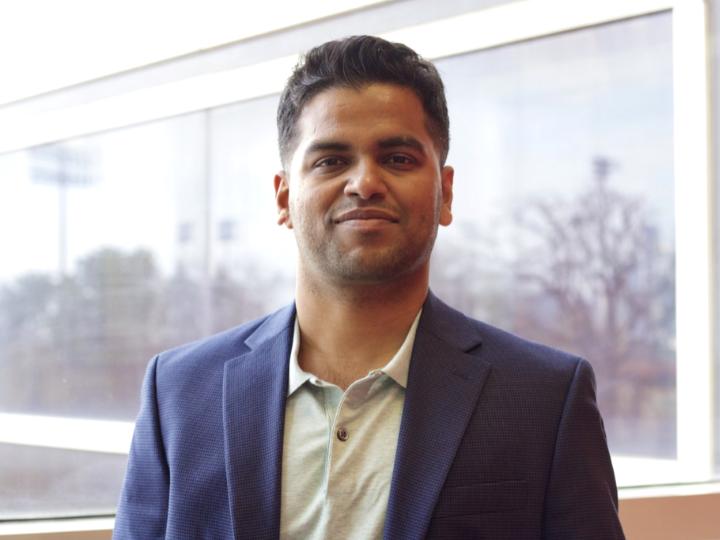
“Before any material makes its way into an application, the dynamics of its electrons needs to be understood very clearly,” said Pavan Hosur, assistant professor of physics at the University of Houston College of Natural Sciences and Mathematics. “Due to their unique make-up, current techniques used to study electrons in topological semimetals have been challenging.”

Hosur, whose research focuses on theoretical condensed matter physics and quantum statistical mechanics, received a $575,000 Faculty Early Career Development (CAREER) Award from the National Science Foundation to devise innovative methods for understanding how electrons “dance,” or organize themselves in two-and three-dimensional topological semimetals.

Traditional semimetals can be converted into either metals or insulators with relative ease, for example, by lowering their temperature or tweaking their chemical composition. In contrast, topological semimetals stubbornly retain their semi-metallic nature under such manipulations.

“What makes topological semimetals even more fascinating is they enable access to the physics of fundamental particles that make up matter through table-top experiments, and they also tend to have conduction properties which make them attractive platforms for novel, low-cost electronic devices,” Hosur explained.

Over the next five years, Hosur and his team will investigate various fundamental aspects of topological semimetals including:

  • The individual and collective behaviors of surface electrons in 3D topological semimetals; The team will develop an approach that can capture the ill-defined dimensionality of surface electrons.
  • Electron transport in 2D topological semimetals in unresolved conditions; The researchers will devise an algorithm for studying physics in these conditions, but which can also be used more broadly beyond topological semimetals.

For the outreach component of his CAREER Award, Hosur will design mobile games to help undergraduate physics students learn the field of condensed matter theory and will create teaching strategies suitable for online and social distancing-compliant classrooms.

“The COVID-19 pandemic has forced us to reinvent our systems of education and outreach over the past year,” Hosur said. “I hope these efforts to harness technology will help to overcome the surmounting hurdles to teaching in the post-COVID era.”

###

NSF CAREER awards are granted to highly promising junior faculty members who exemplify the role of teacher-scholars through “outstanding research, excellent education and the integration of education and research.”

Media Contact
Sara Tubbs
sstubbs2@uh.edu

Original Source

https://uh.edu/news-events/stories/2021/march-2021/03182021-pavan-hosur-nsf-career-award.php

Tags: Algorithms/ModelsAtomic/Molecular/Particle PhysicsChemistry/Physics/Materials SciencesEducationMaterialsMathematics/StatisticsParticle PhysicsSuperconductors/SemiconductorsUndergraduate
Share13Tweet8Share2ShareShareShare2

Related Posts

Vaccinated Parents in Rural California More Likely to Vaccinate Adolescents Against COVID-19

Vaccinated Parents in Rural California More Likely to Vaccinate Adolescents Against COVID-19

November 15, 2026
Review Finds Single Inertial Sensors and AI Recognize Functional Stroke Activities

Review Finds Single Inertial Sensors and AI Recognize Functional Stroke Activities

November 15, 2026

Researchers Generate Stable Mouse Endometrial Tumor Cell Line Using Conditional Reprogramming

November 15, 2026

Betel leaf quantum dots enable rapid fingerprint detection

November 15, 2026
Please login to join discussion

POPULAR NEWS

  • Vaccinated Parents in Rural California More Likely to Vaccinate Adolescents Against COVID-19

    Vaccinated Parents in Rural California More Likely to Vaccinate Adolescents Against COVID-19

    29 shares
    Share 12 Tweet 7
  • Review Finds Single Inertial Sensors and AI Recognize Functional Stroke Activities

    29 shares
    Share 12 Tweet 7
  • Researchers Generate Stable Mouse Endometrial Tumor Cell Line Using Conditional Reprogramming

    29 shares
    Share 12 Tweet 7
  • Betel leaf quantum dots enable rapid fingerprint detection

    29 shares
    Share 12 Tweet 7

About

We bring you the latest biotechnology news from best research centers and universities around the world. Check our website.

Follow us

Recent News

Vaccinated Parents in Rural California More Likely to Vaccinate Adolescents Against COVID-19

Review Finds Single Inertial Sensors and AI Recognize Functional Stroke Activities

Researchers Generate Stable Mouse Endometrial Tumor Cell Line Using Conditional Reprogramming

Subscribe to Blog via Email

Enter your email address to subscribe to this blog and receive notifications of new posts by email.

Join 87 other subscribers
  • Contact Us

Bioengineer.org © Copyright 2023 All Rights Reserved.

Welcome Back!

Login to your account below

Forgotten Password?

Retrieve your password

Please enter your username or email address to reset your password.

Log In
No Result
View All Result
  • Homepages
    • Home Page 1
    • Home Page 2
  • News
  • National
  • Business
  • Health
  • Lifestyle
  • Science

Bioengineer.org © Copyright 2023 All Rights Reserved.