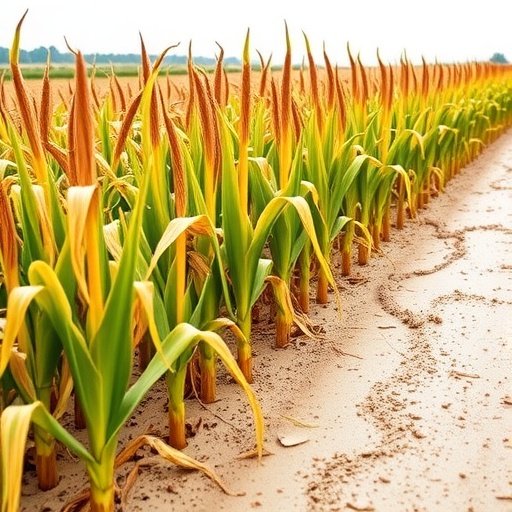
In the realm of modern agriculture, the quest to enhance the resilience of crops in the face of climate change has gained unprecedented significance. Among the leaders in this endeavor is maize, a staple crop that plays a vital role in global food security. Recent advancements in artificial intelligence (AI) are paving the way for a deeper understanding of drought tolerance mechanisms in maize. A groundbreaking study conducted by Quyoom and colleagues presents a maize-centric framework that utilizes explainable AI to decode these intricate mechanisms, offering insights that could revolutionize agricultural practices and drought mitigation strategies.
The study meticulously explores how maize plants respond to drought conditions, examining physiological and molecular responses that determine their survival and productivity. Traditional breeding methods to develop drought-tolerant varieties have often been time-consuming and resource-intensive, prompting researchers to look towards the power of computational models and AI. The novel framework proposed in this research leverages machine learning techniques to analyze vast datasets ranging from genomic sequences to environmental stress responses, ultimately identifying key traits associated with drought tolerance.
Central to the study is the concept of explainable AI, which aims to make AI-driven models more interpretable for researchers and practitioners. Unlike black-box models that provide predictions without insights into how decisions are made, this approach allows scientists to visualize and understand the underlying factors contributing to the drought resilience of maize. This transparency is crucial not only for scientific validation but also for practical applications in breeding programs and agricultural decisions.
One of the standout features of this maize-centric framework is its incorporation of multi-omics data. By integrating genomics, transcriptomics, proteomics, and metabolomics, researchers can create a holistic view of maize’s response to drought stress. This comprehensive data integration facilitates the identification of biomarkers that can indicate drought tolerance, thereby streamlining the selection process for breeding efforts. As climate variability intensifies, having such precise indicators can significantly enhance breeding efficiency and speed.
The researchers conducted extensive experiments that included controlled drought stress conditions and in-field assessments to validate their findings. By employing various machine learning algorithms, including random forests and neural networks, they were able to predict the performance of different maize varieties under drought stress with remarkable accuracy. The robustness of the models ensures that predictions are not only reliable but also adaptable to different environmental scenarios, enhancing their applicability across diverse agricultural contexts.
Moreover, the implications of this research extend beyond maize itself. The methodologies and frameworks developed can be translated to other crops, providing a scalable solution for enhancing crop resilience globally. As more researchers adopt these explainable AI approaches, the collective knowledge will contribute to a more comprehensive understanding of how various species cope with abiotic stresses, which is essential for future food security.
Furthermore, this study highlights the role of interdisciplinary collaboration in agricultural research. The convergence of geneticists, agronomists, data scientists, and AI specialists creates a synergy that fosters innovation. By pooling expertise from these diverse fields, the study not only enriches the ongoing discourse about drought resilience in maize but also lays the groundwork for future explorations in crop improvement.
The importance of communicating these results effectively cannot be overstated. As the agricultural sector grapples with the challenges posed by climate change, the translation of complex scientific findings into actionable insights for farmers and policymakers is crucial. This research’s focus on explainable AI provides a framework that can demystify AI applications, making it easier for stakeholders to make informed decisions based on data-driven insights.
Given the increasing unpredictability of weather patterns, the need for crops that can withstand drought and other environmental stresses cannot be ignored. The implications of this research also resonate with global discussions on sustainability and food security. By developing crops that require less water while still yielding high productivity, we can work towards agricultural practices that are both sustainable and economically viable.
Additionally, the researchers emphasize the importance of field trials and real-world applicability of the developed models. They advocate for a feedback loop between laboratory findings and field observations to ensure that the models remain relevant and accurate in practical settings. Continuous refinement of AI models through empirical data will enable ongoing improvements in predicting drought responses.
The potential societal benefits of implementing these findings are staggering. Improved drought-tolerant maize varieties could lead to increased yields in regions traditionally plagued by water scarcity, thus elevating livelihoods and stabilizing food supplies. Furthermore, the framework encourages a proactive approach to tackling climate adversity, addressing the needs of farmers facing imminent changes in their growing environments.
As the global agricultural landscape continues to evolve, innovations such as the maize-centric framework for explainable AI will play an increasingly pivotal role. Cultivating resilience in crops through advanced technologies not only tackles immediate environmental challenges but also sets the stage for long-term sustainability in food production. As the scientists continue to refine their models and share their insights, the agriculture industry stands on the precipice of a new era, one where technology and nature coexist harmoniously to meet the growing demands of a changing world.
In conclusion, Quyoom and his team have provided a vital contribution to the field of agronomy and AI with their latest research on drought-tolerant maize. This maize-centric framework not only enhances our understanding of drought mechanisms but also equips farmers and researchers with actionable insights for breeding and cultivation. As we move forward, it is imperative that the scientific community embraces such innovative approaches to ensure food security and sustainability in the face of climate change challenges.
Subject of Research: Drought tolerance mechanisms in maize using AI
Article Title: A maize-centric framework for explainable artificial intelligence in decoding drought tolerance mechanisms.
Article References:
Quyoom, B., Wani, A.A., Lone, A.A. et al. A maize-centric framework for explainable artificial intelligence in decoding drought tolerance mechanisms. Discov. Plants 3, 18 (2026). https://doi.org/10.1007/s44372-026-00485-4
Image Credits: AI Generated
DOI: https://doi.org/10.1007/s44372-026-00485-4
Keywords: Drought tolerance, maize, explainable AI, machine learning, agricultural sustainability, crop resilience, multi-omics data, food security.
Tags: artificial intelligence in agricultureclimate change and food securitycomputational models for crop improvementdrought tolerance in maizeenhancing crop resilience with technologyexplainable AI for crop resiliencegenomic analysis for drought resistanceinnovative agricultural practices with AImachine learning in crop researchmaize productivity under droughtphysiological responses of maize to stressunderstanding drought mechanisms in maize