• HOME
  • NEWS
  • EXPLORE
    • CAREER
      • Companies
      • Jobs
    • EVENTS
    • iGEM
      • News
      • Team
    • PHOTOS
    • VIDEO
    • WIKI
  • BLOG
  • COMMUNITY
    • FACEBOOK
    • INSTAGRAM
    • TWITTER
Monday, May 11, 2026
BIOENGINEER.ORG
No Result
View All Result
  • Login
  • HOME
  • NEWS
  • EXPLORE
    • CAREER
      • Companies
      • Jobs
        • Lecturer
        • PhD Studentship
        • Postdoc
        • Research Assistant
    • EVENTS
    • iGEM
      • News
      • Team
    • PHOTOS
    • VIDEO
    • WIKI
  • BLOG
  • COMMUNITY
    • FACEBOOK
    • INSTAGRAM
    • TWITTER
  • HOME
  • NEWS
  • EXPLORE
    • CAREER
      • Companies
      • Jobs
        • Lecturer
        • PhD Studentship
        • Postdoc
        • Research Assistant
    • EVENTS
    • iGEM
      • News
      • Team
    • PHOTOS
    • VIDEO
    • WIKI
  • BLOG
  • COMMUNITY
    • FACEBOOK
    • INSTAGRAM
    • TWITTER
No Result
View All Result
Bioengineer.org
No Result
View All Result
Home NEWS Science News Biology

Underground life has a carbon mass hundreds of times larger than humans'

Bioengineer by Bioengineer
December 10, 2018
in Biology
Reading Time: 2 mins read
0
IMAGE
Share on FacebookShare on TwitterShare on LinkedinShare on RedditShare on Telegram

IMAGE

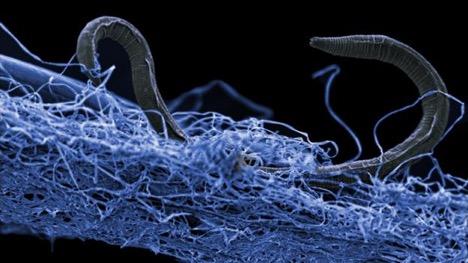
A nematode (eukaryote) in a biofilm of microorganisms. This unidentified nematode (Poikilolaimus sp.) from Kopanang gold mine in South Africa, lives 1.4 km below the surface.


Microorganisms living underneath the surface of the earth have a total carbon mass of 15 to 23 billion tons, hundreds of times more than that of humans, according to findings announced by the Deep Carbon Observatory and coauthored by UT Professor of Microbiology Karen Lloyd.

Carbon is the most prevalent element in living beings because it is part of almost all the molecules that are key for biological processes, including proteins, fats, and even DNA. Ninety percent of the earth’s carbon is in the subsurface.

“Knowing about how carbon is distributed and how living things use it is crucial for understanding not only life cycles but also our environment,” said Lloyd.

The report, which took an international multidisciplinary team 10 years to complete, also sheds light on other aspects of the incredible world of microbial dark matter.

For the research, scientists at hundreds of sites around the world drilled to a depth of 2.5 kilometers into the sea floor. They also took samples from continental mines and boreholes more than 5 kilometers deep into the earth.

In the samples from this deep biosphere, researchers identified members of all three domains of life: bacteria, archaea (microbes with a membrane nucleus), and eukarya (multicellular organisms that contain a nucleus–for example, humans).

“Ten years ago, we knew far less about the physiologies of the bacteria and microbes that dominate the subsurface biosphere,” said Lloyd. “Today we know that, in many places, they invest most of their energy into simply maintaining their existence and little into growth, which is a fascinating way to live.”

The report includes several other striking findings:

  • 70 percent of all earth’s bacteria live underground. This realization dramatically expands the visualization of the tree of life, a biological analogy first proposed in Charles Darwin’s On the Origin of Species to explain the relationship between living and extinct organisms.

  • The deep biosphere–the zone of life underneath earth’s surface–has a volume of between 2 and 2.3 billion cubic kilometers. This is almost as twice the volume of all oceans.

Since climate change is linked to carbon emissions, understanding how these microorganisms interact with carbon could help scientists produce mitigation strategies against climate change with additional time and research, Lloyd said.

“Some of these underground organisms emit carbon and some others sequester it and turn it into rock, for example. But we don’t know any of that yet. We have a lot to discover,” said Lloyd.

###

CONTACT:

Andrea Schneibel ([email protected], 865-974-3993)

Media Contact
Andrea Y Schneibel
[email protected]
865-974-3993

Tags: Earth ScienceGeology/SoilMicrobiology
Share12Tweet8Share2ShareShareShare2

Related Posts

Transforming Jellyfish Bycatch into a Valuable Collagen Source for Cosmetics and Biotechnology — Biology

Transforming Jellyfish Bycatch into a Valuable Collagen Source for Cosmetics and Biotechnology

May 11, 2026
Ancient Plant Populations Reveal Fresh Insights into Climate Resilience — Biology

Ancient Plant Populations Reveal Fresh Insights into Climate Resilience

May 8, 2026

Rare Brain Disorders in Children Linked to Mutations in Lesser-Known Protein Complex

May 8, 2026

From Odd Insect to Underwater Predator: The Remarkable Evolution of a Bloodthirsty Fruit Fly

May 8, 2026
Please login to join discussion

POPULAR NEWS

  • Research Indicates Potential Connection Between Prenatal Medication Exposure and Elevated Autism Risk

    840 shares
    Share 336 Tweet 210
  • New Study Reveals Plants Can Detect the Sound of Rain

    728 shares
    Share 290 Tweet 182
  • Salmonella Haem Blocks Macrophages, Boosts Infection

    62 shares
    Share 25 Tweet 16
  • Breastmilk Balances E. coli and Beneficial Bacteria in Infant Gut Microbiomes

    57 shares
    Share 23 Tweet 14

About

We bring you the latest biotechnology news from best research centers and universities around the world. Check our website.

Follow us

Recent News

Umbilical IL-6 Levels Reveal Preterm Brain Injury Risk

New Cell Model Accelerates Rhinovirus C Research

Evaluating the Efficacy of Cefiderocol and Levofloxacin in Treating Hemorrhagic Pneumonia

Subscribe to Blog via Email

Enter your email address to subscribe to this blog and receive notifications of new posts by email.

Join 82 other subscribers
  • Contact Us

Bioengineer.org © Copyright 2023 All Rights Reserved.

Welcome Back!

Login to your account below

Forgotten Password?

Retrieve your password

Please enter your username or email address to reset your password.

Log In
No Result
View All Result
  • Homepages
    • Home Page 1
    • Home Page 2
  • News
  • National
  • Business
  • Health
  • Lifestyle
  • Science

Bioengineer.org © Copyright 2023 All Rights Reserved.