• HOME
  • NEWS
  • EXPLORE
    • CAREER
      • Companies
      • Jobs
    • EVENTS
    • iGEM
      • News
      • Team
    • PHOTOS
    • VIDEO
    • WIKI
  • BLOG
  • COMMUNITY
    • FACEBOOK
    • INSTAGRAM
    • TWITTER
Monday, June 29, 2026
BIOENGINEER.ORG
No Result
View All Result
  • Login
  • HOME
  • NEWS
  • EXPLORE
    • CAREER
      • Companies
      • Jobs
        • Lecturer
        • PhD Studentship
        • Postdoc
        • Research Assistant
    • EVENTS
    • iGEM
      • News
      • Team
    • PHOTOS
    • VIDEO
    • WIKI
  • BLOG
  • COMMUNITY
    • FACEBOOK
    • INSTAGRAM
    • TWITTER
  • HOME
  • NEWS
  • EXPLORE
    • CAREER
      • Companies
      • Jobs
        • Lecturer
        • PhD Studentship
        • Postdoc
        • Research Assistant
    • EVENTS
    • iGEM
      • News
      • Team
    • PHOTOS
    • VIDEO
    • WIKI
  • BLOG
  • COMMUNITY
    • FACEBOOK
    • INSTAGRAM
    • TWITTER
No Result
View All Result
Bioengineer.org
No Result
View All Result
Home NEWS Science News Biology

Uncovering the architecture of natural photosynthetic machinery

Bioengineer by Bioengineer
July 13, 2020
in Biology
Reading Time: 2 mins read
0
IMAGE
Share on FacebookShare on TwitterShare on LinkedinShare on RedditShare on Telegram

IMAGE

Credit: Zhao, L., Huokko, T., Wilson, S. et al.

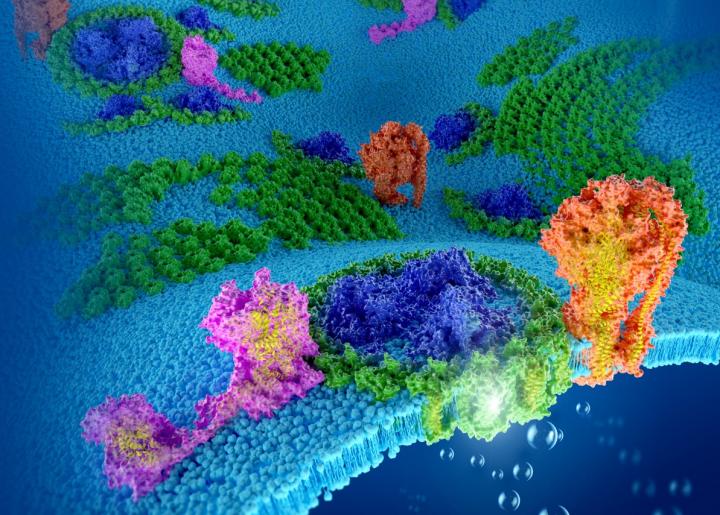
Biological membranes play important roles in shaping the cell, sensing the external environment, molecule transport, and generating energy for life. One of the most significant biological membranes are the thylakoid membranes produced in plants, algae and cyanobacteria, which carry out the light reactions of photosynthesis.

Researchers at the University of Liverpool have uncovered the molecular architecture and organisational landscape of thylakoid membranes from a model cyanobacterium in unprecedented detail. The study, which is published in Nature Plants, could help researchers find new and improved artificial photosynthetic technologies for energy production.

Professor Luning Liu, who led the study, explained: “Cyanobacteria perform plant-like photosynthesis. Hence, thylakoid membranes from laboratory-grown cyanobacteria are the ideal model system for studying and tuning plant photosynthesis.”

The researchers used state-of-the-art atomic force microscopy (AFM) to probe the structures and organisation of photosynthetic proteins within the thylakoid membranes. The results reveal how thylakoid membranes modulate the abundance of different photosynthetic proteins and form structurally variable complexes to adapt to the changing environments.

Dr Longsheng Zhao, the first author of this paper, said: “We observed that different protein complexes have their specific locations in the thylakoid membranes. We also visualised that distinct photosynthetic complexes can be close to each other, indicating that these photosynthetic complexes can form ‘supercomplex’ structures to facilitate electron transport between these protein complexes.”

Professor Luning Liu, added: “The development of structural biology approaches has greatly improved our understanding of individual photosynthetic complexes. However, these techniques have limitations for studying membrane multi-protein assembly and interactions in their native membrane environment. Our research has proved the power and potential of AFM in exploring complex, dynamic membrane structures and transient protein assembly.”

The researchers hope their ongoing work could help find solutions to modulate the photosynthetic efficiency of crop plants to boost plant growth and productivity.

###

The project was done in collaboration with the University’s Centre for Cell Imaging and researchers from Queen Mary University of London, Shandong University (China), Ocean University of China and Henan University (China). The research at the Liu lab was funded by the BBSRC and the Royal Society.

Media Contact
Nicola Frost
[email protected]

Related Journal Article

http://dx.doi.org/10.1038/s41477-020-0694-3

Tags: BacteriologyBiochemistryBiologyCell Biology
Share12Tweet8Share2ShareShareShare2

Related Posts

Natural Hallucinogens: Evolution’s Ecological Tools, Not Mere Chemical Byproducts

June 25, 2026

This Famous Butterfly Revealed: Three Distinct Species Hidden in One

June 25, 2026

Scientists Attack Soybean Cyst Nematode by Starving Its Food Source

June 25, 2026

Decoding the Secret Code of a Crucial Immune Sensor

June 24, 2026
Please login to join discussion

POPULAR NEWS

  • Saying Goodbye to PGY-6: Pediatric Fellowship Realities

    103 shares
    Share 41 Tweet 26
  • Multi-Hospital Study Reveals Long Covid Burden Is Twice as High as Current Estimates

    92 shares
    Share 36 Tweet 23
  • Detection of EDCs in Breast Milk and Infant Urine Up to Six Months Highlights Early Exposure Risks

    77 shares
    Share 31 Tweet 19
  • New Drug Candidate Developed at McMaster Shows Potential for Treating Brain Cancer

    58 shares
    Share 23 Tweet 15

About

We bring you the latest biotechnology news from best research centers and universities around the world. Check our website.

Follow us

Recent News

Tracking Lanthanide-Labeled Microplastics in Plants

POSTECH Researchers Slash Cost of Reconstituted Cell-Free Systems by 95%

AI and Physics Collaborate to Design Advanced Hydrogen Storage Materials

Subscribe to Blog via Email

Success! An email was just sent to confirm your subscription. Please find the email now and click 'Confirm' to start subscribing.

Join 82 other subscribers
  • Contact Us

Bioengineer.org © Copyright 2023 All Rights Reserved.

Welcome Back!

Login to your account below

Forgotten Password?

Retrieve your password

Please enter your username or email address to reset your password.

Log In
No Result
View All Result
  • Homepages
    • Home Page 1
    • Home Page 2
  • News
  • National
  • Business
  • Health
  • Lifestyle
  • Science

Bioengineer.org © Copyright 2023 All Rights Reserved.