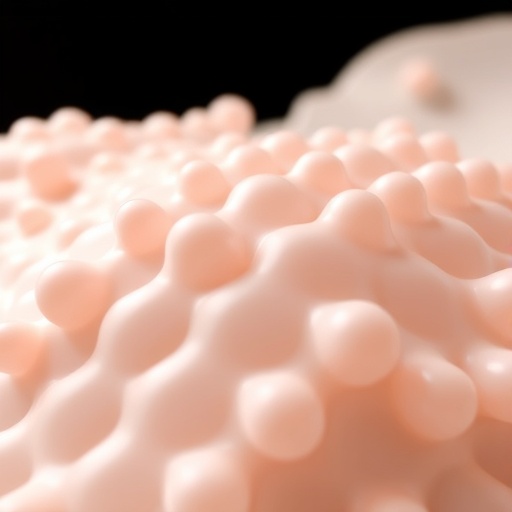
A groundbreaking study by an international team of researchers from The University of Osaka, the National Institute of Advanced Industrial Science and Technology (AIST), Okayama University, and the University of Tokyo has illuminated a long-standing mystery in materials science: why do amorphous materials such as glass and certain plastics deform more readily in certain regions? Utilizing advanced mathematical techniques, the scientists uncovered a hidden hierarchical structure within these materials—one that intricately links ordered and disordered atomic arrangements and directly influences their mechanical softness.
Unlike crystalline solids, whose atoms are arranged in perfectly repeating and well-ordered patterns, amorphous materials lack this long-range periodicity. However, they are not mere random assemblies at the atomic scale. Instead, amorphous solids exhibit what is known as medium-range order (MRO), subtle correlations in atomic positioning that extend several nanometers beyond nearest neighbors. This MRO has long been suspected to condition the physical and mechanical characteristics of these complex materials, yet deciphering its precise role has been hampered by the complexity and irregularity inherent in their atomic networks.
Traditional structural analysis techniques fall short in unraveling this complexity, as the interplay between order and disorder occurs across multiple length scales and lacks classical symmetry. To address this challenge, the research team applied a cutting-edge approach called persistent homology—a branch of topological data analysis designed to capture and characterize structural features spanning various scales. This novel computational toolkit revealed that in amorphous silicon, a prototypical covalent amorphous material with extensive industrial applications, hierarchical ring structures emerge as fundamental units of organization.
Persistent homology exposed a nested arrangement of atomic rings, showcasing smaller rings with uneven edge lengths intricately embedded within larger rings. This architecture embodies a coexistence of order and disorder, revealing that mechanical softness does not originate from randomness alone, but rather from the manner in which medium-range order constraints spatially weave with localized disorder. This hierarchical nesting imparts mechanical heterogeneity, explaining why certain regions within the amorphous matrix exhibit enhanced deformability under stress.
The researchers further connected these hierarchical atomic arrangements to vibrational properties intrinsic to glasses. In particular, these structures correlate strongly with localized low-energy vibrational modes, a phenomenon known as the “boson peak.” This vibrational anomaly has puzzled scientists for decades, yet the current findings provide a structural framework linking it to the identified medium-range order-disorder interplay. It suggests that boson peak characteristics and mechanical softness share a common origin rooted in the hierarchical atomic topology of amorphous materials.
From an applications standpoint, these insights open new avenues for the design and optimization of amorphous solids. Understanding the hierarchical underpinnings of mechanical softness can guide researchers in engineering materials that balance flexibility and strength—qualities essential for a wide range of technologies including display screens, coatings, and energy devices such as solar cells. Amorphous silicon, in particular, stands to benefit, with direct implications for improving the durability and performance of thin-film photovoltaic and semiconductor components.
Lead author Emi Minamitani from The University of Osaka emphasizes that this research marks a paradigm shift. “Our work bridges the gap between atomic-scale structural features and macroscopic mechanical behavior in amorphous materials using a rigorous mathematical framework,” she explains. “This new perspective empowers materials scientists to finely tune atomic arrangements, unlocking the design of glasses and amorphous solids with unprecedented mechanical properties and resilience.”
This study also sets the stage for broader investigation into other amorphous systems beyond silicon, from metallic glasses to polymers and biological materials. By applying persistent homology to these systems, researchers can potentially reveal universal principles governing the interplay of order, disorder, and mechanical response that have so far remained veiled by their complex and seemingly chaotic structures.
Furthermore, the methodology showcased in this study exemplifies the power of cross-disciplinary innovation—in this case, combining topology, computational modeling, and condensed matter physics—to tackle intricate problems in materials science. Persistent homology offers a quantitative and visually intuitive means to dissect atomic configurations, representing a promising tool for future explorations into nanoscale architecture.
The discovery also challenges traditional notions that mechanical softness in amorphous materials stems solely from local disorder. Instead, it highlights that the embedding of such disorder within a medium-range ordered framework is what fundamentally governs mechanical properties. This nuanced understanding pinpoints hierarchical structural motifs as the fingerprints of softness and ductility, overturning simplistic models based on disorder alone.
Consequently, the research lays a solid foundation for the rational design of amorphous solids whose mechanical responses can be tailored by manipulating their atomic-scale topology. This knowledge is highly relevant not only for improving existing materials but also for fabricating novel amorphous compounds with specific mechanical functionalities tailored for emerging technological demands in flexible electronics, wearables, and beyond.
Publication of this work in the esteemed journal Nature Communications marks a significant advancement in the science of amorphous materials and mechanical properties, promising far-reaching impacts across physics, materials engineering, and applied sciences.
Subject of Research:
Article Title: Persistent homology elucidates hierarchical structures responsible for mechanical properties in covalent amorphous solids
News Publication Date: 25-Sep-2025
Web References: https://doi.org/10.1038/s41467-025-63424-z
Image Credits: Emi Minamitani
Keywords
Amorphous solids, Computer modeling, Amorphous silicon, Molecular dynamics, Mechanical properties, Computer simulation
Tags: advanced mathematical techniques in material analysisatomic arrangements in plasticsbreakthroughs in materials researchcomplexities of atomic networksdeformation behavior of amorphous materialshidden patterns in amorphous materialshierarchical structures in materials scienceinterdisciplinary approach to materials sciencemechanical properties of glassmedium-range order in amorphous solidsrelationship between order and disorder in materialssoftness in non-crystalline solids