


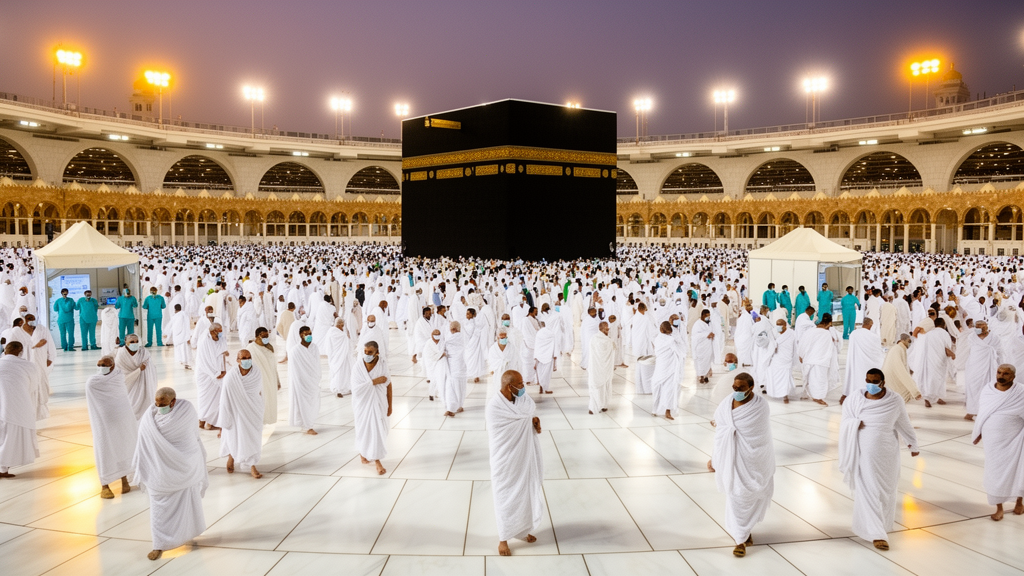
Umrah is often described as a smaller version of Hajj, but according to a recent letter in New Microbes and New Infections by Bilal Irfan and Ziad A. Memish, that analogy can actively misdirect public health planning. Hajj is a highly structured mass gathering compressed into five to six days on fixed dates set by the Islamic Hijri lunar calendar. Attendance is tightly regulated by the Saudi government through quotas, dedicated visas, organized pilgrim groups, and an extensive array of health infrastructure that is reviewed periodically. Umrah, by contrast, can be completed within a few hours and is performed throughout most of the year. Although its rituals are confined to Makkah, many pilgrims remain in Saudi Arabia for days or weeks, traveling on to Madinah and other destinations across the wider Hejaz region.
The authors argue that this continuous character carries several operational consequences. Successive cohorts of pilgrims arrive, perform the rites, remain for varying lengths of time, and depart, producing a constantly renewing population. While the individuals change, the underlying exposure environment does not: dense congregational worship, shared accommodation, public transport, and extensive international travel persist without interruption. Umrah should therefore be treated in public health planning as a dynamic, year-round mass-gathering system rather than a series of isolated “mini-Hajj” events, a distinction with direct implications for epidemiological surveillance, vaccination efforts, and health infrastructure planning.
To sharpen that distinction, the letter lays out an operational comparison between the two pilgrimages across multiple dimensions relevant to infectious-disease planning. Hajj runs on defined annual dates in the Islamic calendar, concentrates a large synchronized annual cohort into a multi-day ritual sequence, and channels pilgrims through dedicated authorization and organized pilgrimage pathways along predominantly planned group and international routes. Crowd dynamics follow a rapid build-up and dispersal around known dates, and surveillance denominators can be anchored to authorized pilgrims or event attendance, supporting an annual surge plan with intensive event-time operations.
Umrah inverts nearly every one of those parameters. It is available year-round with seasonal peaks; the rites may be completed within hours while the total stay varies widely; and attendance consists of successive overlapping cohorts throughout the year. Pilgrim identification spans multiple international and domestic pathways, and pilgrim status may be less consistently captured. Travel routes include international and domestic air, road, and rail options with more independent itineraries. Crowd turnover is continuous, meaning people change while the exposure system persists, and surveillance must distinguish permits, arrivals, performers and performances, and unique persons. The planning implication, the authors conclude, is a standing preparedness posture with seasonal intensification, continuous detection, and post-travel linkage. They are careful to note that “continuous” describes a persistent operational system composed of successive, overlapping cohorts, not that the same people remain continuously present.
The scale involved is substantial. The Pilgrim Experience Program recorded over 18 million international Umrah performers in 2025, although that figure may include individuals who performed multiple pilgrimages within the year. Even with that caveat, the sustained volume creates continuous opportunities for the importation, local transmission, and international exportation of infectious diseases, a pattern fundamentally different from the bounded risk window of a single annual event.
Identification of pilgrims remains a structural weakness. Meningococcal vaccination is mandatory for Umrah, yet the tourist eVisa can also permit pilgrimage and does not reliably distinguish travellers intending to perform the rites. Unlike Hajj, which has clearly defined visa pathways, Umrah spans multiple visa categories, independent travellers, travel agencies, and domestic pilgrims, across different modes of transport, with nearly one-fifth of international arrivals entering Saudi Arabia through non-air routes. This fragmentation complicates any attempt to reach pilgrims with preventive services or to track them epidemiologically.
Saudi Arabia has invested heavily in expanding the Holy Mosques and in improving crowd management, transportation, sanitation, emergency medical services, and access to medicines. Nevertheless, the authors note that respiratory virus transmission remains inevitable in crowded worship areas, transport systems, and accommodation. Influenza, SARS-CoV-2, respiratory syncytial virus, rhinovirus, human metapneumovirus, pertussis, and bacterial pneumonia remain important risks. MERS-CoV, by contrast, is intensively monitored: multiple studies have used pilgrim screening for the virus, and more than 10,000 pilgrims were screened with no identifiable cases of MERS. Seasonal vaccination programmes are also imperfectly aligned with year-round pilgrimage, particularly for travellers crossing hemispheres or journeying outside their country-specific vaccination periods.
Recent meningococcal events illustrate how transmission signals can surface only after pilgrims have dispersed. In 2024, twelve invasive meningococcal disease cases were reported in the United States, the United Kingdom, and France and were linked to Umrah travel, including secondary household transmission from asymptomatic returning pilgrims. By April 2025, the World Health Organization had documented seventeen travel-associated cases across multiple countries. The authors stress that these limited reports cannot estimate overall transmission risk, but they expose the surveillance challenge: many indicators of transmission may emerge only after pilgrims have returned to their countries of origin, underscoring the need for coordinated cross-border surveillance. Additional concerns enumerated in the letter include tuberculosis, measles, poliovirus importation, foodborne diseases, antimicrobial-resistant organisms, and bloodborne infections associated with hair shaving when single-use blades and adequate sterilization are not consistently practiced.
In response, the authors call for a comprehensive, year-round health architecture. Vaccination reminders covering meningococcal disease, influenza, COVID-19, measles-mumps-rubella, pertussis, yellow fever, and polio could be integrated into the Nusuk platform and other digital systems linked to visas and pilgrimage services regardless of visa category. Airlines, travel agencies, primary care providers, mosques, and religious leaders could reinforce vaccination and preventive health advice while addressing persistent barriers, including vaccine hesitancy, limited awareness, and access to vaccination.
Surveillance would form the backbone of that architecture. A continuous model could integrate pre-travel prevention, in-country detection, and post-travel follow-up. Temporary clinics at major pilgrimage sites and transport hubs could strengthen case detection and health promotion, while syndromic and laboratory surveillance incorporates multiplex diagnostics and genomic sequencing, stratified by season, country of origin, visa pathway, and exposure setting. Surveillance efforts should clearly distinguish unique individuals by their time of arrival, the permit pathways utilized, and their interactions with field clinics, ensuring a precise understanding of epidemiological trends. Hajj preparedness is appropriately surge-based around a defined event and identifiable cohort, the authors conclude, whereas Umrah requires a permanent surveillance and preparedness system with increases during peak seasons such as Ramadan, demanding multifactorial coordination across transport, healthcare, laboratories, and international public health agencies. Recognizing Umrah as a continuous mass-gathering system, they argue, is the step that keeps the public health architecture robust and ever-adapting throughout the year.
Subject of Research: Infectious-disease preparedness for the year-round Umrah pilgrimage
Article Title: Year-round Umrah requires a continuous infectious-disease preparedness model
Article References: Irfan, B., & Memish, Z. A. (2026). Year-round Umrah requires a continuous infectious-disease preparedness model. New Microbes and New Infections, 74, Article 101870. https://doi.org/10.1016/j.nmni.2026.101870
Image Credits: AI Generated
DOI: 10.1016/j.nmni.2026.101870
Keywords: Umrah, Hajj, mass gatherings, infectious disease surveillance, meningococcal disease, MERS-CoV, respiratory viruses, vaccination, Saudi Arabia, public health preparedness, travel medicine, pilgrimage
News Source: Kristina Jarvis. (October 29, 2026). Umrah’s Year-Round Flow Demands a Standing Infectious-Disease Defense. Scienmag.



