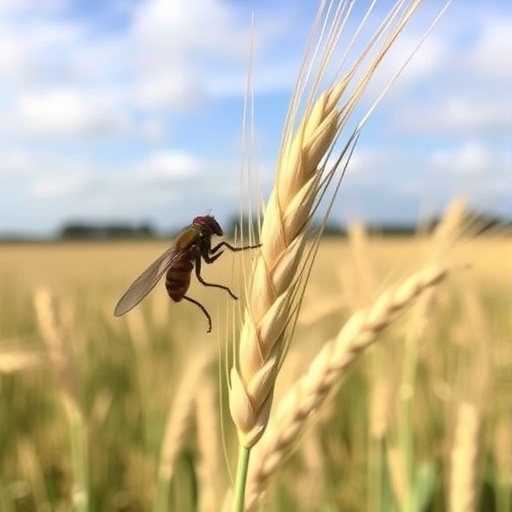
For half a century, scientists have known that some wheat varieties can withstand the Hessian fly, a tiny mosquito-like insect whose larvae can devastate cereal crops. What remained elusive was the molecular explanation: researchers could identify resistance traits in wheat, but they could not isolate the responsible gene and show precisely how it recognized an insect-derived molecule. A new study led by researchers at the University of Maryland and collaborators reports that this barrier has now been overcome. The team cloned the wheat resistance gene H13 and demonstrated that it directly responds to a specific protein produced in the saliva of Hessian fly larvae, revealing a central step in the plant’s immune response.
The finding, published August 14, 2026, in Science Advances, provides one of the clearest demonstrations yet of a direct receptor–effector interaction between a crop plant and an insect pest. In plant pathology, such interactions are often described using the language of an immune receptor and an avirulence effector. The receptor is a plant protein encoded by a resistance gene, while the effector is a molecule delivered by a pathogen or herbivore to manipulate plant cells. When the plant recognizes the effector as a threat, it activates defenses that can halt the invader. The H13 study shows that this molecular logic also operates in wheat against an insect that feeds by chemically reprogramming plant tissue.
Hessian fly larvae do not simply chew through wheat leaves. After hatching, they move toward the base of the plant and establish themselves near the stem, where they inject salivary secretions into plant cells. These secretions contain molecules that alter the behavior and development of the cells, converting them into a nutrient-rich feeding site. The resulting abnormal tissue supplies the larva with fluids and nutrients while diverting resources away from normal wheat growth. Across the world, Hessian flies attack wheat, barley, rye and other cereal crops, causing economic losses estimated at hundreds of millions of dollars. In the United States, infestations are associated with an annual reduction of approximately 5 percent in wheat yield.
Wheat possesses multiple genes known to confer resistance to Hessian fly populations, but identifying the genes and explaining their action has been extraordinarily difficult. The wheat genome is exceptionally large, containing extensive regions of repeated DNA and multiple related chromosome sets. Resistance genes can therefore be surrounded by nearly identical sequences, making it challenging to distinguish one gene from its genetic neighbors. Traditional cloning methods that work efficiently in simpler organisms often fail when applied to such a complex genome. As a result, scientists could observe that particular wheat lines resisted larvae, yet could not easily connect that resistance to a purified gene or demonstrate how the gene sensed a particular insect molecule.
Nidhi Rawat, an associate professor of plant science at the University of Maryland and a coauthor of the study, and her colleagues developed genomic strategies to locate H13 within the wheat genome. Once the candidate gene had been identified, the researchers produced wheat cultures in the laboratory in which H13 was expressed at elevated levels. These over-expression cultures provided a controlled system for testing the gene’s activity and separating its effects from the thousands of other defense-related genes that wheat can activate after injury. The approach also allowed the scientists to examine the response to individual insect proteins rather than relying only on whole larvae or complex mixtures of saliva.
The experiments showed that H13 is activated by a specific protein secreted by Hessian fly larvae. The protein functions as an avirulence effector in resistant wheat: rather than helping the insect establish a successful feeding site, its detection alerts the plant to the attack. The direct interaction between the insect protein and the H13-encoded resistance machinery is the critical result. It explains how wheat can distinguish a Hessian fly attack from ordinary physical damage and initiate a targeted immune response. According to the researchers, this is the first time a pest-resistance gene in wheat has been cloned and its direct interaction with a protein from the responsible insect has been demonstrated.
Once H13 recognizes the larval molecule, the plant launches several defensive programs at once. Cells near the attack site are instructed to die, a response known as a hypersensitive reaction. By sacrificing localized tissue, the plant can prevent the larva from maintaining the living cells it needs for feeding. Neighboring cells reinforce their walls, creating a more difficult physical barrier for the insect’s feeding structures and restricting the spread of the larval secretions. The resistant tissue also produces defensive compounds that are toxic to the larvae. Together, localized cell death, strengthened cell walls and chemical defenses deprive the insect of both access and nourishment.
This response is fundamentally different from the broad physical defenses associated with tough leaves or thick stems. H13-mediated resistance depends on molecular recognition, meaning that the plant’s effectiveness is linked to the particular effector protein carried by a Hessian fly population. Such specificity can be powerful, but it can also create an evolutionary contest. If an insect population loses, alters or stops producing the recognized effector, it may evade detection and overcome the resistance gene. Understanding the exact receptor–effector pairing gives breeders and molecular biologists a way to monitor that risk, identify new resistance genes and potentially combine several genes so that insects must overcome multiple recognition systems simultaneously.
The study could therefore influence both conventional wheat breeding and future gene-based approaches to pest management. Breeders may be able to use the H13 sequence as a precise marker when selecting resistant plants, while researchers can investigate whether versions of the gene provide protection against different Hessian fly populations. The newly established experimental framework may also accelerate the discovery of additional wheat resistance genes whose effects have been known for decades but whose molecular mechanisms remain unresolved. Rather than depending exclusively on chemical insecticides, farmers could eventually benefit from wheat varieties equipped with carefully assembled combinations of natural immune traits.
For wheat producers, the practical payoff will depend on further testing under field conditions and on the durability of H13 resistance across diverse insect populations. The laboratory results do not by themselves guarantee complete protection in every environment, where temperature, plant development, insect abundance and other stresses can alter the outcome. Even so, the work marks a major shift in the study of cereal insect resistance. Fifty years after genetic resistance to Hessian fly was first recognized, researchers now have a defined wheat gene, a matching insect effector and an experimentally supported mechanism connecting recognition to larval starvation and death. That molecular clarity could turn a long-standing agricultural defense into an increasingly precise tool for protecting one of the world’s most important food crops.
Subject of Research: Not applicable
Article Title: Direct avirulence effector-receptor interaction confers wheat immunity against insects
Web References: https://doi.org/10.1126/sciadv.aef4700
References: Science Advances, DOI: 10.1126/sciadv.aef4700
Keywords: Agriculture; pest control; insecticide resistance; wheat; Hessian fly; plant immunity; H13 resistance gene; insect effectors
Tags: advances in crop pest managementcrop pest resistance geneticsgenetic basis of pest resistance in cerealsH13 resistance gene characterizationHessian fly resistance gene in wheatmolecular cloning of plant resistance genesmolecular plant pathology and resistanceplant immune receptors and insect saliva proteinsplant-insect interaction mechanismsreceptor-effector interactions in plantswheat defense against Hessian fly larvaewheat immune response to insect pests