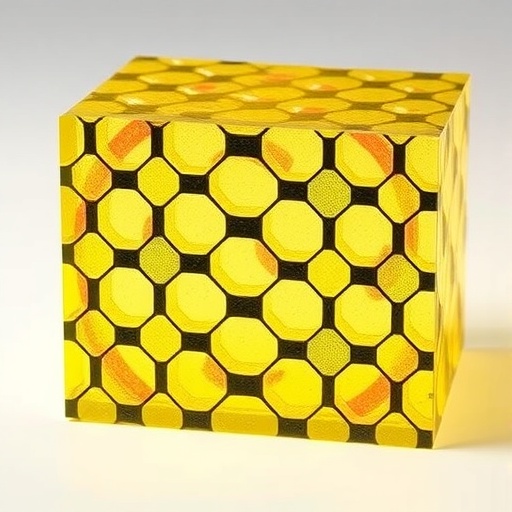
In a remarkable advance poised to reshape the future of polymer-based materials, researchers at the University of Massachusetts Amherst have unveiled a groundbreaking approach to suppressing heat transfer in plastics without compromising their mechanical integrity. This innovative strategy, focused on manipulating the vibrational dynamics at the atomic scale, heralds new possibilities for crafting flame-retardant, flexible, and mechanically robust polymers with significantly reduced thermal conductivity — a feat long sought but challenging to achieve through conventional means.
Thermal conductivity, the measure of a material’s ability to conduct heat, is a fundamental property with wide-ranging implications across engineering and materials science. Conventional methods to enhance insulation, especially in inorganic substances, often rely on introducing porosity or air pockets, which impede heat flow due to air’s low thermal conductivity. However, such tactics fall short in polymeric materials. Introducing porosity in plastics tends to sacrifice their inherent strength and flexibility, undermining performance and manufacturability. Recognizing this limitation, the UMass Amherst team adopted an alternative perspective focusing on the molecular origins of heat transfer.
Heat propagation at the atomic level occurs through vibrational energy—phonons—that travel through a lattice or molecular network. In polymers, these vibrational modes manifest complex dynamics given their chain-like structures and chemical heterogeneity. The research led by Assistant Professor Yanfei Xu centered around the concept of “vibrational engineering,” aiming to disrupt the pathways available for thermal energy to traverse, essentially throttling heat conduction by controlling which vibrations can carry energy efficiently.
Rather than introducing physical voids, Xu’s approach mimics a scenario where vibrational energy movement resembles a chaotic, uncoordinated assembly rather than a seamless relay. One can visualize this as replacing a well-organized brigade of firefighters efficiently passing large buckets down a chain (representing heat transfer in conventional polymers), with a group of toddlers randomly holding small cups moving in uncoordinated ways, reducing the effective thermal flux. This analogy encapsulates the essence of limiting acoustically active vibrational modes — only a few small energy packets are passed inefficiently, thereby suppressing thermal conductivity.
This paradigm was experimentally validated in a hybrid polymer combining polyurethane with tetrahydroxy deoxybenzoin triazole (THDBT), where molecular aggregates of THDBT serve as vibrational scatterers inducing this “slow chaos” state. At the molecular level, these aggregates restrict the density and connectivity of thermally accessible vibrational pathways, compelling heat to meander rather than flow naturally, thus achieving a measured 17% decrease in thermal conductivity without introducing porosity or sacrificing material density.
An intriguing byproduct of this vibrational manipulation is enhanced flame-retardant behavior. Typically, the introduction of flame retardants into polymers can negatively impact mechanical properties or require additives compromising flexibility. However, with the THDBT aggregates’ unique molecular structure and vibrational impact, the polymeric matrix attains improved resistance to combustion inherently, expanding its potential applications into safety-critical domains like aerospace and building insulation.
Importantly, Xu emphasizes that the observed drop in thermal conductivity, while modest in this inaugural study, opens what she describes as a new fundamental mechanism to dictate heat transport. By engineering the vibrational density of states—effectively a spectrum of how atoms in the polymer can move thermally—scientists can finely tune the thermal behavior of polymers independently from structural modifications that often degrade mechanical qualities.
Conducted in collaboration with leading institutions including North Carolina State University, MIT, and national laboratories such as Brookhaven, Oak Ridge, and Argonne, this multidisciplinary effort employed advanced experimental techniques and computational modeling to decode how molecular vibrations translate into macroscopic thermal properties. The insights gleaned pave the way for a new class of polymeric materials that do not rely on trapped gases or foaming agents, thus maintaining exceptional strength and flexibility while exhibiting superior insulation and safety profiles.
Such materials are poised to impact a variety of high-performance applications, ranging from space exploration gear requiring lightweight yet thermally resilient spacesuits to thermal shields for spacecraft enduring extreme temperature fluctuations. Additionally, these innovations could markedly reduce energy consumption in buildings by curtailing heat loss or gain through structurally sound polymer-based panels, advancing sustainability efforts in urban environments.
Future research aims to optimize the concentration, distribution, and chemical nature of thermally disruptive fillers like THDBT to escalate thermal resistance gains while comprehensively understanding the interplay between vibrational modes and polymer chain dynamics. This will involve leveraging state-of-the-art spectroscopy, neutron scattering, and computational vibrational analyses to tailor materials with bespoke thermal and mechanical attributes suited for next-generation technological demands.
Professor Xu’s vision propels polymer engineering into a vibrant frontier where thermal transport is governed not by manipulating bulk structural features but by exquisitely controlling atomic-scale vibrations. Such control enables the design of dense, durable, and flexible polymers that deliver both energy efficiency and safety, harmonizing material performance with the exigencies of modern innovation.
This pioneering work, recently showcased on the cover of the acclaimed journal Materials Horizons, exemplifies the synergy of fundamental science and applied engineering. It highlights that sometimes, the key to solving macroscopic challenges lies in orchestrating molecular-level behavior—turning the conventional wisdom of heat transport on its head and setting the stage for revolutionary materials that meet the thermal challenges of tomorrow.
Subject of Research: Polymer engineering and thermal transport mechanisms in polymer hybrids.
Article Title: Suppressing thermal transport in nonporous polymer hybrids by limiting thermally accessible vibrational modes.
News Publication Date: 18-May-2026.
Web References:
University of Massachusetts Amherst Engineering Directory: Yanfei Xu
Research Article in Materials Horizons: 10.1039/D6MH00633G
U.S. National Science Foundation Award Details: NSF Award
References: Materials Horizons, Royal Society of Chemistry (2026).
Image Credits: Yanfei Xu, UMass Amherst; reproduced from Materials Horizons with permission from the Royal Society of Chemistry.
Keywords
Polymer engineering, polymers, conductive polymers, plastics, heat transport, heat conduction, materials science.
Tags: advanced polymer engineeringatomic scale vibrational dynamicsflame-retardant polymer developmentflexible mechanical polymersheat transfer suppression in polymersmolecular heat transfer manipulationpolymer heat propagation mechanismspolymer material science innovationpolymer thermal conductivity reductionrobust insulating plasticsthermal insulation in plasticsUMass Amherst polymer research