


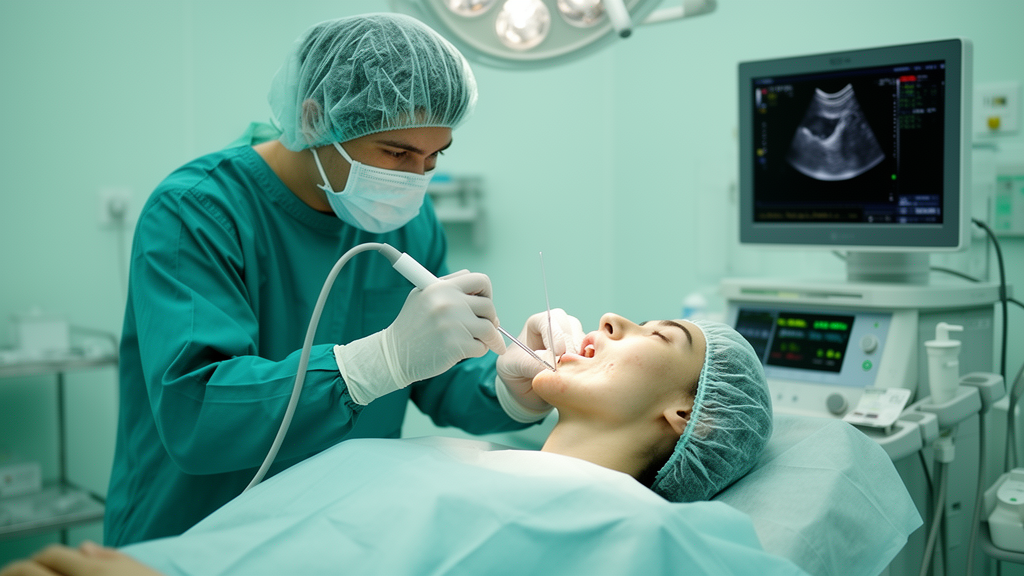
Patients undergoing bimaxillary orthognathic surgery were significantly less likely to experience a marked spike in blood pressure during the most stimulating phase of the operation when an ultrasound-guided trigeminal nerve block was added to general anesthesia, according to a retrospective cohort study published in BMC Anesthesiology. The finding, drawn from 171 adults treated at a single center between April 2024 and March 2025, suggests that this regional technique may blunt the hemodynamic surges that anesthesiologists work hard to control during corrective jaw surgery.
Orthognathic surgery, which repositions the upper and lower jaws through Le Fort I osteotomy combined with bilateral sagittal split ramus osteotomy, is intensely stimulating. Noxious stimuli during the procedure can induce marked fluctuations in mean arterial pressure, and such swings may increase surgical bleeding, impair visibility of the operative field, and reduce surgical precision. Ultrasound-guided trigeminal nerve block, abbreviated USG-TNB, has been used as an adjunct to general anesthesia to attenuate these responses in oral and maxillofacial surgery, but its association with intraoperative hemodynamic control had remained unclear.
The study enrolled adults aged 18 or older with American Society of Anesthesiologists Physical Status I or II. Patients received either the ultrasound-guided trigeminal nerve block combined with local infiltration anesthesia, or local infiltration anesthesia alone. The primary outcome was the incidence of a 20 percent or greater increase in mean arterial pressure during maxillary osteotomy relative to the corresponding pre-osteotomy phase. Because the design was nonrandomized and observational, the researchers adjusted statistically for potential confounders, including the anesthetic maintenance technique and the total volume of 1 percent lidocaine with epinephrine used for intraoral infiltration.
The cohort comprised 95 patients in the block group and 76 in the non-block group. Most demographic and perioperative variables did not differ significantly between the two groups, which strengthens the comparability of the comparison. During maxillary osteotomy, a 20 percent or greater rise in mean arterial pressure occurred in 6.3 percent of patients who received the nerve block, compared with 19.7 percent of those who did not, a difference that was statistically significant with a p value of 0.008. The relative risk was 0.32, with a 95 percent confidence interval of 0.13 to 0.79.
The protective association held after multivariable logistic regression. Ultrasound-guided trigeminal nerve block remained linked to lower odds of the primary outcome, with an adjusted odds ratio of 0.258 and a 95 percent confidence interval of 0.093 to 0.713, and a p value of 0.009. In practical terms, patients receiving the block had roughly a quarter of the adjusted odds of experiencing this blood pressure surge compared with those managed with infiltration alone.
Not every hemodynamic measure moved in the same direction. The researchers observed no significant between-group differences in systolic blood pressure or heart rate, indicating that the block’s apparent benefit was concentrated on mean arterial pressure during the maxillary osteotomy phase rather than on all intraoperative vital signs throughout the operation.
Safety data were reassuring within the limits of the study. No block-related complications were identified among the 95 patients who received the ultrasound-guided trigeminal nerve block.
The study was registered with the University Hospital Medical Information Network Clinical Trials Registry under registration number UMIN000057867 on May 15, 2025. As a retrospective, nonrandomized, single-center observational study, it can demonstrate an association but not causation, and residual confounding cannot be excluded despite the multivariable adjustment. The authors note that the analysis was limited to adjustment for anesthetic maintenance technique and lidocaine-epinephrine infiltration volume, so other unmeasured differences between the groups could have influenced the results.
The conclusion drawn by the researchers is deliberately measured: ultrasound-guided trigeminal nerve block was associated with lower odds of a 20 percent or greater increase in mean arterial pressure during maxillary osteotomy after adjustment for anesthetic maintenance technique and infiltration volume.
Subject of Research: The association between ultrasound-guided trigeminal nerve block and intraoperative hemodynamic responses during bimaxillary orthognathic surgery.
Article Title: Association between ultrasound-guided trigeminal nerve block and intraoperative hemodynamic responses during bimaxillary orthognathic surgery: a retrospective cohort study
Article References: Kawauchi, A., Sato, Y., Ito, T., Yamazaki, Y., Tomomatsu, N., & Maeda, S. (2026). Association between ultrasound-guided trigeminal nerve block and intraoperative hemodynamic responses during bimaxillary orthognathic surgery: a retrospective cohort study. BMC Anesthesiology. https://doi.org/10.1186/s12871-026-04377-8
Image Credits: AI Generated
DOI: 10.1186/s12871-026-04377-8
Keywords: trigeminal nerve block, ultrasound-guided anesthesia, orthognathic surgery, mean arterial pressure, Le Fort I osteotomy, retrospective cohort study, hemodynamic responses, local infiltration anesthesia, BMC Anesthesiology, regional anesthesia, Association, between
News Source: Ophelia Keating. (October 30, 2026). Ultrasound-Guided Trigeminal Nerve Block Tied to Steadier Blood Pressure in Jaw Surgery. Scienmag.



