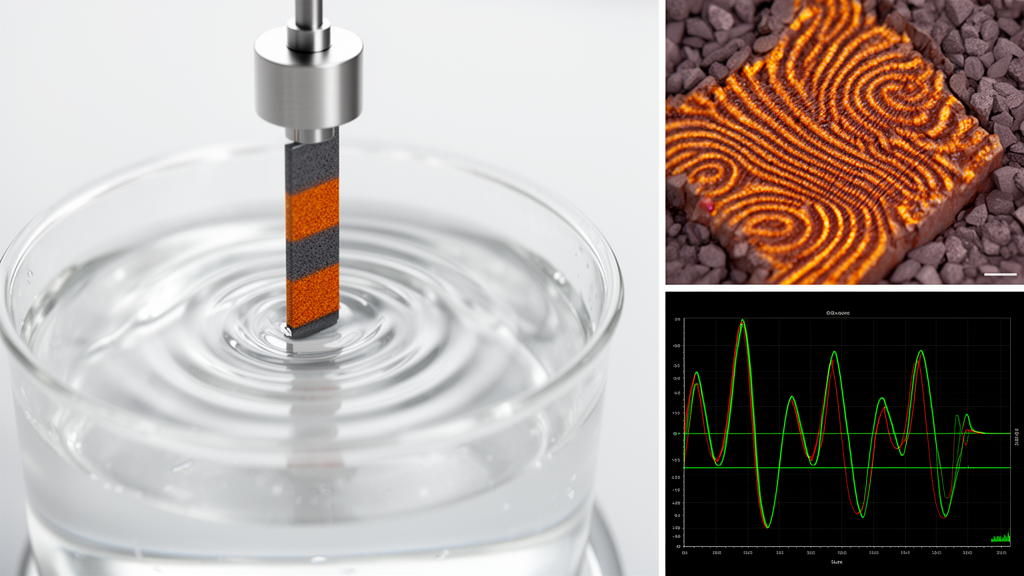
Ultrasonic processing produced its strongest measured electrochemical result in a laboratory study of BiVO₄ composite electrodes containing 20.0 wt% hematite. For that formulation, the fitted charge-transfer resistance, Rct, fell from 10.848 to 2.070 kΩ·cm² after treatment, while the assigned Bode relaxation time decreased from 3.21 × 10⁻² to 5.77 × 10⁻³ s. Repeated cyclic-voltammetry measurements on the same electrode at each tested scan rate also yielded a mean double-layer capacitance, Cdl, of 22.44 ± 1.26 µF cm⁻² for the ultrasonically processed material, compared with 17.26 ± 1.43 µF cm⁻² without ultrasonication, a 30.0% increase.
The study associated these changes with reduced clustering of iron-rich domains before deposition. The researchers prepared monoclinic scheelite BiVO₄ through a sol–gel process and combined it with α-Fe₂O₃, or hematite, at loadings of 11.1, 20.0, or 33.3 wt%. The composites were prepared either by mechanical mixing, designated No-US, or by bath ultrasonication at 48 kHz for 30 minutes, designated US.
They were then deposited by drop-casting onto fluorine-doped tin oxide to create physically biphasic composite electrodes. X-ray diffraction confirmed that both the BiVO₄ and hematite phases were retained after ultrasonic processing. The treatment therefore did not eliminate either constituent oxide phase, although diffraction alone does not establish how extensively the particles were redistributed within the deposited material.
Representative Fe Kα1 maps obtained by field-emission scanning electron microscopy with energy-dispersive X-ray spectroscopy showed less spatial clustering of the iron signal after ultrasonication. The pattern was consistent with hematite-rich regions being more evenly distributed within the composites before deposition, rather than concentrated in larger clusters. This structural observation provides a possible physical context for the electrochemical differences, but the study established a composition-resolved association between particle organization and interfacial behavior rather than proving that redistribution alone caused every measured improvement.
The experiments also concerned particulate electrodes tested without illumination, so their results do not demonstrate the performance of an operating photoelectrochemical device. Electrochemical measurements were performed in non-illuminated 0.5 M Na₂SO₄. The researchers fitted the impedance data with an equivalent circuit containing a series resistance, Rs, connected to a parallel charge-transfer resistance and constant-phase element, expressed as Rs–(Rct ∥ CPE).
Among the six tested combinations of hematite loading and processing method, the ultrasonically processed BVF-20 electrode, containing 20.0 wt% hematite, showed the largest decrease in Rct. It also produced the smallest normalized EC-Lab fit indicator, χ²/|Z| = 0.09186, and the lowest assigned Bode relaxation time. The overall impedance response varied non-monotonically with hematite loading: increasing the hematite fraction across the three tested compositions did not produce a steadily improving result.
Mott–Schottky analysis gave ultrasonically processed BVF-20 the largest apparent donor-density estimate among the composites at both 500 and 1000 Hz. The investigators treated these values as comparative apparent densities rather than direct measurements of bulk carrier concentrations, limiting their interpretation to the tested samples. Together, the diffraction, elemental-mapping, impedance, relaxation-time, cyclic-voltammetry and Mott–Schottky results identify ultrasonically processed BVF-20 as the most favorable of the six formulations for dark interfacial response under the reported conditions.
The work links the pre-deposition organization of iron-rich domains in BiVO₄/hematite composites with improved interfacial electrochemical behavior and presents this composition-specific processing strategy without introducing a dopant or cocatalyst. Because the study was limited to three hematite loadings, two preparation routes, laboratory deposition on conductive glass and measurements in the dark, the results should not be generalized beyond this electrode system without further testing.
Subject of Research: Effects of ultrasonic processing on iron-domain organization and interfacial impedance in BiVO₄/hematite composite electrodes
Article Title: Ultrasonic processing effects on Fe-domain distribution and interfacial impedance of BiVO₄/α-Fe₂O₃ composite electrodes
Article References: Saidatin, N., Purnami, P., Hamidi, N., & Wardana, I. N. G. (2026). Ultrasonic processing effects on Fe-domain distribution and interfacial impedance of BiVO₄/α-Fe₂O₃ composite electrodes. Ionics. https://doi.org/10.1007/s11581-026-07595-9
Image Credits: AI Generated
DOI: 10.1007/s11581-026-07595-9
Keywords: BiVO₄ electrodes, hematite composites, ultrasonication, iron-domain distribution, electrochemical impedance, charge-transfer resistance, cyclic voltammetry, Mott–Schottky analysis, Ultrasonic, processing, effects, Fe-domain
News Source: Denise Maddox. (October 20, 2026). Ultrasonic processing alters iron domains and impedance in BiVO₄/hematite electrodes. Scienmag.