Ultraprocessed foods now supply the majority of calories consumed in the United States, and decades of epidemiological work have tied them to obesity, cancer and metabolic dysfunction. Yet a persistent puzzle has remained: are these foods harmful simply because of what they contain, or because of how industrial processing changes the way the body handles those nutrients? A new randomized, controlled crossover study published in Nature Metabolism offers some of the most direct experimental evidence yet that processing itself rewires the body’s metabolic and neural response to food, even when calories, macronutrients and glycaemic index are held essentially identical.
The research team, led by Zach Hutelin and Alexandra DiFeliceantonio of Virginia Tech’s Fralin Biomedical Research Institute, recruited 57 healthy-weight adults between 18 and 45 years old with body mass indices in the normal range. Participants’ habitual diets contained roughly 54 percent ultraprocessed foods, mirroring the national average of about 55 percent, which the authors argue makes the sample representative of typical Western eating patterns. Thirty-two participants completed both metabolic testing sessions, while 52 completed the functional magnetic resonance imaging arm of the study, and everyone who finished the metabolic sessions also underwent brain scanning.
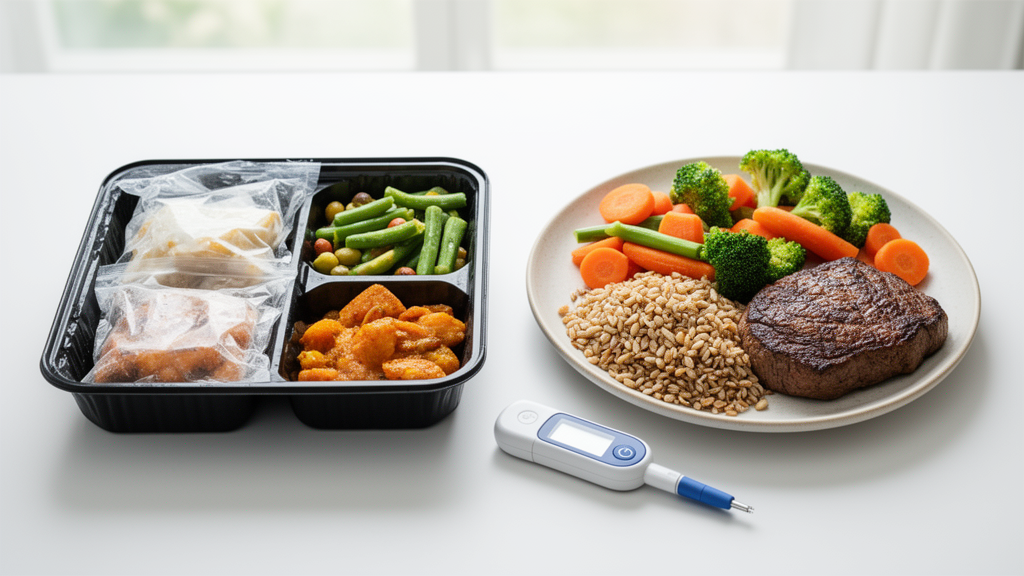
The metabolic experiment was deliberately rigorous. On two separate days, in randomized order, participants entered a whole-room indirect calorimeter for four hours and consumed a roughly 300-kilocalorie meal composed entirely of either ultraprocessed foods or minimally processed alternatives. The two meals were algorithmically matched on weight, energy, energy density, total and available carbohydrate, fat, protein, glycaemic index, glycaemic load, fibre, sodium and water, with deviations of no more than 1.6 percent between conditions. Participants had to finish each meal within ten minutes, and blood was drawn through an intravenous catheter at eight time points spanning from an hour before eating to three hours afterward.
The results were striking. Blood glucose area under the curve did not differ between conditions, exactly as expected given the matched glycaemic indices. But the insulin story was entirely different: the ultraprocessed meal evoked a markedly larger insulinaemic response, with insulin concentrations significantly elevated between 40 and 120 minutes after eating compared with the non-ultraprocessed condition. Post-ingestive metabolic rate was also greater after the ultraprocessed meal, while the respiratory exchange ratio was higher after the whole-food meal, indicating that the body partitioned substrates differently despite identical macronutrient loads. Carbohydrate oxidation rose more robustly after the non-ultraprocessed meal, and fat oxidation was correspondingly greater after the ultraprocessed one.
The authors interpret this pattern as a blunted post-ingestive shift from fat to carbohydrate oxidation following ultraprocessed food consumption, a dynamic that resembles the delayed substrate switching seen in insulin resistance and type 2 diabetes. They suggest a plausible physical mechanism: many ultraprocessed products, though eaten as solids, are engineered to fracture easily in the first bite and combine rapidly with saliva into a lubricated, semi-fluid bolus, accelerating digestion kinetics and increasing nutrient exposure at the proximal small intestine, the site of greatest absorption. Manufacturing techniques designed primarily to optimize oral sensory experience may therefore unintentionally alter downstream metabolic signalling, producing higher insulin output even when peak blood glucose looks the same.
Crucially, the study went beyond metabolism to ask whether these processing-related physiological differences are reflected in the brain. In a separate imaging session, participants viewed pictures of 14 ultraprocessed and 14 non-ultraprocessed foods that had been validated in an independent cohort to be matched on 26 characteristics, including nine visual properties, eleven nutritional characteristics and six perceptual attributes such as liking, familiarity and expected satiety. Participants then bid real money for each item in a Becker–DeGroot–Marschak auction inside the scanner, a task that reliably quantifies subjective food value.
When the researchers regressed the between-condition difference in peak carbohydrate oxidation onto brain responses to non-ultraprocessed versus ultraprocessed food cues, they found whole-brain-corrected associations in the left superior temporal gyrus and, within a predefined striatal region of interest, significant effects in the right caudate and left ventral striatum. A larger carbohydrate oxidation response to whole foods relative to ultraprocessed foods was negatively associated with the neural contrast, extending previous findings from sugar-sweetened beverages to whole foods and reinforcing the idea that carbohydrate metabolism specifically conveys nutrient information from gut to brain through flavour-nutrient learning.
Perhaps the most intriguing finding concerned subjective value. Willingness to pay did not differ between the two food categories after adjusting for perceived healthiness and frequency of consumption, yet the neural encoding of value diverged dramatically. Value signals in the left fusiform gyrus and lingual gyrus, regions of higher-order visual cortex that include the so-called fusiform food area, were positive for non-ultraprocessed items but negative for ultraprocessed ones. The same opposing pattern appeared in the right putamen and caudate, striatal regions central to reward valuation. In other words, even when participants bid the same amounts, their brains represented the worth of ultraprocessed and whole foods in fundamentally different ways, hinting that processing level engages valuation circuitry through mechanisms independent of macronutrient content.
The authors are careful about limitations. Protein sources differed between meals even though total protein was matched, which could have influenced insulin secretion; the study did not directly measure the physical and chemical structure of the food matrix beyond total fibre; and the modest 300-kilocalorie meal size may not generalize to larger loads. Eating rate also differed slightly, with the ultraprocessed meal consumed about 1.5 minutes more slowly, though the team argues this is unlikely to be physiologically meaningful. Because the study was acute and conducted in healthy-weight adults, it cannot establish whether repeated exposure to these altered post-ingestive responses causes chronic disease, only that a plausible mechanism exists.
Even with those caveats, the implications are considerable. The findings provide experimental support for the hypothesis that altered nutritional availability, driven by changes in food structure rather than nutrient labels, is a candidate mechanism linking ultraprocessed food consumption to both metabolic dysfunction and overconsumption. If the gut-to-brain signals that teach us the value of food are systematically amplified or distorted by industrial processing, then two products with identical nutrition facts panels may not be metabolically or neurologically equivalent after all. As regulators and health agencies worldwide grapple with how to respond to the ultraprocessed food era, this study suggests that the degree of processing itself, as captured by the Nova classification, carries physiological consequences that calories and macronutrients alone cannot explain.
Subject of Research: Effects of food processing level on post-ingestive metabolism and brain responses to nutritionally matched meals
Article Title: Metabolic and neural responses to ultraprocessed foods: a randomized, controlled, crossover study
Article References: Hutelin, Z., Ahrens, M., Baugh, M. E., Nartey, E., Herald, D. L., III, Hanlon, A. L., & DiFeliceantonio, A. G. (2026). Metabolic and neural responses to ultraprocessed foods: a randomized, controlled, crossover study. Nature Metabolism. https://doi.org/10.1038/s42255-026-01619-4
Image Credits: AI Generated
DOI: 10.1038/s42255-026-01619-4
Keywords: ultraprocessed foods, Nova classification, insulin response, indirect calorimetry, carbohydrate oxidation, striatum, fMRI, food reward, flavour-nutrient learning, metabolism, nutrition, gut-brain signalling
News Source: Daisy Hatcher. (October 8, 2026). Ultraprocessed Meals Trigger Stronger Insulin Spikes Than Identical Nutrients in Whole Foods. Scienmag.