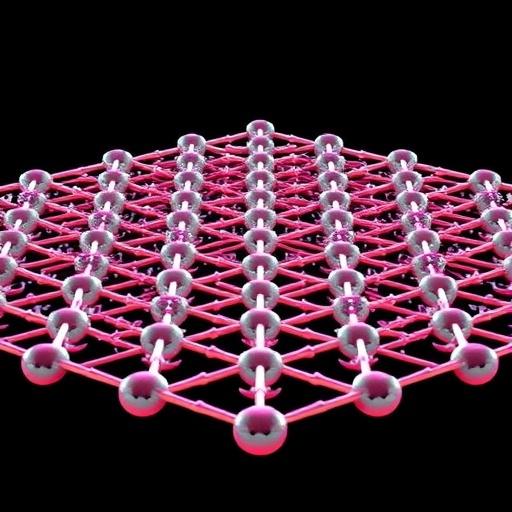
In a groundbreaking advancement that promises to reshape the landscape of photonic device engineering, a team of researchers led by Zhou, Jin, and He has unveiled a novel approach to achieving ultrahigh-Q resonances in tetramer metasurfaces. Detailed in their recent publication, this pioneering work introduces the concept of centroid symmetry protection combined with stringent area conservation, culminating in a metasurface design that exhibits extraordinary resonance robustness. This breakthrough carries profound implications for enhancing the performance of optical sensors, lasers, and a broad array of photonic components integral to modern technology.
The crux of this research lies in meticulously engineered tetramer metasurfaces, where the arrangement and symmetry of constituent nanostructures play a pivotal role in governing resonant behaviors. Traditionally, attaining ultrahigh quality (Q) factors in metasurface resonances has been an elusive target due to intrinsic material losses and environmental perturbations. The newly proposed framework leverages centroid symmetry—a symmetry that accounts for the geometric center of the unit cells—and employs it as a protective mechanism to sustain resonance integrity even under perturbations that would ordinarily degrade performance.
A key conceptual leap in this study is the imposition of area conservation conditions alongside centroid symmetry preservation. By enforcing the conservation of the tetramer’s effective area during structural deformations, the authors demonstrate that localized resonances can maintain their coherence and energy confinement, substantially extending their lifetimes. This dual-constraint design paradigm effectively decouples the resonance quality from extraneous geometric variations, thereby fostering ultrahigh-Q modes with notable resilience.
To reach these conclusions, the researchers utilized advanced numerical simulations coupled with rigorous theoretical modeling, grounded in electromagnetic theory and perturbation analyses. The models explicitly reveal how centroid symmetry acts as a topological safeguard in the metasurface, ensuring that specific symmetry-protected modes exhibit minimal radiative loss. In conjunction, the area conservation maintains the balance of electromagnetic fields localized within the metasurface, optimizing mode confinement and quality.
One of the pivotal outcomes of this work is the demonstration that the ultrahigh-Q resonances manifest robustly even when the tetramer’s geometry undergoes slight distortions—a scenario common in real-world applications where fabrication imperfections or operational stress can alter nominal structures. This robustness signals a substantial leap in the practical viability of metasurface-based photonic devices, promising enhanced operational stability without sacrificing performance.
Furthermore, the authors explore the interplay between the tetramer’s structural parameters and the resonant mode characteristics, meticulously charting how variations in centroid positioning and area conservation influence resonance frequency and linewidth. Such detailed parametric mapping equips designers with a versatile toolkit to tailor metasurface resonances precisely to application-specific needs, ranging from sharp spectral filters to ultra-sensitive sensors.
The ramifications of this study extend beyond fundamental photonics, touching upon emerging fields such as quantum information processing and nonlinear optics where controlled light-matter interaction at the nanoscale is paramount. The ultrahigh-Q modes elucidated here could facilitate prolonged photon lifetimes and intensified field enhancements, vital for efficient quantum state manipulation and frequency conversion processes.
Importantly, the research team underscores the scalability of their work, emphasizing that the principles of centroid symmetry protection and area conservation are not confined to a narrow class of materials or wavelengths. Instead, these principles show promise across a spectrum of metasurface implementations, potentially spanning from near-infrared to visible and even terahertz regimes, thus broadening the horizon for multidisciplinary applications.
This development also provides fertile ground for future exploration into novel metasurface configurations. By extending the symmetry and conservation laws to more complex multi-element unit cells, researchers may unlock an even richer variety of protected resonance phenomena. The resultant metasurfaces might exhibit tailored dispersion properties or directional emission characteristics, unlocking new functionalities hitherto inaccessible in conventional designs.
From the perspective of materials science and nanofabrication, implementing centroid-symmetry-protected tetramer metasurfaces will spur innovation in precision patterning and nanoscale assembly. The precise control over element placement and deformation required by this approach calls for next-generation lithographic and self-assembly methods that can deliver the requisite accuracy and repeatability, thereby catalyzing advances in fabrication technology.
As the scientific community digests these exciting results, there is a growing anticipation that these robust ultrahigh-Q resonances might serve as a foundational platform for integrated photonic circuits. The potential for low loss, high-Q metasurface resonances supports tighter integration of photonic components on-chip, translating to enhanced performance, miniaturization, and new design freedoms for optical information technologies.
The broader scientific impact of this research is underscored by its alignment with the quest for enhanced light manipulation strategies. By harnessing protected symmetry properties in metasurfaces, the study sidesteps many traditional loss mechanisms, offering a fresh paradigm in photonics design. This approach bridges theoretical physics concepts with tangible engineering applications, embodying the interdisciplinary nature of modern cutting-edge research.
In conclusion, the work by Zhou, Jin, He, and their colleagues marks a transformative milestone in the field of metasurface photonics. The innovative harnessing of centroid symmetry protection alongside area conservation opens a new frontier wherein ultrahigh-Q resonances can be engineered with unprecedented robustness and flexibility. This insight not only enriches our fundamental understanding of light-matter interactions at the nanoscale but also heralds a new era of metasurface-enabled technologies with widespread commercial and scientific relevance.
With the continuous evolution of metasurface research, this breakthrough sets the stage for an era of resilient and high-performance photonic devices capable of operating under challenging conditions while maintaining superior optical characteristics. The prospect of integrating these robust ultrahigh-Q resonators into real-world applications is poised to revolutionize sectors ranging from telecommunications and sensing to advanced computing and beyond.
As experimental validations and material explorations progress, the principles elucidated in this study may well become cornerstones in the design of next-generation optical platforms. The synergy between symmetry protection and geometric conservation is likely to inspire further theoretical investigations aimed at uncovering new symmetry-protected phenomena and pushing the boundaries of what is achievable with engineered nanostructured surfaces.
In essence, this advance not only exemplifies the power of fundamental symmetry considerations in photonics but also paves a promising pathway toward the creation of robust and finely tunable optical devices meeting the ever-increasing demands of modern technological applications.
Subject of Research: Ultrahigh-Q resonances in tetramer metasurfaces enabled by centroid symmetry protection and area conservation.
Article Title: Robust ultrahigh-Q resonances in tetramer metasurfaces through centroid symmetry protection and area conservation.
Article References:
Zhou, C., Jin, R., He, H. et al. Robust ultrahigh-Q resonances in tetramer metasurfaces through centroid symmetry protection and area conservation. Light Sci Appl 15, 84 (2026). https://doi.org/10.1038/s41377-025-02164-7
Image Credits: AI Generated
DOI: 23 January 2026
Tags: area conservation in metasurface designcentroid symmetry in resonanceenvironmental perturbations in photonicsinnovative photonic componentslaser technology improvementsnanostructure arrangement in metasurfacesoptical sensor performance enhancementphotonic device engineering advancementsrobust resonance mechanismssymmetry protection in photonicstetramer metasurfacesUltrahigh-Q resonances