• HOME
  • NEWS
  • EXPLORE
    • CAREER
      • Companies
      • Jobs
    • EVENTS
    • iGEM
      • News
      • Team
    • PHOTOS
    • VIDEO
    • WIKI
  • BLOG
  • COMMUNITY
    • FACEBOOK
    • INSTAGRAM
    • TWITTER
Saturday, February 7, 2026
BIOENGINEER.ORG
No Result
View All Result
  • Login
  • HOME
  • NEWS
  • EXPLORE
    • CAREER
      • Companies
      • Jobs
        • Lecturer
        • PhD Studentship
        • Postdoc
        • Research Assistant
    • EVENTS
    • iGEM
      • News
      • Team
    • PHOTOS
    • VIDEO
    • WIKI
  • BLOG
  • COMMUNITY
    • FACEBOOK
    • INSTAGRAM
    • TWITTER
  • HOME
  • NEWS
  • EXPLORE
    • CAREER
      • Companies
      • Jobs
        • Lecturer
        • PhD Studentship
        • Postdoc
        • Research Assistant
    • EVENTS
    • iGEM
      • News
      • Team
    • PHOTOS
    • VIDEO
    • WIKI
  • BLOG
  • COMMUNITY
    • FACEBOOK
    • INSTAGRAM
    • TWITTER
No Result
View All Result
Bioengineer.org
No Result
View All Result
Home NEWS Science News

Ultrafast detection of a cancer biomarker enabled by innovative nanobiodevice

Bioengineer by Bioengineer
March 8, 2017
in Science News
Reading Time: 2 mins read
0
Share on FacebookShare on TwitterShare on LinkedinShare on RedditShare on Telegram
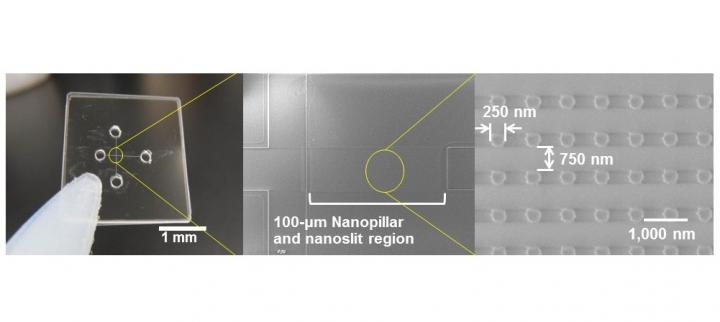
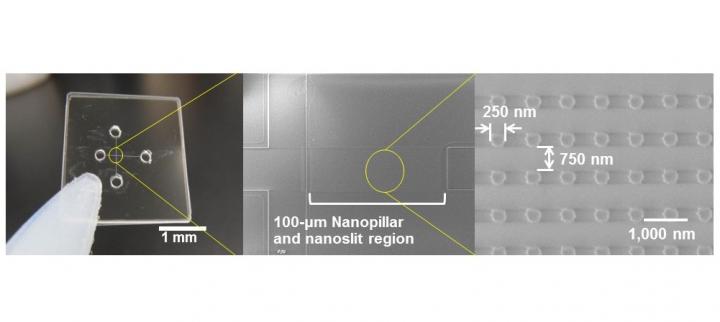
IMAGE

Credit: Noritada Kaji

Nagoya, Japan – Like DNA, ribonucleic acid (RNA) is a type of polymeric biomolecule essential for life, playing important roles in gene processing. Short lengths of RNA called microRNA are more stable than longer RNA chains, and are found in common bodily fluids. The level of microRNA in bodily fluids is strongly correlated with the presence and advance of cancer. This means that microRNA can act as an easily accessible biomarker to diagnose cancer, which causes over 14% of deaths annually worldwide.

To use microRNA as a biomarker for cancer, it needs to be isolated by a rapid, efficient process. A collaboration led by researchers at Nagoya University has developed an innovative nanobiodevice that can separate microRNA from DNA/RNA mixtures obtained from cells in less than 100 ms.

The nanobiodevice consists of a quartz substrate containing a 25×100 μm array of "nanopillars" (small columns with a diameter of 250 nm and height of 100 nm) in shallow "nanoslits" with a height of 100 nm and fabricated in a microchannel by electron beam lithography.

The ability of the nanobiodevice to separate microRNA from DNA was first investigated using mixtures containing components with known concentrations. The team optimized the separation conditions, achieving almost complete separation of microRNA from DNA in just 20 ms. This is the fastest complete separation of microRNA to date.

The researchers then separated a mixture of microRNA, RNA, and DNA isolated from cells using the nanobiodevice. Separation with high resolution was realized in 100 ms. The nanobiodevice separated microRNA from RNA and DNA because of the different mobilities of these materials through the nanopillar region of the microchannel.

"We believe that the nanobiodevice separates microRNA from mixtures through a combination of two different physical behaviors of confined polymers in the nanopoillar array, non-equilibrium transport and entropic trapping," corresponding author Noritada Kaji says. "The applied electric field combines with the unique nanostructure of the nanobiodevice to generate a strong electric force that induces rapid concentration and separation."

The speed at which this nanobiodevice can separate microRNA from complex mixtures means that it is promising for integration with nanopore DNA sequencing, which aims to realize direct sequencing of DNA or RNA at a rate of 1 base/ms. The developed nanobiodevice separation approach may lead to faster, more reliable isolation of microRNA, facilitating its use as a biomarker to allow quicker and easier detection of cancer.

This study was conducted by Nagoya University, Kyushu University, Hokkaido University, and Osaka University.

The article, "A millisecond micro-RNA separation technique by a hybrid of nanopillars and nanoslits" was published in Scientific Reports at DOI: 10.1038/srep43877

###

Media Contact

Koomi Sung
[email protected]

http://www.nagoya-u.ac.jp/en/

############

Story Source: Materials provided by Scienmag

Share12Tweet8Share2ShareShareShare2

Related Posts

Succinate Receptor 1 Limits Blood Cell Formation, Leukemia

February 7, 2026

Palmitoylation of Tfr1 Drives Platelet Ferroptosis and Exacerbates Liver Damage in Heat Stroke

February 7, 2026

Oxygen-Enhanced Dual-Section Microneedle Patch Improves Drug Delivery and Boosts Photodynamic and Anti-Inflammatory Treatment for Psoriasis

February 7, 2026

Scientists Identify SARS-CoV-2 PLpro and RIPK1 Inhibitors Showing Potent Synergistic Antiviral Effects in Mouse COVID-19 Model

February 7, 2026
Please login to join discussion

POPULAR NEWS

  • Robotic Ureteral Reconstruction: A Novel Approach

    Robotic Ureteral Reconstruction: A Novel Approach

    82 shares
    Share 33 Tweet 21
  • Digital Privacy: Health Data Control in Incarceration

    63 shares
    Share 25 Tweet 16
  • Study Reveals Lipid Accumulation in ME/CFS Cells

    57 shares
    Share 23 Tweet 14
  • Breakthrough in RNA Research Accelerates Medical Innovations Timeline

    53 shares
    Share 21 Tweet 13

About

We bring you the latest biotechnology news from best research centers and universities around the world. Check our website.

Follow us

Recent News

Succinate Receptor 1 Limits Blood Cell Formation, Leukemia

Palmitoylation of Tfr1 Drives Platelet Ferroptosis and Exacerbates Liver Damage in Heat Stroke

Oxygen-Enhanced Dual-Section Microneedle Patch Improves Drug Delivery and Boosts Photodynamic and Anti-Inflammatory Treatment for Psoriasis

Subscribe to Blog via Email

Enter your email address to subscribe to this blog and receive notifications of new posts by email.

Join 73 other subscribers
  • Contact Us

Bioengineer.org © Copyright 2023 All Rights Reserved.

Welcome Back!

Login to your account below

Forgotten Password?

Retrieve your password

Please enter your username or email address to reset your password.

Log In
No Result
View All Result
  • Homepages
    • Home Page 1
    • Home Page 2
  • News
  • National
  • Business
  • Health
  • Lifestyle
  • Science

Bioengineer.org © Copyright 2023 All Rights Reserved.