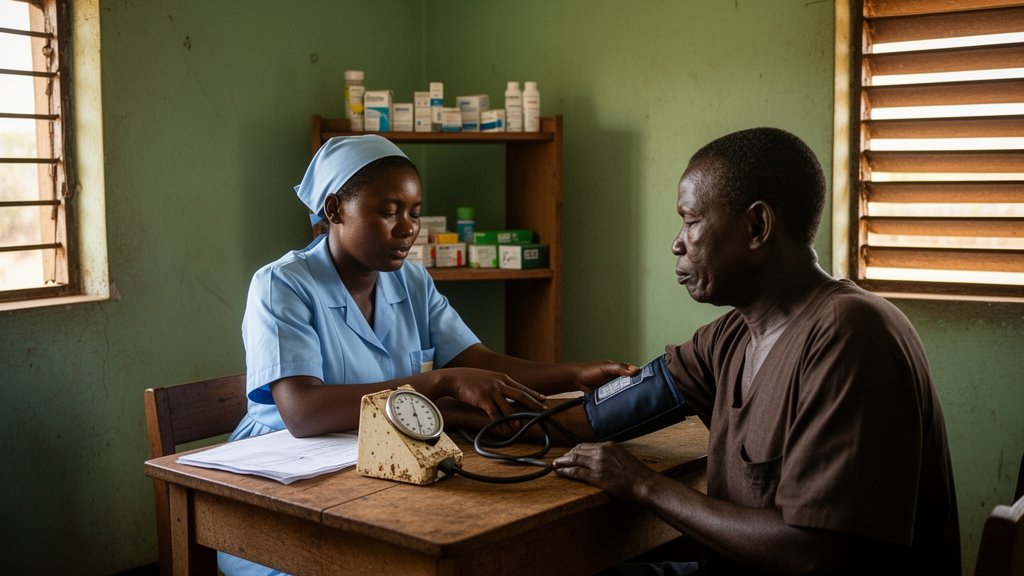
Healthcare providers working in HIV clinics around Kampala and Wakiso, Uganda, report substantial gaps in their knowledge of hypertension care, along with shortages of blood pressure devices, medicines and reporting tools, according to a formative mixed-methods study published in BMC Health Services Research. The survey and interview study, conducted between June and November 2021, was designed to inform the development of a sustainable model for integrating hypertension care into primary health care HIV clinics in urban and peri-urban Uganda. Despite existing national guidelines for integrating HIV and hypertension care, access to quality hypertension treatment in Uganda remains largely confined to a small number of tertiary HIV clinics.
The research team, led by John Baptist Kiggundu and colleagues, set out to document the current state of hypertension care in HIV settings, to measure providers' knowledge, attitudes and practices, and to gather the perceptions of providers, healthcare managers and policymakers about integrated HIV-hypertension care. The study used a parallel convergent mixed-methods design at ten HIV clinics across the two districts. The quantitative component consisted of a survey of 89 healthcare providers involved in routine HIV care, recruited consecutively.
The qualitative component involved semi-structured key informant interviews with 40 providers and 6 healthcare managers, selected purposively. Interviews were audio recorded, transcribed, and coded inductively through an iterative process; the resulting codes were then mapped deductively onto the updated Consolidated Framework for Implementation Research, a widely used implementation science framework. Quantitative data were analysed in Stata 14, with categorical variables summarised as proportions and frequencies and continuous variables summarised using medians and interquartile ranges.
Results were stratified by district. The surveyed providers had a median age of 35 years, with an interquartile range of 29 to 45 years, and 62 percent were female. Across the sample, providers reported having received no in-service training on hypertension, holding insufficient knowledge about the condition, and having limited access to simplified protocols for hypertension treatment.
The ten clinics showed varying levels of HIV-hypertension integration in practice. When asked about the main obstacles to providing integrated care, providers pointed to an insufficient number of functional blood pressure devices, shortages of anti-hypertensive medicines, a lack of reporting tools, and an absence of feedback on hypertension care metrics. These findings map directly onto the implementation barriers the researchers were probing: even where providers are willing to deliver combined care, the material infrastructure to measure blood pressure, prescribe and track treatment, and monitor outcomes is missing at the clinic level.
Attitudes, by contrast, emerged as a clear asset. Despite the hindrances they described, providers expressed willingness to integrate HIV and hypertension care, citing expected benefits that included reduced client waiting time, lower costs for patients, and reduced workload for staff. The triangulation of survey data with interview data is characteristic of convergent mixed-methods designs, in which quantitative and qualitative strands are collected in parallel and brought together at the interpretation stage to build a fuller picture of the implementation context.
The authors characterise the work as formative assessment: its purpose is not to test an intervention but to establish the baseline conditions under which one would be designed. On that basis, they conclude that the identified gaps in hypertension care within HIV clinics in urban and peri-urban Uganda provide the context for designing a robust and sustainable model for integrating hypertension and HIV care in primary health care HIV clinics. In other words, the study supplies the diagnostic evidence, training deficits, equipment and drug shortages, missing protocols and reporting systems, alongside demonstrated provider willingness, that a subsequent implementation model would need to address.
As with any single-district formative study, the results describe conditions in ten clinics in Kampala and Wakiso during a defined 2021 survey period and are not an outcome evaluation; the value of the work lies in its detailed, provider-level mapping of what is missing and what is promising in the move toward integrated chronic disease care.
Subject of Research: Knowledge, attitudes and practices of healthcare providers regarding integrated HIV-hypertension care in Ugandan primary care HIV clinics
Article Title: Addressing gaps in healthcare providers’ knowledge, attitudes, and practices to establish a sustainable model for integrated HIV-hypertension care in Uganda
Article References: Kiggundu, J. B., Semitala, F. C., Ayebare, F., Kiwala, C., Senfuma, J., Mutungi, G., Ssinabulya, I., Spiegelman, D., Kayima, J., Muddu, M., Schwartz, J. I., Katahoire, A. R., & Longenecker, C. T. (2026). Addressing gaps in healthcare providers’ knowledge, attitudes, and practices to establish a sustainable model for integrated HIV-hypertension care in Uganda. BMC Health Services Research. https://doi.org/10.1186/s12913-026-15522-x
Image Credits: AI Generated
DOI: 10.1186/s12913-026-15522-x
Keywords: HIV, hypertension, Uganda, integrated care, primary health care, healthcare providers, mixed methods, implementation research, non-communicable diseases, sub-Saharan Africa, health systems, BMC Health Services Research
News Source: Ophelia Keating. (October 28, 2026). Ugandan HIV clinics lack tools and training to treat hypertension, survey finds. Scienmag.