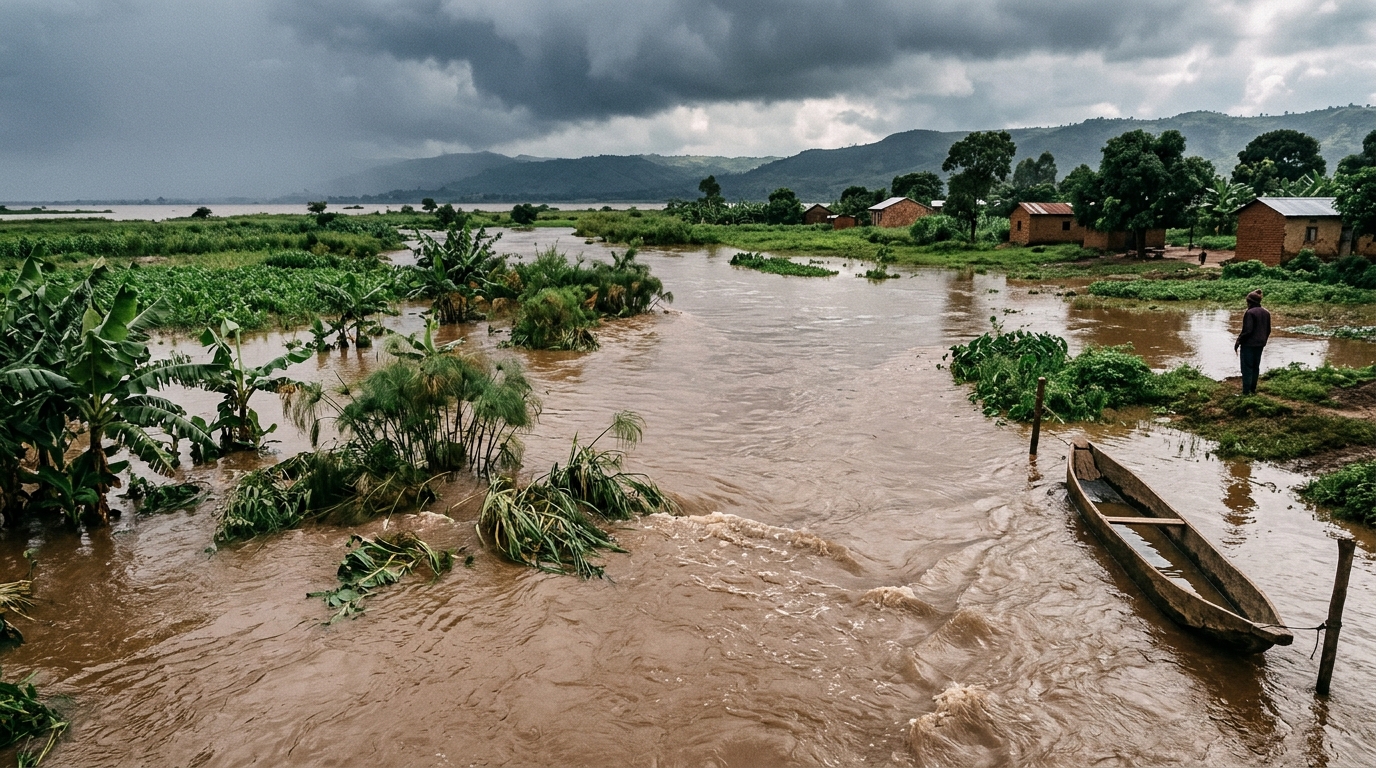
A new study published in Discover Applied Sciences assesses future flood risk in the River Nyamugasani Basin in Uganda’s Rwenzori region, where flooding increasingly threatens settlements, livelihoods, and essential services. The research integrates hydrological and hydrodynamic modelling to evaluate how climate change may alter flood hazards, exposure, and socioeconomic impacts in the basin. The study aims to provide evidence for future-climate planning, a domain where such data has previously been limited for this specific region of Uganda.
The researchers utilized bias-corrected rainfall data from 11 CMIP6 models to drive the HEC-HMS hydrological model. These simulations were conducted under three Shared Socioeconomic Pathways: SSP1-2.6, SSP2-4.5, and SSP5-8.5. Annual maximum discharges were fitted with the Generalized Extreme Value distribution and subsequently passed to HEC-RAS 2D for hydrodynamic inundation mapping. This multi-model approach allows for a range of potential climate outcomes to be considered in the risk assessment.
Under the high-emission SSP5-8.5 scenario, the estimated 100-year discharge increased significantly from a baseline of 61.9 cubic meters per second to 126.0 cubic meters per second. The baseline estimate carried a 95% confidence interval of 44.1 to 95.7 cubic meters per second, while the future projection had a 95% confidence interval of 113.9 to 140.7 cubic meters per second.
The corresponding inundated area expanded from 16.05 square kilometers at baseline to 22.96 square kilometers under the SSP5-8.5 scenario. As a result of this expanded flood extent, the exposed population rose from 4,862 individuals to 6,956 individuals.
The study also estimated direct physical losses to critical infrastructure, including schools, health facilities, and religious institutions. These losses were calculated at USD 1.91 million in constant June 2025 prices. A combined sensitivity analysis revealed a range of USD 1.09 million to USD 2.69 million, reflecting the uncertainty inherent in damage estimation models.
Management options were ranked using household surveys and expert ratings to identify preferred structural and non-structural measures. Diversion channels and gabion revetments emerged as the preferred structural measures for flood mitigation. In the non-structural category, flood forecasting and warning systems were identified as the leading priority.
Despite the detailed modelling, the study notes significant limitations in model calibration. Attempts to calibrate both HEC-HMS and SWAT models showed weak performance due to limited available observational data. Consequently, the final HEC-HMS discharge series was generated using physically estimated parameters rather than a calibrated parameter set. This means the discharge, inundation, exposure, and damage estimates should be interpreted as scenario-based screening results rather than precise engineering-design values.
The study supports the use of these results for floodplain zoning, prioritizing the protection of critical facilities, and expanding forecasting and warning systems. It also suggests a phased evaluation of structural flood-management measures, providing a framework for adaptive management in the face of increasing climate uncertainty.
Subject of Research: Climate-driven flood risk and socioeconomic impacts in the River Nyamugasani Basin, Uganda
Article Title: Integrated hydrological and hydrodynamic modelling of climate driven flood risk and socioeconomic impacts in the River Nyamugasani Basin in Uganda
Article References: Betungura, A., Mubialiwo, A., & Aluku, H. (2026). Integrated hydrological and hydrodynamic modelling of climate driven flood risk and socioeconomic impacts in the River Nyamugasani Basin in Uganda. Discover Applied Sciences. https://doi.org/10.1007/s42452-026-09794-5
Image Credits: AI Generated
DOI: 10.1007/s42452-026-09794-5
Keywords: flood risk, climate change, Uganda, hydrological modelling, socioeconomic impacts, CMIP6, HEC-HMS, HEC-RAS, Rwenzori region, flood management, Integrated, hydrological
News Source: Violet Maxwell. (November 7, 2026). Uganda Flood Study Projects Significant Climate-Driven Risk Increases. Scienmag.