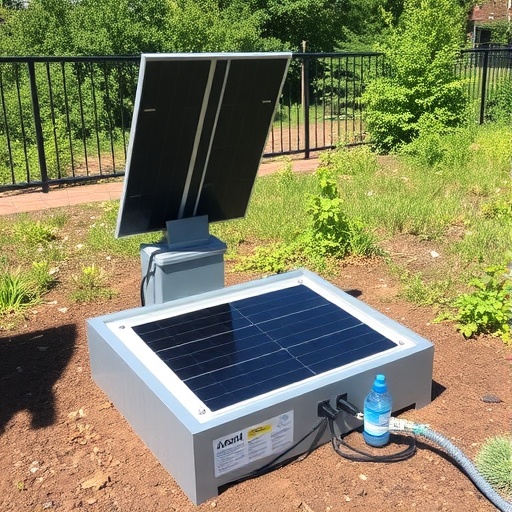
In many parts of the developed world, the provision of clean and safe drinking water is a largely seamless service, managed efficiently by municipalities equipped with cutting-edge filtration and ultraviolet (UV) light disinfection technologies. These sophisticated systems ensure that citizens rarely need to worry about their tap water’s safety, and many homes add additional filtration units for extra security. However, in numerous regions, particularly in the Global South including parts of Africa and South America, access to such advanced technology remains limited. Yet, these sun-drenched areas possess a unique advantage in the challenge of water purification: abundant solar energy.
Researchers led by Eric Ryberg, an assistant professor specializing in allied health sciences at Yale University’s College of Agriculture, Health and Natural Resources (CAHNR), have pioneered an innovative solar-powered water disinfection system that ingeniously integrates multiple existing solar-based purification methods. Their work, published in the prestigious journal npj Clean Water, showcases a novel approach designed for scalable deployment in resource-limited settings, harnessing the sun’s power to improve water quality without reliance on expensive infrastructure or continuous fuel sources.
Unlike conventional boiling methods, which are energy-intensive and thus less practical for many households, this system employs a multi-faceted approach to pathogen inactivation. Boiling requires sustained heat sufficient to denature microbial proteins and nucleic acids but carries high fuel costs and environmental impacts. The new device combines physical filtration, solar pasteurization, UV-driven disinfection, and a cutting-edge photosensitization technique—all harmonized to maximize efficiency and safety through solar energy.
Physical filtration remains foundational to water purification by mechanically removing large contaminants such as protozoa and sediment. Ceramic pot filters, for example, have long been used to block microbial particles. Solar pasteurization then heats the filtered water to temperatures sufficient to eliminate many bacteria and viruses but consumes about half the energy of boiling. However, the efficacy of pasteurization declines markedly during cloudy weather and in colder seasons, limiting its year-round reliability.
Solar disinfection (SODIS) leverages UVA and UVB rays from sunlight to inactivate pathogens. On sunny days, leaving a bottle of water exposed to direct sunlight for approximately six hours can reduce bacterial populations by over 99.9%. UVA light works by inducing oxidative stress through reactive oxygen species generated when ultraviolet radiation interacts with water compounds and microbial cells. UVB, which causes human sunburn, directly inflicts DNA damage on microorganisms. Yet, viruses, with their smaller size and different biological makeup, require significantly longer sunlight exposure—up to 30 hours—for effective inactivation, making SODIS less reliable against them.
To address these limitations, Ryberg’s team employed a photosensitization process involving photosensitizers—compounds that absorb solar photons and transfer energy to oxygen molecules in water, generating reactive, excited oxygen species capable of attacking even the most resilient viruses. This mechanism is especially valuable since viruses are notoriously difficult to neutralize with filtration or pasteurization alone. By integrating this method, the device offers a robust defense against a broader spectrum of pathogens.
An innovative aspect of Ryberg’s system lies in its use of erythrosine, a familiar red food dye, as the photosensitizer. This choice not only facilitates the generation of reactive oxygen species under sunlight but also provides a practical, visual indicator of water safety: as erythrosine breaks down during the disinfection process, the water’s color fades, signaling to users when the water has reached a safe drinking standard. This feature cleverly overcomes a common limitation of solar disinfection methods, which lack immediate feedback on treatment completeness.
Testing under controlled conditions with peak sunlight intensities around 1100 watts per square meter showed that the device achieves safe water standards in under one hour for initial batches and just 28 minutes for subsequent ones. Field trials conducted in Guatemala at a sunlight intensity of 1050 watts per square meter closely matched these results, validating the model’s predictive power. Such rapid disinfection times are crucial for practicality in daily use.
Furthermore, rigorous modeling across varied climates, including Cape Town’s pronounced dry and wet seasons, Guatemala’s fluctuating sunlight availability, and the consistently sun-soaked city of Phoenix, Arizona, indicated the system’s capacity to reliably provide the United Nations recommended 50 liters of potable water per person per day. Impressively, this level of service could be maintained all but 20 days annually, even in locations with challenging weather patterns, suggesting great potential for year-round application in diverse environments.
Scalability is also a key highlight of this development. The compact modular design allows the system to be deployed at the individual household level or expanded to serve entire communities, depending on local needs and resources. This flexibility facilitates tailored strategies for water safety that can evolve as infrastructure and demand grow, presenting a sustainable, adaptive solution for many underserved populations.
Looking forward, Ryberg’s research group is exploring natural photosensitizers as alternatives to synthetic dyes like erythrosine, aiming to reduce potential toxicological risks and environmental impacts. Early investigations have focused on chlorophyll—the green pigment in plants—and hypericin, found in St. John’s Wort, both of which hold promise due to their natural occurrence and light-activated properties. Transitioning to such materials would align the technology more closely with principles of green chemistry and sustainability.
Overall, this pioneering work represents a significant advance in the quest for accessible, efficient, and reliable water purification technologies worldwide. By creatively integrating multiple solar-driven disinfection mechanisms, Ryberg and colleagues have developed a system that transcends the limitations of individual methods alone, offering a dignified and practical route to safe drinking water for millions who currently face daily challenges in securing this most vital resource.
Subject of Research: Not applicable
Article Title: Building-integrated solar water disinfection system for reliable year-round drinking water safety.
News Publication Date: 5-Feb-2026
Web References: http://dx.doi.org/10.1038/s41545-025-00539-2
References: Ryberg et al., npj Clean Water, 2026
Keywords: Water resources, solar water disinfection, photosensitizers, erythrosine, solar pasteurization, UV water treatment
Tags: clean drinking water in developing countriesinnovative water purification researchlow-cost water disinfection solutionspathogen inactivation using solar powerscalable water purification systemssolar energy for water sanitationsolar water purification technologysolar-powered water disinfection systemsustainable water treatment methodsUV light and solar combined water treatmentwater quality improvement in resource-limited areasYale University water research