• HOME
  • NEWS
  • EXPLORE
    • CAREER
      • Companies
      • Jobs
    • EVENTS
    • iGEM
      • News
      • Team
    • PHOTOS
    • VIDEO
    • WIKI
  • BLOG
  • COMMUNITY
    • FACEBOOK
    • INSTAGRAM
    • TWITTER
Wednesday, May 13, 2026
BIOENGINEER.ORG
No Result
View All Result
  • Login
  • HOME
  • NEWS
  • EXPLORE
    • CAREER
      • Companies
      • Jobs
        • Lecturer
        • PhD Studentship
        • Postdoc
        • Research Assistant
    • EVENTS
    • iGEM
      • News
      • Team
    • PHOTOS
    • VIDEO
    • WIKI
  • BLOG
  • COMMUNITY
    • FACEBOOK
    • INSTAGRAM
    • TWITTER
  • HOME
  • NEWS
  • EXPLORE
    • CAREER
      • Companies
      • Jobs
        • Lecturer
        • PhD Studentship
        • Postdoc
        • Research Assistant
    • EVENTS
    • iGEM
      • News
      • Team
    • PHOTOS
    • VIDEO
    • WIKI
  • BLOG
  • COMMUNITY
    • FACEBOOK
    • INSTAGRAM
    • TWITTER
No Result
View All Result
Bioengineer.org
No Result
View All Result
Home NEWS Science News Chemistry

UCLA physicists develop world’s best quantum bits

Bioengineer by Bioengineer
May 18, 2020
in Chemistry
Reading Time: 2 mins read
0
IMAGE
Share on FacebookShare on TwitterShare on LinkedinShare on RedditShare on Telegram

IMAGE

Credit: Stuart Wolpert

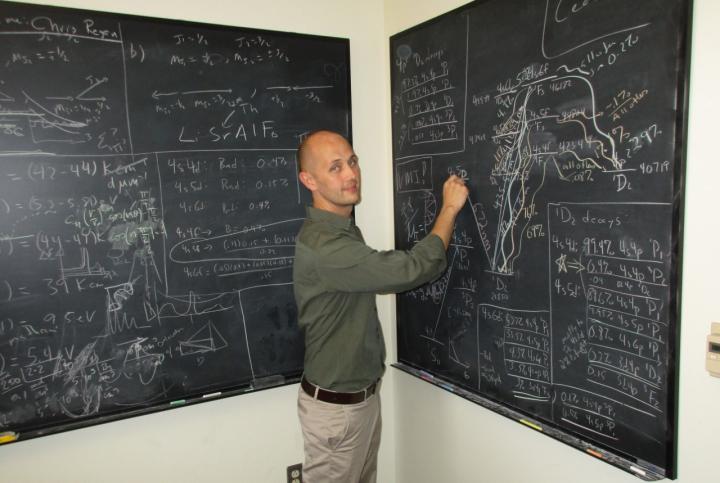
A team of researchers at UCLA has set a new record for preparing and measuring the quantum bits, or qubits, inside of a quantum computer without error. The techniques they have developed make it easier to build quantum computers that outperform classical computers for important tasks, including the design of new materials and pharmaceuticals. The research is published in the peer-reviewed, online open-access journal, npj Quantum Information, published by Nature and including the exceptional research on quantum information and quantum computing.

Currently, the most powerful quantum computers are “noisy intermediate-scale quantum” (NISQ) devices and are very sensitive to errors. Error in preparation and measurement of qubits is particularly onerous: for 100 qubits, a 1% measurement error means a NISQ device will produce an incorrect answer about 63% of the time, said senior author Eric Hudson, a UCLA professor of physics and astronomy.

To address this major challenge, Hudson and UCLA colleagues recently developed a new qubit hosted in a laser-cooled, radioactive barium ion. This “goldilocks ion” has nearly ideal properties for realizing ultra-low error rate quantum devices, allowing the UCLA group to achieve a preparation and measurement error rate of about 0.03%, lower than any other quantum technology to date, said co-senior author Wesley Campbell, also a UCLA professor of physics and astronomy.

The development of this exciting new qubit at UCLA should impact almost every area of quantum information science, Hudson said. This radioactive ion has been identified as a promising system in quantum networking, sensing, timing, simulation and computation, and the researchers’ paper paves the way for large-scale NISQ devices.

###

Co-authors are lead author Justin Christensen, a postdoctoral scholar in Hudson’s laboratory, and David Hucul, a former postdoctoral scholar in Hudson and Campbell’s laboratories, who is now a physicist at the U.S. Air Force Research Laboratory.

The research is funded by the U.S. Army Research Office.

Campbell and Hudson are primary investigators of a major $2.7 million U.S. Department of Energy Quantum Information Science Research project to lay the foundation for the next generation of computing and information processing, as well as many other innovative technologies.

Media Contact
Stuart Wolpert
[email protected]

Original Source

https://www.college.ucla.edu/2020/05/15/ucla-physicists-develop-worlds-best-quantum-bits/

Tags: Chemistry/Physics/Materials SciencesComputer ScienceParticle PhysicsTechnology/Engineering/Computer Science
Share12Tweet8Share2ShareShareShare2

Related Posts

Gravitational Wave Detectors Now Feature Automatic Signal Tuning — Chemistry

Gravitational Wave Detectors Now Feature Automatic Signal Tuning

May 13, 2026
Harnessing Neural Networks for Advances in Nonlinear Optics — Chemistry

Harnessing Neural Networks for Advances in Nonlinear Optics

May 12, 2026

Innovative Method Unveiled to Detect Signs of Dark Matter

May 12, 2026

Illuminating the Science Behind Historical Featherwork Art

May 12, 2026
Please login to join discussion

POPULAR NEWS

  • Research Indicates Potential Connection Between Prenatal Medication Exposure and Elevated Autism Risk

    842 shares
    Share 337 Tweet 211
  • New Study Reveals Plants Can Detect the Sound of Rain

    728 shares
    Share 290 Tweet 182
  • Salmonella Haem Blocks Macrophages, Boosts Infection

    62 shares
    Share 25 Tweet 16
  • Breastmilk Balances E. coli and Beneficial Bacteria in Infant Gut Microbiomes

    57 shares
    Share 23 Tweet 14

About

We bring you the latest biotechnology news from best research centers and universities around the world. Check our website.

Follow us

Recent News

Nanoplatform Combats Skin Inflammation via RNA, ROS

PSU-Led Team Advances Promising New Drug Candidate for Malaria Control and Eradication

Study Finds Increased Psychosis Risk in High-Risk Groups with Combined Cannabis and Tobacco Use

Subscribe to Blog via Email

Enter your email address to subscribe to this blog and receive notifications of new posts by email.

Join 82 other subscribers
  • Contact Us

Bioengineer.org © Copyright 2023 All Rights Reserved.

Welcome Back!

Login to your account below

Forgotten Password?

Retrieve your password

Please enter your username or email address to reset your password.

Log In
No Result
View All Result
  • Homepages
    • Home Page 1
    • Home Page 2
  • News
  • National
  • Business
  • Health
  • Lifestyle
  • Science

Bioengineer.org © Copyright 2023 All Rights Reserved.