• HOME
  • NEWS
  • EXPLORE
    • CAREER
      • Companies
      • Jobs
    • EVENTS
    • iGEM
      • News
      • Team
    • PHOTOS
    • VIDEO
    • WIKI
  • BLOG
  • COMMUNITY
    • FACEBOOK
    • INSTAGRAM
    • TWITTER
Tuesday, May 26, 2026
BIOENGINEER.ORG
No Result
View All Result
  • Login
  • HOME
  • NEWS
  • EXPLORE
    • CAREER
      • Companies
      • Jobs
        • Lecturer
        • PhD Studentship
        • Postdoc
        • Research Assistant
    • EVENTS
    • iGEM
      • News
      • Team
    • PHOTOS
    • VIDEO
    • WIKI
  • BLOG
  • COMMUNITY
    • FACEBOOK
    • INSTAGRAM
    • TWITTER
  • HOME
  • NEWS
  • EXPLORE
    • CAREER
      • Companies
      • Jobs
        • Lecturer
        • PhD Studentship
        • Postdoc
        • Research Assistant
    • EVENTS
    • iGEM
      • News
      • Team
    • PHOTOS
    • VIDEO
    • WIKI
  • BLOG
  • COMMUNITY
    • FACEBOOK
    • INSTAGRAM
    • TWITTER
No Result
View All Result
Bioengineer.org
No Result
View All Result
Home NEWS Science News Biology

UBC research discovers a chemical-free way to keep apples fresher longer

Bioengineer by Bioengineer
September 14, 2017
in Biology
Reading Time: 2 mins read
0
Share on FacebookShare on TwitterShare on LinkedinShare on RedditShare on Telegram
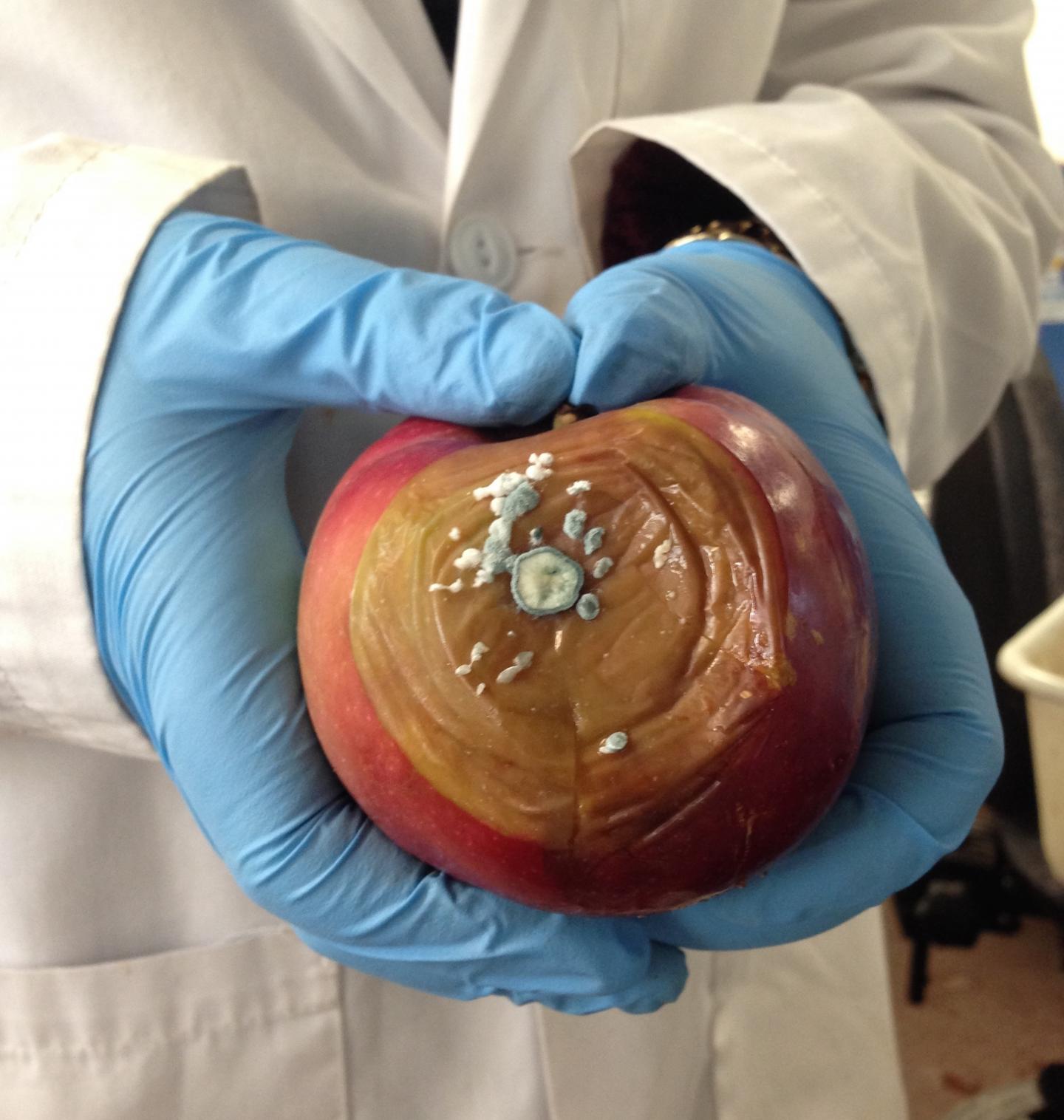
IMAGE

Credit: UBC Okanagan

An apple a day may keep the doctor away, but the mold on it could make you sick.

Rhiannon Wallace, a PhD candidate at UBC Okanagan's campus, has developed a way to stop, or at least control, blue mold–a pathogen that can rot an apple to its core. Wallace's research has determined that bacteria, originally isolated from cold Saskatchewan soils, may be the answer to preventing mold growth and apple rot while the fruit is in storage or transport.

"The majority of postharvest fungal pathogens are opportunistic," explains Wallace, who is working with UBC Biology Prof. Louise Nelson. "If a fruit is physically damaged, it is at an increased risk of rotting during storage. So a tiny blemish on the fruit from harvest or handling can turn into a conduit for attack by fungal pathogens and subsequently result in the development of mold."

The fungal pathogen Penicillium expansum, also known as blue mold, destroys millions of stored apples each year. Post-harvest rot can result in yield losses of up to 20 per cent in developed countries such as Canada, while developing countries can lose up to 50 per cent of the crop, Wallace says.

The goal of her research is to reduce the amount of produce lost due to post-harvest blue mold. Traditionally, post-harvest rot has been controlled with chemical fungicides, but Wallace says these treatments have become less effective as the pathogen has developed resistance and there is consumer pushback to the chemicals. The research by Wallace and Nelson aims to provide a safer and more sustainable alternative to fungicides.

Wallace suggests the solution may lie in a particular bacterium specific to Saskatchewan soil. Pseudomonas fluorescens, due to its prairie roots, can survive in cold storage–a characteristic that is key to dealing with cold-stored produce like apples.

During tests conducted at the British Columbia Tree Fruits Cooperative storage facility in the Okanagan, Wallace determined that these bacteria can prevent blue mold from growing on McIntosh and Spartan apples while in storage. In addition, during these experiments, the bacteria provided control of blue mold on apples that was comparable to a commercially available biological control agent and a chemical fungicide.

"What is novel about our research is that we show the bacterial isolates we tested have an array of mechanisms to inhibit or kill Penicillium expansum (blue mold) on apples while fungicides generally act only by a single mode," Wallace says. "These findings suggest that the development of resistance by blue mold against our soil bacteria is unlikely."

She does note that while all three isolates of P. fluorescens tested provided control of blue mold, the level of control provided by each isolate varied with apple variety.

###

Wallace's research, supported by the Canadian Horticulture Council and Agriculture and Agri-Food Canada, was recently published in the journal Postharvest Biology and Technology. Further support came from the BC Tree Fruits Cooperative and Agriculture Canada's Summerland Research and Development Centre.

Media Contact

Patty Wellborn
[email protected]
250-807-8463

http://ok.ubc.ca/welcome.html

Original Source

https://news.ok.ubc.ca/2017/09/13/ubc-research-looks-at-ways-to-control-rot-in-stored-apples/
Share12Tweet7Share2ShareShareShare1

Related Posts

Electroacupuncture and Spinal Neural Cell Transplantation Synergize to Enhance Nerve Regeneration and Functional Recovery After Spinal Cord Injury — Biology

Electroacupuncture and Spinal Neural Cell Transplantation Synergize to Enhance Nerve Regeneration and Functional Recovery After Spinal Cord Injury

May 26, 2026
Gut Microbiome Clusters Offer New Insights into Predicting Inflammatory Bowel Disease Severity and Progression — Biology

Gut Microbiome Clusters Offer New Insights into Predicting Inflammatory Bowel Disease Severity and Progression

May 26, 2026

App Uses Insect Wing Identification to Combat Tropical Disease Threat

May 26, 2026

How Homing Pigeons Simplify Navigation While Flying Home in Flocks

May 26, 2026
Please login to join discussion

POPULAR NEWS

  • ESMO 2025: mRNA COVID Vaccines Enhance Efficacy of Cancer Immunotherapy

    317 shares
    Share 127 Tweet 79
  • New Study Reveals Plants Can Detect the Sound of Rain

    735 shares
    Share 293 Tweet 183
  • Common Food Preservatives Associated with Elevated Blood Pressure and Increased Heart Disease Risk

    56 shares
    Share 22 Tweet 14
  • Research Indicates Potential Connection Between Prenatal Medication Exposure and Elevated Autism Risk

    847 shares
    Share 339 Tweet 212

About

We bring you the latest biotechnology news from best research centers and universities around the world. Check our website.

Follow us

Recent News

Sanguinarine: The Key that Flips BiP to Battle Lung Cancer

Lund University Professor Appointed Chair of Lancet Commission on Precision Medicine

Platinum-Antibody Conjugates Enhance Tumor Recognition by the Immune System

Subscribe to Blog via Email

Enter your email address to subscribe to this blog and receive notifications of new posts by email.

Join 82 other subscribers
  • Contact Us

Bioengineer.org © Copyright 2023 All Rights Reserved.

Welcome Back!

Login to your account below

Forgotten Password?

Retrieve your password

Please enter your username or email address to reset your password.

Log In
No Result
View All Result
  • Homepages
    • Home Page 1
    • Home Page 2
  • News
  • National
  • Business
  • Health
  • Lifestyle
  • Science

Bioengineer.org © Copyright 2023 All Rights Reserved.