• HOME
  • NEWS
  • EXPLORE
    • CAREER
      • Companies
      • Jobs
    • EVENTS
    • iGEM
      • News
      • Team
    • PHOTOS
    • VIDEO
    • WIKI
  • BLOG
  • COMMUNITY
    • FACEBOOK
    • INSTAGRAM
    • TWITTER
Saturday, June 27, 2026
BIOENGINEER.ORG
No Result
View All Result
  • Login
  • HOME
  • NEWS
  • EXPLORE
    • CAREER
      • Companies
      • Jobs
        • Lecturer
        • PhD Studentship
        • Postdoc
        • Research Assistant
    • EVENTS
    • iGEM
      • News
      • Team
    • PHOTOS
    • VIDEO
    • WIKI
  • BLOG
  • COMMUNITY
    • FACEBOOK
    • INSTAGRAM
    • TWITTER
  • HOME
  • NEWS
  • EXPLORE
    • CAREER
      • Companies
      • Jobs
        • Lecturer
        • PhD Studentship
        • Postdoc
        • Research Assistant
    • EVENTS
    • iGEM
      • News
      • Team
    • PHOTOS
    • VIDEO
    • WIKI
  • BLOG
  • COMMUNITY
    • FACEBOOK
    • INSTAGRAM
    • TWITTER
No Result
View All Result
Bioengineer.org
No Result
View All Result
Home Headlines

UAB researchers find protein that improves mobility after spinal cord…

Bioengineer.org by Bioengineer.org
January 29, 2018
in Headlines, Health, Science News
Reading Time: 2 mins read
0
Share on FacebookShare on TwitterShare on LinkedinShare on RedditShare on Telegram
IMAGE

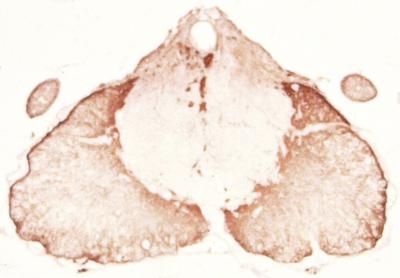
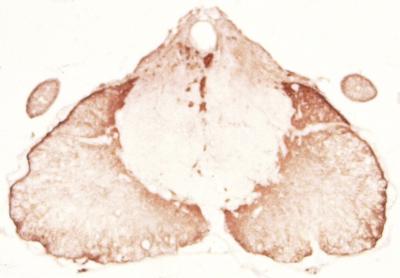
IMAGE: Injured mouse spinal cord.

Credit: UAB

Spinal cord injuries cause severe functional disabilities in those who sustain them, including paraplegia or tetraplegia, depending on the scale of the injury. This is due to the degeneration of the spinal pathways that carry nerve signals from the brain to the different parts of the body and vice versa, resulting in loss of mobility and sensitivity underneath the injured area. Over the past few years, different studies have shown that the inflammatory response that develops after an injury contributes to the degeneration of these pathways, thus increasing the functional deficits brought by the injury. However, clinical trials using anti-inflammatory drugs like methylprednisolone have not proven their efficacy.

This work shows for the first time that IL-37 suppresses the inflammatory response after a spinal cord injury and minimises spinal tissue degeneration and functional disabilities. Although IL-37 was identified 15 years ago, studying its function has proven difficult as it is not synthesised in mice.

The team led by Dr Rubén López – of the UAB's Department of Cell Biology, Physiology and Immunology and Institute of Neuroscience, and the Centre for Networked Biomedical Research in Neurodegenerative Diseases (CIBERNED) – used a genetically modified mouse that produces the human form of IL-37 to study the function of this protein. They have shown that if IL-37 is administered immediately after the injury the mice recover a certain degree of mobility.

This work has therefore led to the discovery of a new therapeutic strategy to treat acute spinal cord injuries, for which currently there is no effective treatment available for clinical use. This discovery could also open the door to treatments for other neurodegenerative illnesses, as the inflammatory response also plays a major role in these.

The study, published recently in the online version of the prestigious journal Proceedings of the National Academy of Sciences (PNAS), was carried out at the UAB, with collaboration from Radboud University Medical Center (the Netherlands), University of Colorado (USA) and Maximilian University of Munich (Germany), and was funded principally by Fundació La Marató, the Spanish Ministry of Economy and Competitiveness, and the International Foundation for Research in Paraplegia.

###

Media Contact

Rubèn López
[email protected]
34-935-811-348
@UAB_info

http://www.uab.es
Share12Tweet8Share2ShareShareShare2

Related Posts

Tracking Lanthanide-Labeled Microplastics in Plants

June 25, 2026

POSTECH Researchers Slash Cost of Reconstituted Cell-Free Systems by 95%

June 25, 2026

AI and Physics Collaborate to Design Advanced Hydrogen Storage Materials

June 25, 2026

Natural Hallucinogens: Evolution’s Ecological Tools, Not Mere Chemical Byproducts

June 25, 2026
Please login to join discussion

POPULAR NEWS

  • Saying Goodbye to PGY-6: Pediatric Fellowship Realities

    103 shares
    Share 41 Tweet 26
  • Multi-Hospital Study Reveals Long Covid Burden Is Twice as High as Current Estimates

    92 shares
    Share 36 Tweet 23
  • Detection of EDCs in Breast Milk and Infant Urine Up to Six Months Highlights Early Exposure Risks

    77 shares
    Share 31 Tweet 19
  • New Drug Candidate Developed at McMaster Shows Potential for Treating Brain Cancer

    58 shares
    Share 23 Tweet 15

About

We bring you the latest biotechnology news from best research centers and universities around the world. Check our website.

Follow us

Recent News

Tracking Lanthanide-Labeled Microplastics in Plants

POSTECH Researchers Slash Cost of Reconstituted Cell-Free Systems by 95%

AI and Physics Collaborate to Design Advanced Hydrogen Storage Materials

Subscribe to Blog via Email

Success! An email was just sent to confirm your subscription. Please find the email now and click 'Confirm' to start subscribing.

Join 82 other subscribers
  • Contact Us

Bioengineer.org © Copyright 2023 All Rights Reserved.

Welcome Back!

Login to your account below

Forgotten Password?

Retrieve your password

Please enter your username or email address to reset your password.

Log In
No Result
View All Result
  • Homepages
    • Home Page 1
    • Home Page 2
  • News
  • National
  • Business
  • Health
  • Lifestyle
  • Science

Bioengineer.org © Copyright 2023 All Rights Reserved.