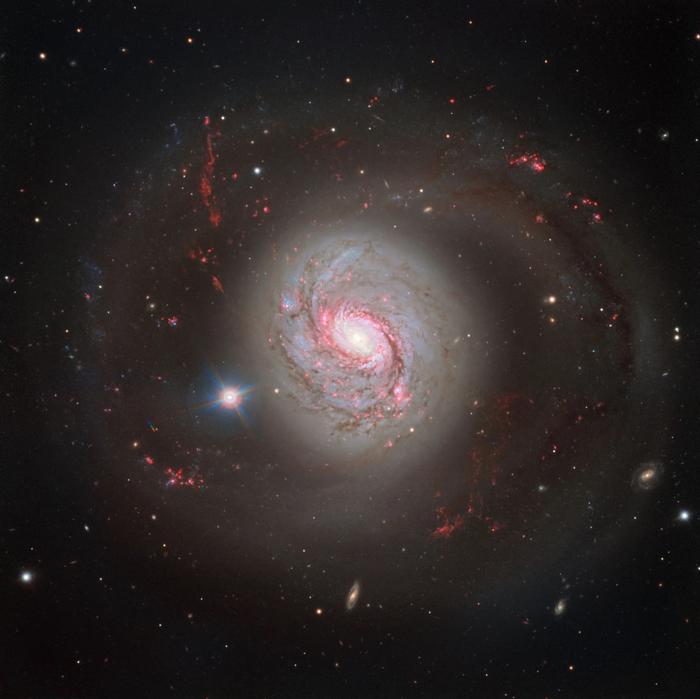
Astronomers, utilizing the innovative capabilities of the Large Binocular Telescope Interferometer (LBTI), have achieved a significant milestone in astrophysics by capturing the highest resolution direct images of active galactic nuclei (AGNs) in the infrared spectrum. The research is a collaborative effort led by the University of Arizona, with contributions from the Max Planck Institute for Astronomy in Germany, and it has implications for our understanding of supermassive black holes and their environments across the cosmos.
Active galactic nuclei are fundamentally unique; they are powered by supermassive black holes situated at the centers of galaxies. As surrounding matter falls into these black holes, immense amounts of energy are released, resulting in luminous emissions visible from vast distances. The excitement around this new imaging technique lies in its direct observation of AGNs, which are recognized as some of the most energetic phenomena in the universe. The observations made possible by the LBTI underscore a transformative advancement in astronomical technology.
At a distance of approximately 47 million light-years, the galaxy NGC 1068 serves as a prime target for studying AGNs. This galaxy is emblematic of type 2 AGNs, which occur in environments where the black hole remains shrouded by thick clouds of gas and dust. Despite this obscurity, the new imaging techniques employed have enabled researchers to penetrate these clouds and unveil the dynamics occurring therein. It is this breakthrough that could redefine our grasp of galactic evolution and the roles played by supermassive black holes.
Jacob Isbell, a postdoctoral research associate at the University of Arizona and the lead author of the study, has emphasized the significance of the LBTI as a precursor to the next generation of extremely large telescopes. The LBTI, with its ability to combine the light from two 8.4-meter mirrors, achieves unparalleled observational resolution. This capability allows the telescope to gather data capable of distinguishing between different astrophysical processes that were previously indiscernible due to the overlap of various signals.
The core of the research focused on the phenomena surrounding NGC 1068 and its AGN, which exhibits intense brightness and serves as a compelling observational target for astronomers. The imaging conducted revealed a complex environment around the black hole, showing a dusty outflowing wind influenced by radiation pressure emitted by the luminous accretion disk. This wind is significant in our understanding of galaxy feedback mechanisms and highlights how energy can influence the surrounding interstellar medium.
Moreover, researchers employed sophisticated techniques to analyze the feedback effects of an associated radio jet—a stream of charged particles emitted by the supermassive black hole as it devours surrounding matter. By observing this AGN, the team was able to discern the interactions between the radio jet, the accretion disk, and the ambient gas and dust. This intricate dance of cosmic forces is pivotal for understanding the life cycle of galaxies and their ability to sustain star formation.
The observational prowess of the LBTI opens new avenues in astronomy. The team is now poised to apply this high-resolution imaging technique to other astrophysical objects, such as protoplanetary disks and evolved stars with significant dusty envelopes. By advancing our capacity to observe these celestial phenomena, astronomers can unlock mysteries long hidden from view, leading to profound revelations about the universe.
In summary, the study published in Nature Astronomy illustrates the remarkable achievements made possible through the combined efforts of pioneering telescopic technology and dedicated research teams. The implications of these findings extend beyond mere imaging; they challenge existing paradigms within astrophysics and foster a deeper understanding of galaxy formation and the tumultuous dynamics surrounding supermassive black holes.
This groundbreaking research sets a precedent for future studies, linking observational astronomy with theoretical frameworks around galaxy evolution and the universal role of black holes. As these large observational facilities come online and researchers refine their techniques, the potential for new discoveries bolsters excitement within the astronomical community.
For the scientific community, these advancements not only enhance our knowledge of AGNs but also raise tantalizing questions regarding the symbiotic relationship between supermassive black holes and their host galaxies. What further secrets lie in the heart of these enigmatic structures? The ongoing inquiry drives the search for answers, continuing to inspire both seasoned astronomers and the next generation of scientists.
As the field of astronomy evolves, the insights gleaned from studies such as those conducted by Isbell and his team will guide future explorations and deepen our comprehension of the cosmos. With each new layer of understanding, we venture closer to unraveling the mysteries that define our universe.
Subject of Research: Active Galactic Nuclei and their environments
Article Title: Direct imaging of active galactic nucleus outflows and their origin with the 23 m Large Binocular Telescope
News Publication Date: 17-Jan-2025
Web References: Nature Astronomy
References: doi:10.1038/s41550-024-02461-y
Image Credits: Credit: European Southern Observatory
Keywords
AGN, supermassive black holes, NGC 1068, Large Binocular Telescope Interferometer, astronomy, galaxy evolution, radiation pressure, radio jets, cosmic phenomena, observational astronomy.