• HOME
  • NEWS
  • EXPLORE
    • CAREER
      • Companies
      • Jobs
    • EVENTS
    • iGEM
      • News
      • Team
    • PHOTOS
    • VIDEO
    • WIKI
  • BLOG
  • COMMUNITY
    • FACEBOOK
    • INSTAGRAM
    • TWITTER
Thursday, June 25, 2026
BIOENGINEER.ORG
No Result
View All Result
  • Login
  • HOME
  • NEWS
  • EXPLORE
    • CAREER
      • Companies
      • Jobs
        • Lecturer
        • PhD Studentship
        • Postdoc
        • Research Assistant
    • EVENTS
    • iGEM
      • News
      • Team
    • PHOTOS
    • VIDEO
    • WIKI
  • BLOG
  • COMMUNITY
    • FACEBOOK
    • INSTAGRAM
    • TWITTER
  • HOME
  • NEWS
  • EXPLORE
    • CAREER
      • Companies
      • Jobs
        • Lecturer
        • PhD Studentship
        • Postdoc
        • Research Assistant
    • EVENTS
    • iGEM
      • News
      • Team
    • PHOTOS
    • VIDEO
    • WIKI
  • BLOG
  • COMMUNITY
    • FACEBOOK
    • INSTAGRAM
    • TWITTER
No Result
View All Result
Bioengineer.org
No Result
View All Result
Home NEWS Science News Chemistry

Typhoons and marine eutrophication are probably the missing source of organic nitrogen in ecosystems

Bioengineer by Bioengineer
November 14, 2019
in Chemistry
Reading Time: 2 mins read
0
IMAGE
Share on FacebookShare on TwitterShare on LinkedinShare on RedditShare on Telegram

IMAGE

Credit: Ming Chang

Atmospheric nitrogen deposition has a significant impact on both terrestrial and aquatic ecosystems, and alterations in its level will significantly affect the productivity and stability of an ecosystem. In recent years, with the reduction of anthropogenic inorganic nitrogen emissions, interest in organic nitrogen (ON) has increased because it represents a large fraction of total nitrogen. Given this large amount of ON deposition, researchers are interested in identifying its sources. However?scientists find large gaps between ON deposition and emission?and therefore suspect that there are missing sources of ON.

In a paper recently published in Atmospheric and Oceanic Science Letters, Dr. Ming Chang from the Institute for Environmental and Climate Research, Jinan University, and his coauthors, try to address this concern based on their recently completed preliminary work on the deposition-emission relationship.

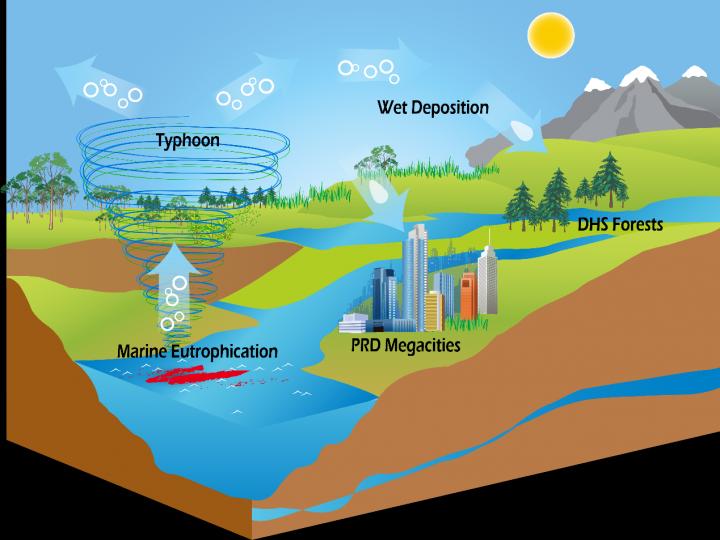
“We classified observed flux data of dissolved ON in terms of the attributes of the wet deposition event itself, such as the season, precipitation, air mass backward trajectory, and effect of typhoons. The reverse trajectories of each air mass responsible for high ON flux precipitation events were tracked and superimposed with chlorophyll-a concentration maps in the ocean,” says Dr. Chang.

According to this study, approximately one third of the total wet deposition of ON was found to be derived from a confluence of three factors: rain in the wet season, air masses from the ocean, and rainfall over 50 mm. It was also found that the co-occurrence of intense events, such as a typhoons and eutrophic surface sea waters, might be an important source of dissolved ON in wet deposition.

“However, further quantitative and targeted research is needed to confirm the validity of these possibilities,” adds Dr. Chang.

###

Media Contact
Ms. Zheng Lin
[email protected]
86-108-299-5053

Related Journal Article

http://dx.doi.org/10.1080/16742834.2019.1679016

Tags: Atmospheric ScienceChemistry/Physics/Materials SciencesEarth SciencePollution/Remediation
Share13Tweet8Share2ShareShareShare2

Related Posts

AI and Physics Collaborate to Design Advanced Hydrogen Storage Materials

June 25, 2026

International Team Including Dresden Scientists Develops Novel Designer Proteins for Advanced Study of Living Tissue

June 25, 2026

New Study Uncovers Key Factors Driving Water Chemistry in Nanoscale Environments

June 25, 2026

Plasma Technology Extends Catalyst Lifespan in Hydrogen Production

June 24, 2026
Please login to join discussion

POPULAR NEWS

  • Saying Goodbye to PGY-6: Pediatric Fellowship Realities

    103 shares
    Share 41 Tweet 26
  • Multi-Hospital Study Reveals Long Covid Burden Is Twice as High as Current Estimates

    92 shares
    Share 36 Tweet 23
  • Detection of EDCs in Breast Milk and Infant Urine Up to Six Months Highlights Early Exposure Risks

    77 shares
    Share 31 Tweet 19
  • New Drug Candidate Developed at McMaster Shows Potential for Treating Brain Cancer

    58 shares
    Share 23 Tweet 15

About

We bring you the latest biotechnology news from best research centers and universities around the world. Check our website.

Follow us

Recent News

Tracking Lanthanide-Labeled Microplastics in Plants

POSTECH Researchers Slash Cost of Reconstituted Cell-Free Systems by 95%

AI and Physics Collaborate to Design Advanced Hydrogen Storage Materials

Subscribe to Blog via Email

Enter your email address to subscribe to this blog and receive notifications of new posts by email.

Join 82 other subscribers
  • Contact Us

Bioengineer.org © Copyright 2023 All Rights Reserved.

Welcome Back!

Login to your account below

Forgotten Password?

Retrieve your password

Please enter your username or email address to reset your password.

Log In
No Result
View All Result
  • Homepages
    • Home Page 1
    • Home Page 2
  • News
  • National
  • Business
  • Health
  • Lifestyle
  • Science

Bioengineer.org © Copyright 2023 All Rights Reserved.